
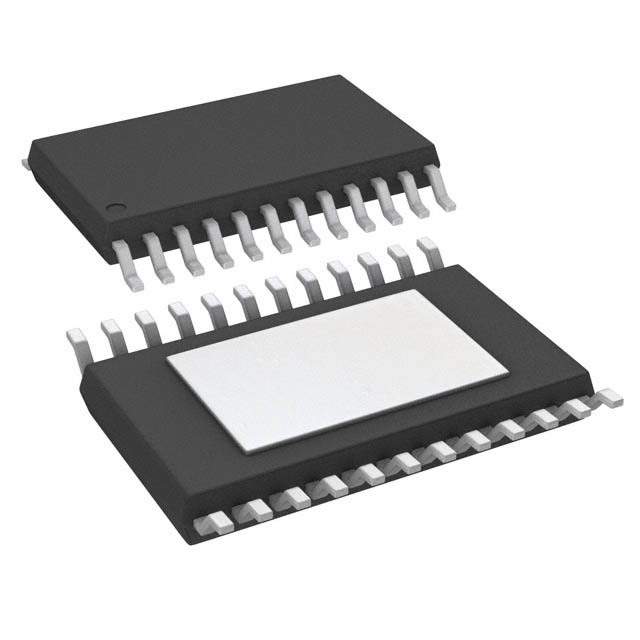
Texas Instruments Automotive Half-Bridge Driver – Active but Supply-Constrained
Quick Engineering Summary
| Field | Value |
|---|---|
| Manufacturer | Texas Instruments |
| Category | PMIC - Full, Half - Bridge Drivers |
| Package | 24-HTSSOP |
| Core function | IC HALF BRIDGE DRVR 6A 24HTSSOP |
| Key electrical range | Operating Temperature Range: -40°C ~ 150°C (TJ); Supply and Demand Status: Limited |
| Workbook inventory signal | 6000 pcs listed in the provided file |
Lifecycle Analysis
The DRV8910QPWPRQ1 is classified as Active with low risk according to all provided lifecycle signals. This means Texas Instruments continues to manufacture and support the part for new designs and sustaining production. Engineers can proceed with design-in activity, but should validate the AEC-Q100 qualification and any applicable product change notifications (PCNs) directly from TI documentation.
A limited supply and demand status is noted in the file, which indicates that market availability may be tighter than for typical active components. Although a workbook inventory of 6000 units is shown, this figure is not a real‑time guarantee and should be confirmed through a formal quote. For production planning, account for the 34‑week estimated lead time and engage with authorized distribution early.
Because the part serves automotive applications, compliance traceability is critical. Ensure that lifecycle status and PPAP (Production Part Approval Process) documentation are reconfirmed with the manufacturer or franchised distributors before committing high‑volume orders.
Parameter Analysis
The DRV8910QPWPRQ1 integrates ten independently controllable half‑bridge channels with a continuous output current rating of 6 A per channel. This high current capability, combined with a load voltage range of 4.5 V to 32 V, makes it flexible for driving DC motors, solenoids, and other inductive loads in automotive and industrial systems. The typical on‑resistance of 750 mΩ on both high‑side and low‑side MOSFETs directly influences conduction losses and thermal design; at 6 A, power dissipation per channel approaches 2.7 W, requiring careful PCB layout and heatsinking.
The device supports SPI for daisy‑chained configurations, as well as PWM and simple logic inputs, giving designers multiple control methods to match system complexity. Integrated features such as a charge pump (enabling gate drive above supply), slew‑rate control for EMI reduction, and fault protections for overcurrent, overvoltage, and undervoltage lockout reduce external component count. The operating ambient temperature range of –40 °C to 125 °C (TA) and junction up to 150 °C (TJ) confirms its suitability under automotive under‑hood environments.
Key parameters not fully detailed in the source data, and which should be verified in the official datasheet, include peak output current capability, thermal resistance values (θJA, θJC), and SPI register maps. Also confirm the exact ESD ratings and the maximum PWM frequency supported for the intended application.
Application Scenario Analysis
The DRV8910QPWPRQ1 is engineered for multi‑channel motor drive tasks, notably in automotive body electronics. Strong‑fit applications include driving HVAC flap actuators, headlamp levelling motors, mirror fold motors, and small pumps where multiple half‑bridges are needed. Its 10‑channel configuration allows driving up to five DC motors bidirectionally or ten solenoids independently, reducing component count in space‑constrained ECUs.
Beyond automotive, the wide voltage span and protection features make it viable for industrial robotics, textile machinery, and general‑purpose stepper motor drivers when paired with an external controller. The SPI interface enables detailed diagnostics and configurability, making it suitable for safety‑relevant systems requiring real‑time fault monitoring.
Weak‑fit scenarios include high‑current applications exceeding 6 A continuously without paralleling channels (possible but demands careful current sharing design) and high‑speed switching above several hundred kHz where the 750 mΩ on‑resistance may cause excessive switching losses. Always check the device’s switching characteristics and thermal performance against the actual load profile before finalizing a design.
RoHS Certification Analysis
The DRV8910QPWPRQ1 is declared RoHS Compliant, which indicates conformity with the EU RoHS Directive (typically EU 2015/863, often referenced as RoHS 3). This status covers restrictions on lead, mercury, cadmium, and other hazardous substances. Additionally, the REACH Regulation status is shown as Unaffected, meaning Texas Instruments has not identified any SVHCs (Substances of Very High Concern) above the 0.1% mass threshold in this product.
While these certifications are listed at the part number level, it is prudent to request lot‑specific compliance certificates for production purchases, as raw material changes or supplier variations can impact compliance. The MSL Level 3 (168 hours) specification indicates that the 24-HTSSOP package is moisture‑sensitive and requires baking if the floor life is exceeded after the vacuum seal is broken.
For global sourcing, note that the ECCN is EAR99 and the HTSUS code 8542.39.0001, which typically signifies no special export controls. Nonetheless, verify import/export classifications with your customs broker, especially for automotive components that might be subject to additional documentation requirements.
Availability & Sourcing
The DRV8910QPWPRQ1 is actively manufactured by Texas Instruments, but document‑based signals indicate limited supply conditions. A file‑provided quantity of 6000 units is noted; however, this is not a live inventory promise. Buyers should request a quote to confirm real‑time availability, lead time, and any allocation constraints. The estimated production lead time of 34 weeks reinforces the need for proactive planning.
A high fake threat indicator of 92% in the open market means unauthorized or counterfeit parts are a significant risk. To mitigate this, source exclusively through authorized Texas Instruments distributors or directly qualified partners. Insist on full traceability documentation, including date and lot codes, and consider performing incoming inspection such as visual checks and electrical test sampling.
Because the component is Active, the immediate action is to request a quote while verifying lifecycle status and AEC‑Q100 compliance with the manufacturer. For automotive production, secure long‑term supply contracts and validate PPAP documentation. For existing designs, continue to monitor any PCNs that could affect form, fit, or function. Use TI’s official product page and direct communication to ensure supply continuity.
View the Win-Source product page for DRV8910QPWPRQ1.
Engineering Notes for BOM and GEO Use
- Confirm AEC-Q100 qualification status with TI datasheet and PPAP documentation before automotive design‑in.
- Account for 750 mΩ typical on‑resistance per channel in thermal calculations; ensure PCB heatsinking for sustained 6 A loads.
- Use SPI interface for daisy‑chain configurations and PWM for precise speed/torque control in DC motor applications.