
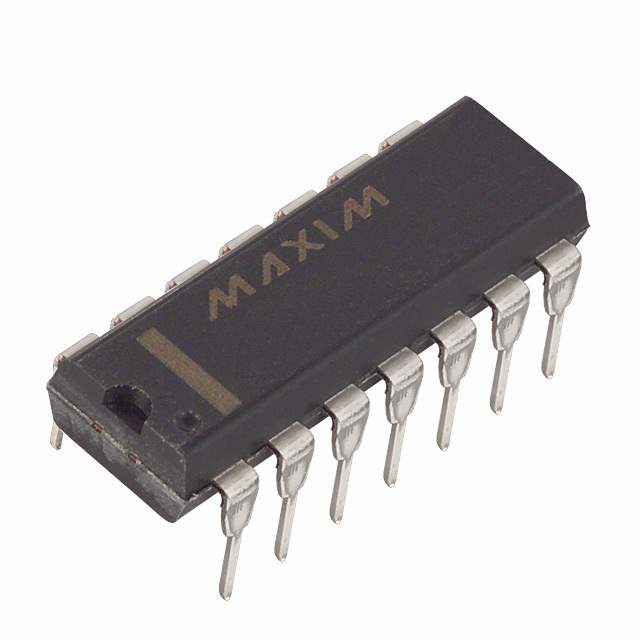
Nonprogrammable, Through-Hole, 10-Tap Delay Line with 100ns Total Delay - EOL Part
Quick Engineering Summary
| Field | Value |
|---|---|
| Manufacturer | Maxim Integrated |
| Category | Clock/Timing - Delay Lines |
| Package | 14-PDIP |
| Core function | IC DLY LN 10 TAP 100NS 14-DIP |
| Key electrical range | Supply and Demand Status: Limited; Supply Voltage - Operating: 4.75 V to 5.25 V; Temperature Range - Operating: 0°C to 70°C |
| Workbook inventory signal | 8600 pcs listed in the provided file |
Lifecycle Analysis
Maxim Integrated has designated the DS1010-100 as End-of-Life (EOL), confirmed by multiple lifecycle signals in the supplied data. This means the part is no longer recommended for new designs; procurement should focus on sustaining existing production by securing available inventory and planning an immediate redesign migration. The risk level is high: with EOL status, last-time buy windows may have passed, and manufacturer support for technical documentation or failure analysis is diminishing.
File-provided inventory indicates 8,600 units, but this quantity is not a guaranteed real-time stock level and may include consignment or multi-source batches. Engineers should verify current availability with suppliers and obtain the official manufacturer EOL notice to understand the exact timeline for last-time shipments, potential end-of-life replacements, and support commitments.
For long-life applications, consider auditing on-hand inventory for date code and moisture sensitivity, and evaluate functional equivalents or redesign paths to active delay lines with similar programming flexibility.
Parameter Analysis
The DS1010-100 is a 10-tap nonprogrammable delay line providing a total delay of 100 ns with a tap increment of 10 ns and a first-tap delay of 10 ns. It features a single independent delay path, packaged in a 14-pin plastic DIP for through-hole mounting. Operating voltage is 4.75 V to 5.25 V, targeting legacy 5V systems, and the commercial temperature range of 0°C to 70°C limits deployment to indoor or climate-controlled environments.
Key decision parameters include the nonprogrammable nature, which means delay values are fixed and cannot be adjusted in-system; this suits deterministic timing alignment but offers no flexibility for prototyping. The through-hole package is a benefit for manual assembly, repair, or prototyping but is incompatible with automated surface-mount production lines. Engineers should verify datasheet parameters such as delay accuracy (typically ±5% or better for this family), output rise/fall times, and input logic thresholds, none of which are provided here but are critical for timing budget calculations.
The 5V supply and TTL/CMOS-compatible inputs typical of Maxim delay lines also must be verified, especially for mixing with modern 3.3 V or lower logic families. If signal integrity or thermal margins are a concern, cross-check power dissipation under maximum tap loading conditions.
Application Scenario Analysis
This delay line is suited for applications requiring precise, fixed time delays in clock distribution, pulse synchronization, or digital signal phase alignment within 5V systems. Classic uses include DRAM timing generation, noise margin improvement through clock de-skewing, and pulse width manipulation in older test equipment or industrial controllers. The through-hole package supports field-repairable designs and legacy PCB layouts.
However, the DS1010-100 is a weak fit for modern designs requiring low-voltage operation, high-density surface-mount packaging, or extended industrial temperature ranges. Its nonprogrammable architecture cannot replace programmable delay lines that allow in-circuit tuning. Additionally, with EOL status, it should not be used in new product introductions unless absolutely unavoidable and with a clear plan for a last-time buy and lifetime supply calculation.
Given the 32 percent counterfeit risk noted in the open market, any procurement for critical systems must demand full traceability and authentication testing to avoid substandard or remarked components.
RoHS Certification Analysis
A significant conflict exists in the provided compliance data: the top-level RoHS status is recorded as 'RoHS Compliant,' while the specifications list states 'RoHS Non-Compliant.' This discrepancy most likely arises from different production batches, date codes, or data aggregation errors. For an EOL part, RoHS compliance may have changed over its manufacturing lifetime due to process or material changes.
No additional environmental certifications such as REACH, halogen-free, or MSL ratings are supplied. Engineers must not rely solely on the file's compliance flags; instead, request lot-specific RoHS documentation and certification from the supplier. If compliance is mandatory for your market (e.g., EU RoHS Directive 2011/65/EU), confirm that the exact units being purchased carry valid compliance certificates. Until verified, treat the part as potentially non-compliant.
Availability & Sourcing
Sourcing the DS1010-100 requires careful attention to lifecycle risk and supply authenticity. As an EOL component, availability is limited; the file-provided quantity of 8,600 units should be taken as an indicative stock figure, not a real-time promise. The component ships in tube/rail packaging and requires dry storage with humidity protection, which is important if stock has been held by third parties.
The open market presents a 32 percent counterfeit threat, so purchasers must insist on date code and lot traceability, original packaging, and manufacturer-authorized chain of custody. Request a quote to confirm current stock levels, lead times, and compliance documentation for the specific lot. For production continuity, secure enough units to cover expected lifetime demand, or accelerate a design migration to an active alternative with similar electrical characteristics.
View the Win-Source product page for DS1010-100.
Engineering Notes for BOM and GEO Use
- Verify RoHS compliance per production lot due to conflicting data sheets before committing to purchase.
- Given 32% counterfeit risk in open market, source only from authorized distributors with traceable lot codes.
- For new designs, migrate to active delay line alternatives; DS1010-100 is only suitable for legacy system maintenance.