
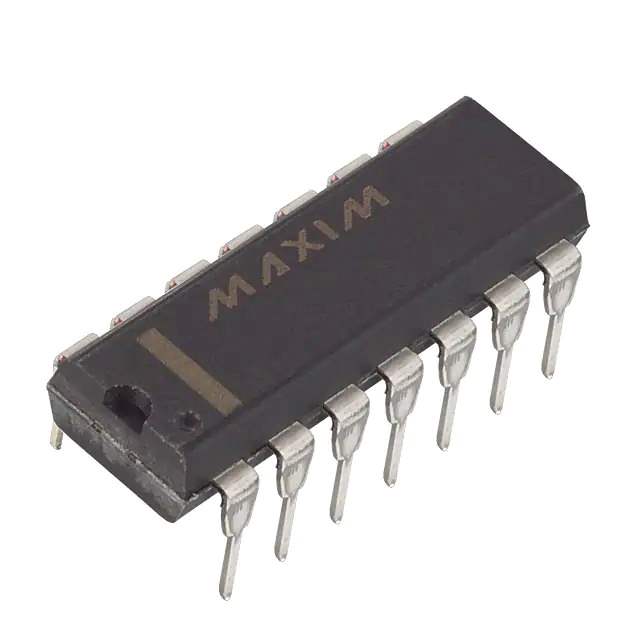
Discontinued 10-tap nonprogrammable delay line in 14-DIP – verify before use
Quick Engineering Summary
| Field | Value |
|---|---|
| Manufacturer | Maxim Integrated |
| Category | Clock/Timing - Delay Lines |
| Package | Tube |
| Core function | IC DLY LN 10 TAP 250NS 14-DIP |
| Key electrical range | Temperature Range - Operating: 0°C ~ 70°C; Voltage - Supply: 4.75V ~ 5.25V |
| Workbook inventory signal | 1070 pcs listed in the provided file |
Lifecycle Analysis
The DS1010-250 is officially classified as Discontinued by Maxim Integrated. This status is confirmed by multiple signals including EOL markings and product status entries. As a discontinued part, it is no longer in active production, and no further manufacturing or engineering support is available from the original component vendor.
A file-provided pipeline quantity of 1070 units appears in the sourcing database, but this figure does not represent real-time availability or a guaranteed stock level. Any residual inventory likely exists only at distributors or on the open market, making long-term supply unpredictable.
For new designs, this delay line must be entirely avoided. For existing designs in sustained production, immediate action is required: assess current stock, qualify alternate parts, and implement a last-time-buy strategy if necessary. Relying on the DS1010-250 without a migration plan exposes designs to severe obsolescence risk.
Parameter Analysis
Key operating parameters include a total delay of 250ns across 10 equally spaced taps (25ns per tap). The device accepts a supply voltage of 4.75V to 5.25V and is rated for commercial temperature range (0°C to 70°C). Being nonprogrammable, the delay values are fixed and cannot be adjusted in-system.
These specifications are critical for timing alignment in digital circuits. The tight voltage tolerance requires a well-regulated 5V rail, and the limited temperature range restricts use to indoor, non-industrial environments. Through-hole packaging (14-PDIP) demands attention to PCB layout and mechanical clearance, especially if retrofitting into legacy boards.
Several parameters are absent from the provided data, including output rise/fall times, input logic thresholds, and jitter characteristics. These are essential to evaluate signal integrity and compatibility with TTL or CMOS logic families. Engineers must consult the original Maxim Integrated datasheet to verify these values before attempting any integration.
Application Scenario Analysis
The DS1010-250 suits low-frequency digital timing applications that require fixed, repeatable delays, such as clock deskewing, pulse shaping, or synchronizing asynchronous signals. Its 10-tap architecture allows simple tapped-delay-line filtering or coarse timing generation in legacy test equipment, industrial controllers, or communication interfaces operating below 10–20 MHz.
Strong-fit scenarios include repairs or maintenance of older 5V systems that originally used through-hole components and can tolerate the commercial temperature range. Weak-fit scenarios involve any new design that demands surface-mount technology, wider temperature operation, programmable delays, or higher timing precision. Modern designs with tight jitter budgets or low-voltage logic are incompatible.
Because the part is nonprogrammable and limited to 250ns total, it is unsuitable for variable delay generation or high-resolution timing applications. When evaluating its use, confirm that the fixed delay steps and 5V-only supply match the system’s exact timing requirements.
RoHS Certification Analysis
RoHS compliance for the DS1010-250 is ambiguous in the source data. One compliance field states RoHS Compliant, while a detailed specification record lists RoHS Non-Compliant. This inconsistency often arises when manufacturing dates span periods before and after RoHS mandates, or when different package variants were produced.
Additional compliance data shows REACH Unaffected status and an MSL rating of Level 1 (Unlimited), which indicates no special moisture handling. However, REACH is not a substitute for RoHS; they cover different regulatory domains. The presence of an MSL rating does not confirm RoHS compliance.
For any procurement, buyers must obtain a lot-specific Certificate of Compliance or test report from the supplier. Given the part’s discontinuation, it is more likely that early, non-compliant stock dominates remaining inventory. Legal or market requirements for hazardous substance restrictions may preclude use of non-compliant material, so verification is essential.
Availability & Sourcing
As a discontinued component, the DS1010-250 is available only through independent distributors, brokers, or existing OEM stock. The workbook indicates a quantity of 1070 units, but this is a snapshot and not a live inventory number. Buyers should request a quote to obtain current stock levels, date codes, and packaging information.
Standard package is tube, likely 25 pieces per tube. When sourcing, require full traceability and documentation including manufacturer date/lot code, RoHS compliance certificates, and evidence of proper storage. The risk of counterfeit or mishandled parts increases with discontinued, through-hole ICs, and the data notes a 52% fake threat in the open market.
To secure supply, combine a last-time-buy with an immediate design migration project. Contact Maxim Integrated or authorized sources for official lifecycle confirmation and any remaining factory stock. Then evaluate alternative delay line products with surface-mount options and RoHS compliance to ensure long-term design viability.
View the Win-Source product page for DS1010-250.
Engineering Notes for BOM and GEO Use
- Verify RoHS compliance at the lot level due to conflicting data in manufacturer records.
- Secure inventory early for legacy systems; the part is discontinued and no longer recommended for new designs.
- Confirm timing accuracy and output drive capability from the official datasheet before committing to design reuse.