
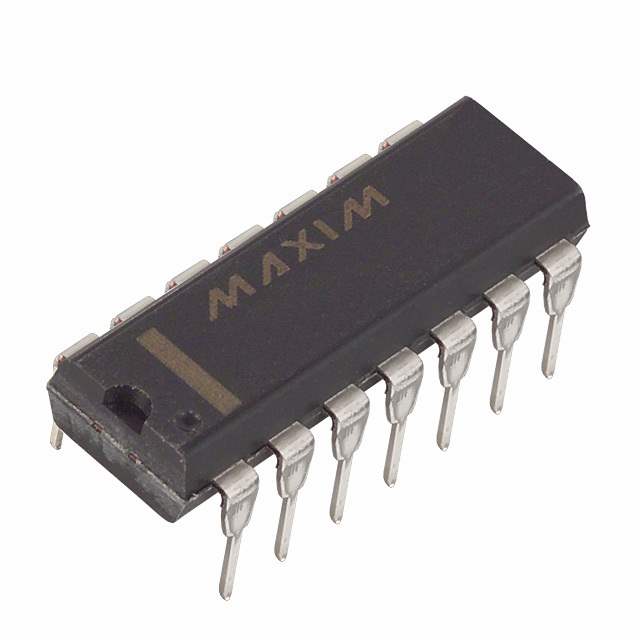
EOL multiple nonprogrammable delay line with 15 ns total delay, 14-pin PDIP package, and three independent outputs.
Quick Engineering Summary
| Field | Value |
|---|---|
| Manufacturer | Maxim Integrated |
| Category | Clock/Timing - Delay Lines |
| Package | 14-PDIP |
| Core function | IC DELAY LINE 15NS 14-DIP |
| Key electrical range | Supply and Demand Status: Balance; Supply Voltage - Operating: 4.75 V to 5.25 V; Temperature Range - Operating: 0°C to 70°C |
| Workbook inventory signal | 2820 pcs listed in the provided file |
Lifecycle Analysis
The Maxim Integrated DS1013-15 is confirmed as End‑of‑Life (EOL) with a high procurement risk. All lifecycle signals from the data source align on obsolete status, meaning the manufacturer has ceased production and normal supply channels are depleted.
For new designs, this part must not be considered. Engineers working on sustaining legacy systems should immediately secure any required inventory from trusted distributors or authorized excess stock sources. While file‑provided data shows a workbook quantity of 2,820 units, this is not a real‑time guarantee and must be re‑verified at the time of quote.
Without an official last‑time‑buy notice in the source data, procurement teams are strongly advised to contact Maxim Integrated (now part of Analog Devices) to confirm remaining availability and to request a lifetime‑buy option if available. Additionally, planning for redesign with an active equivalent is critical to avoid production gaps.
Parameter Analysis
The DS1013-15 provides a fixed total delay of 15 ns with three independent nonprogrammable delay lines, making it a straightforward timing element for simple skew compensation. Each delay tap delivers the full 15 ns delay to its first tap, with no intermediate tap increments reported. The part operates from a single 4.75 V to 5.25 V supply and is rated for commercial temperature (0°C to 70°C), which restricts it to standard environment digital systems.
Package‑wise, the 14‑PDIP through‑hole format enables easy prototyping and rework but occupies significant board area compared to surface‑mount alternatives. Key missing datasheet parameters that must be verified include tap‑to‑tap skew, propagation delay, input‑to‑output rise/fall time, and power dissipation. These directly impact timing margin and signal integrity.
From a procurement standpoint, the 41% open‑market fake‑threat indicator underscores the need for traceability and authenticity testing when sourcing from non‑authorized channels. Buyers should insist on date‑code and lot‑code traceability documentation.
Application Scenario Analysis
The DS1013-15 fits well in legacy 5 V digital systems requiring a fixed, repeatable delay of 15 ns, such as clock distribution, signal synchronization, and pulse‑width manipulation in older industrial controls or communication interfaces. Its three independent delays allow a single IC to manage multiple timing paths simultaneously, reducing component count.
However, this part is unsuitable for modern low‑voltage designs (3.3 V or below) or for applications needing adjustable or programmable delay. The commercial temperature range excludes use in automotive or extended industrial environments without additional qualification. Because the delay is fixed and equal to the first‑tap value, it cannot generate phased clock outputs; it only copies the input pulse with a deterministic lag.
Engineers should verify that the 15 ns delay meets system timing budget, accounting for part‑to‑part variation and temperature drift. If tighter accuracy or multiple tap resolutions are needed, consider active programmable delay lines from the same manufacturer’s portfolio.
RoHS Certification Analysis
RoHS status for the DS1013-15 is ambiguous due to conflicting source data. The headline compliance field states “RoHS Compliant,” but a detailed specifications record explicitly lists “RoHS Non‑Compliant.” This discrepancy often arises from lot‑level variability: some date‑code batches may have been produced under transitional or exempt conditions.
Consequently, the conservative interpretation is that this part cannot be assumed RoHS‑compliant for all procurement lots. Buyers shipping into EU markets governed by RoHS Directive 2011/65/EU and its amendments (including 2015/863) must request manufacturer‑issued certificates of compliance for the specific stock being purchased. The absence of REACH, MSL, or halogen‑free data further limits environmental assurance.
Until verified, this part should be treated as non‑compliant in material declarations for new designs or high‑volume orders. Sourcing teams should prioritize lots with documented RoHS testing reports.
Availability & Sourcing
As an EOL component, DS1013-15 availability is limited to existing distributor stock and the open market. The file‑reported quantity of 2,820 units must be validated through a direct RFQ with a verified supplier; real‑time global inventory can change quickly. The part is packaged in standard tube/rail format, compatible with manual or automated through‑hole assembly.
Given the 41% fake‑threat rating in the open market, procurement should prioritize authorized channels or certified excess inventory programs. Request traceability documentation including date codes, lot codes, and original manufacturer packaging labels. Visual and electrical incoming inspection is advised for any lot from non‑franchised sources.
To order, contact a sourcing specialist with the Win Source Part Number 115674‑DS1013‑15 for a current lead‑time and availability quote. Do not commit to production usage without a formal lifecycle confirmation from the manufacturer and a valid RoHS compliance certificate for the specific stock.
View the Win-Source product page for DS1013-15.
Engineering Notes for BOM and GEO Use
- Verify RoHS compliance status: datasheet conflicts exist; confirm with manufacturer if compliance is lot- or date-code dependent.
- As an EOL part, secure inventory now and evaluate migration path to active delay line alternatives.
- For timing-critical designs, validate actual delay accuracy and signal integrity parameters against the official datasheet.