
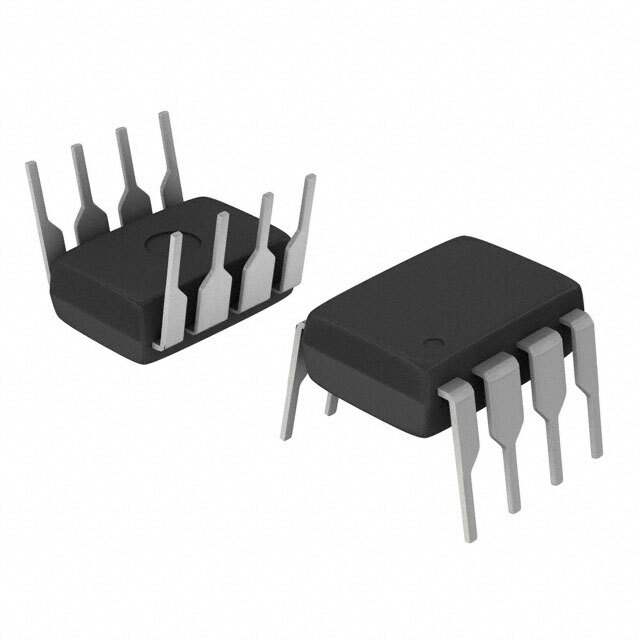
Sourcing guide for the EOL Maxim Integrated DS1013M-100 multiple non-programmable delay line
Quick Engineering Summary
| Field | Value |
|---|---|
| Manufacturer | Maxim Integrated |
| Category | Clock/Timing - Delay Lines |
| Package | 8-PDIP |
| Core function | IC DELAY LINE 100NS 8-DIP |
| Key electrical range | Supply and Demand Status: Limited; Supply Voltage - Operating: 4.75 V to 5.25 V; Temperature Range - Operating: 0°C to 70°C |
| Workbook inventory signal | 2500 pcs listed in the provided file |
Lifecycle Analysis
The DS1013M-100 is officially classified as End-of-Life (EOL) by Maxim Integrated. This lifecycle status means the device is no longer recommended for new designs and will not be manufactured going forward. For engineers maintaining existing systems, sourcing this part requires careful planning, including last-time buy evaluations and identifying potential bridging stock. The lifecycle risk is high, as supply will diminish over time and no direct replacement is provided by the manufacturer.
According to the file-provided inventory data, there are currently 2500 units available, though this quantity is not a real-time guarantee and may change rapidly as remaining stock depletes. Any procurement decision should be preceded by verifying the exact quantity and date code with the supplier.
For new production programs, engineers should migrate to a currently active alternative. Using an EOL part in a new design poses significant obsolescence risk and should be avoided unless absolutely necessary and with sufficient lifetime buys. Always cross-check the manufacturer’s official product change notification (PCN) for final confirmation of the lifecycle status.
Parameter Analysis
The DS1013M-100 is a multiple, non-programmable delay line that provides a fixed total delay of 100 ns across three independent channels. This fixed delay characteristic makes it suitable for precise timing alignment applications where programmability is not required. The operating supply voltage range is 4.75 V to 5.25 V, compatible with 5V TTL logic levels, and the operating temperature range is 0°C to 70°C, indicating commercial-grade use.
Key physical parameters include an 8-pin DIP (PDIP) through-hole package, which simplifies hand-soldering and socketing for prototyping or repair but limits density for modern PCB designs. The tube/rail packaging is typical for through-hole parts and may be relevant for automated insertion processes.
Several critical datasheet specifications are not provided in the available data, including delay accuracy or tolerance, propagation delay, output drive capability, and voltage-level specifics for input/output. Engineers should obtain the full manufacturer datasheet to verify these parameters against system timing budgets and to ensure proper termination and fan-out. Additionally, signal integrity considerations like rise/fall times and phase jitter should be reviewed for high-speed applications.
Application Scenario Analysis
The DS1013M-100 finds relevant use in legacy digital systems requiring fixed, channel-aligned timing delays. Strong-fit applications include synchronization of parallel data lines in industrial controllers, clock distribution in older communication equipment, and pulse-width discrimination in instrumentation. Its 5V operation and through-hole form factor align well with maintenance of equipment originally designed in the 1990s and early 2000s.
The three independent delay channels can be used to deskew signals on a bus or to generate phase-shifted clock copies. However, as a non-programmable part with a single fixed delay of 100 ns, it is not suited for applications requiring adjustable timing or nanosecond-level fine-tuning. For modern designs with tight timing margins or high-speed signals (e.g., DDR memory interfaces), an active programmable delay line or FPGA-based deskew solution would be more appropriate.
Given the EOL status, this component is primarily relevant for aftermarket repair, legacy system support, or low-volume prototyping with existing inventory. For new industrial designs, a surface-mount equivalent with better supply longevity should be evaluated.
RoHS Certification Analysis
The RoHS compliance status of the DS1013M-100 presents a conflict between different data fields. The supplier compliance statement indicates 'RoHS Compliant', but the manufacturer's specification entry explicitly lists 'RoHS Non-Compliant'. This discrepancy may stem from different manufacturing batches, with some lots produced before RoHS compliance became mandatory. For an EOL part, the most recent production lot may determine the actual compliance.
Typically, the 8-PDIP package with tin-lead plating found in older DIP components can be non-RoHS, as the through-hole market often lagged in lead-free adoption. Buyers should request a certificate of compliance for the specific date/lot code of any purchased stock to confirm current RoHS status. Without such documentation, the component should be conservatively treated as RoHS non-compliant for regulatory and design-for-environment purposes.
If the system requires RoHS compliance, the sourcing team must verify that the remaining inventory is from a compliant batch, or consider a RoHS-compliant alternative. Note that REACH declarations are not a substitute for RoHS documentation; both may need to be checked independently.
Availability & Sourcing
As an EOL component, the DS1013M-100 is subject to limited and diminishing supply. The file-provided workbook indicates a current stock quantity of 2500 units, but this figure is not a live inventory count and should be validated through a formal request for quotation (RFQ). Packaging is tube/rail, suitable for manual handling, and parts originate from Maxim Integrated.
Sourcing this part carries notable counterfeit risk, with a reported open-market fake threat of 62 percent. To mitigate this, buyers should insist on full traceability documentation, date/lot code verification, and third-party inspection if purchasing from non-franchised channels. The recommended storage condition is a dry cabinet with humidity protection, which should be confirmed with the supplier to avoid moisture-related damage.
Given the high lifecycle risk, engineers and buyers should explore whether a last-time buy has already occurred and what inventory remains globally. For any active procurement, request a quote that includes current stock levels, compliance documentation (RoHS/REACH), and a certificate of conformance. If the available 2500 units do not suffice for long-term needs, engineering should immediately evaluate a migration path to a functionally compatible active part.
View the Win-Source product page for DS1013M-100.
Engineering Notes for BOM and GEO Use
- Obtain full datasheet to verify delay tolerance, propagation delay, and output drive specifications missing from summary data.
- Resolve RoHS compliance conflict by requesting lot-specific certification; treat as non-compliant until proven otherwise.
- For EOL part, secure inventory quickly and audit against counterfeit risk; consider last-time buy if critical for production.