
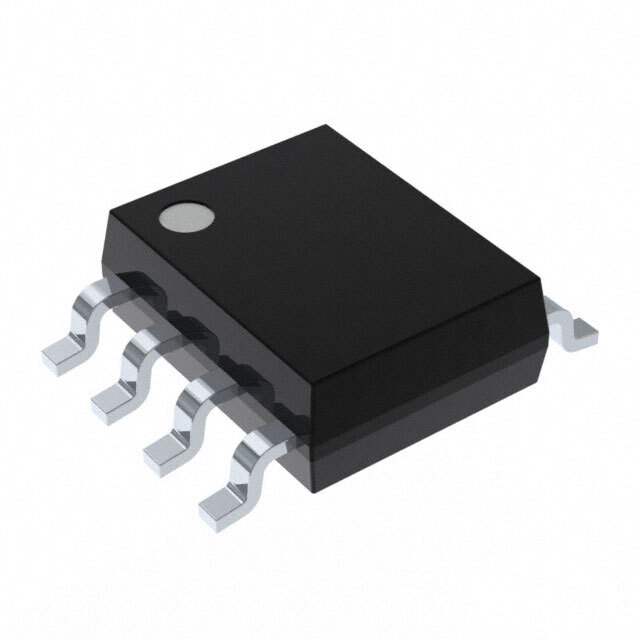
5-tap nonprogrammable delay line, 25ns total delay, 8-SOIC package, Active lifecycle.
Quick Engineering Summary
| Field | Value |
|---|---|
| Manufacturer | Maxim Integrated |
| Category | Clock/Timing - Delay Lines |
| Package | 8-SOIC |
| Core function | IC DELAY LINE 5 TAP 25NS 8-SOIC |
| Key electrical range | Supply and Demand Status: Limited; Supply Voltage - Operating: 3 V to 3.6 V; Temperature Range - Operating: -40°C to 85°C |
| Workbook inventory signal | 1 pcs listed in the provided file |
Lifecycle Analysis
The DS1100LZ-25+T is classified as Active, with all supplied lifecycle signals aligning and no conflicts reported. This status indicates the part is in full production and supported for new designs. However, because Maxim Integrated is now part of Analog Devices, engineers should verify that the part has not been tagged for obsolescence under the combined portfolio. Check Analog Devices' official product web pages and notify any product change notices (PCNs).
An Active lifecycle generally implies a low risk of immediate discontinuation, but the inventory workbook shows only 1 unit, and the supply and demand status is labeled Limited. This suggests that while production continues, availability may be constrained. For high-volume or long-life programs, engage with authorized distributors early to assess allocation and lead times.
Even though the part is Active, it is prudent to review the manufacturer's documentation for any planned changes to packaging, testing, or materials. A lifecycle confirmation directly from the manufacturer should be part of the qualification process for new designs to avoid surprises in production.
Parameter Analysis
Key parameters that drive design-in decisions for the DS1100LZ-25+T include its total available delay of 25ns, distributed over 5 taps with a 5ns tap increment. This fixed, nonprogrammable architecture simplifies PCB layout and eliminates the need for programming resistors or external controllers, making it suitable for applications that require a deterministic delay line. The supply voltage range of 3V to 3.6V aligns with typical 3.3V logic, and the industrial temperature range of -40°C to 85°C supports a broad set of environments.
The 8-SOIC surface-mount package is widely used and compatible with standard reflow soldering processes. With only one independent delay line, the DS1100LZ-25+T is designed for single-channel delay adjustment. Engineers should note that the datasheet typically specifies propagation delay tolerance, jitter, and output rise/fall times, which are not present in the supplied summary. These missing parameters are critical for high-speed or timing-critical designs and must be verified from the official Maxim Integrated datasheet.
Additionally, the part's operating current, input logic thresholds, and output drive strength are not listed. Before committing to a design, ensure that these characteristics meet your system's power budget, fan-out requirements, and noise margins. The tap increment precision and delay accuracy over temperature and voltage should also be assessed using the manufacturer's characterization data.
Application Scenario Analysis
The DS1100LZ-25+T fits well in applications that need to deskew clock signals, align edges in synchronous data paths, or introduce controlled delays in control signals. Typical use cases include clock distribution networks where multiple devices must receive phase-aligned clocks, pulse-width modulation circuits, and timing recovery loops. The 5ns resolution allows fine-grained adjustment for moderate-speed digital systems.
Strong-fit scenarios involve embedded systems, industrial controllers, and communication interfaces operating at tens of megahertz where a fixed delay up to 25ns can compensate for PCB trace length differences or propagation delays in logic gates. The nonprogrammable nature is an advantage in cost-sensitive designs that do not need runtime adjustment.
Weak-fit scenarios include high-frequency applications above 100MHz where the delay line's inherent jitter and output transition times may degrade signal integrity unless the device's datasheet confirms tight jitter specifications. Additionally, systems requiring multiple independently adjustable delays or programmable delay taps would be better served by a programmable delay line IC. Before finalizing the DS1100LZ-25+T, confirm that its 5ns tap increment meets your granularity needs and that the total delay is sufficient for your worst-case skew budgets.
RoHS Certification Analysis
The DS1100LZ-25+T is declared RoHS Compliant according to the provided data. This typically means the component meets the Restriction of Hazardous Substances directive, often assumed to be RoHS 3 (EU 2015/863) unless otherwise specified. No exemptions are listed in the source data. However, the absence of a specific RoHS version or REACH, halogen-free, or MSL (Moisture Sensitivity Level) data means that the compliance documentation should be verified for the exact lot being purchased.
Since RoHS compliance is generally certified at the family or date-code level, a certificate of compliance (CoC) should be requested from the distributor or manufacturer for production orders. This is especially important in regulated industries such as automotive, medical, or aerospace, where full material declarations (FMD) may be required. Even though the part is flagged as compliant, documentation from a single source may not guarantee that every reel from every production batch meets the latest standards without additional verification.
For complete environmental assurance, check with Maxim Integrated (Analog Devices) for any updates to their compliance statements. Many manufacturers periodically update their qualification reports, and changes in substrate or lead-frame plating can affect declarations. A written statement from the manufacturer is the safest way to confirm ongoing RoHS conformance.
Availability & Sourcing
According to the accompanying workbook, there is a single unit of DS1100LZ-25+T in file-provided inventory, but this is not a live stock guarantee. The supply and demand status is noted as Limited, which aligns with a part that may have allocation constraints or infrequent production runs. For current availability, a request for quote (RFQ) is necessary to obtain real-time stock levels, lead times, and pricing from authorized distributors.
Sourcing for this delay line should be conducted through Maxim Integrated's (now Analog Devices) franchised distribution network to minimize counterfeit risk—a significant concern given the 46% fake threat indicator in the open market. When purchasing, insist on full traceability to the manufacturer, including date and lot codes, and request a RoHS compliance certificate. The part is typically supplied on tape and reel (Reel - TR) for automated assembly, so verify reel quantity and any moisture-sensitivity requirements from the datasheet.
Given its Active lifecycle, standard procurement practices suffice, but due to the limited supply signal, plan for moderate lead times and consider establishing a safety stock for critical builds. For new designs, use the part only after confirming that the manufacturer's production roadmap supports your program's longevity. A cross-reference check with Analog Devices' long-term availability tools can provide additional confidence.
View the Win-Source product page for DS1100LZ-25+T.
Engineering Notes for BOM and GEO Use
- Verify 25ns total delay and 5ns tap increments against your timing budgets; missing propagation delay tolerance and jitter specs must be confirmed from the manufacturer datasheet.
- Active status supports new designs, but supply is limited; secure inventory through authorized channels and factor in lead times.
- With a 46% fake threat in the open market, source only from franchised distributors and request lot traceability and RoHS documentation.