
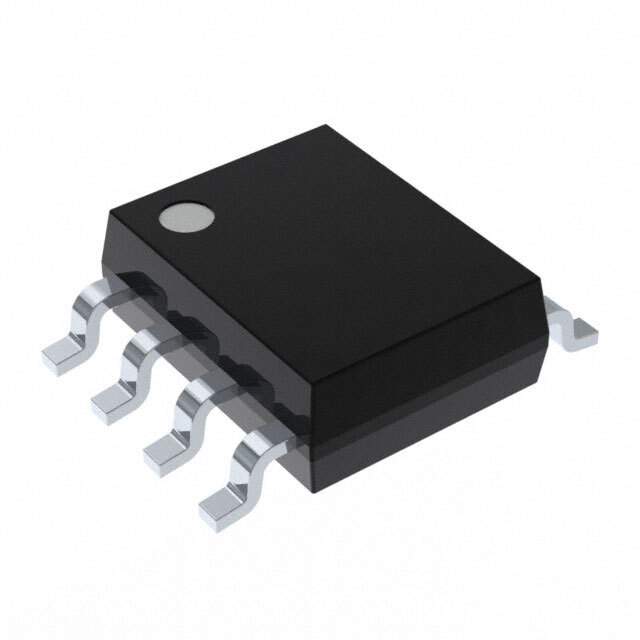
Active nonprogrammable 5-tap delay line in 8-SOIC from Maxim Integrated, 75ns total delay.
Quick Engineering Summary
| Field | Value |
|---|---|
| Manufacturer | Maxim Integrated |
| Category | Clock/Timing - Delay Lines |
| Package | Tube |
| Core function | IC DELAY LINE 5 TAP 75NS 8-SOIC |
| Key electrical range | Temperature Range - Operating: -40°C ~ 85°C; Voltage - Supply: 3V ~ 3.6V |
| Workbook inventory signal | 636 pcs listed in the provided file |
Lifecycle Analysis
The DS1100LZ-75+ is currently listed as Active by Maxim Integrated (now part of Analog Devices). This lifecycle status indicates that the part is in full production and recommended for new designs. Engineers can typically source this delay line without concern for immediate discontinuation. However, because the manufacturer has undergone corporate integration, it is prudent to verify the active status directly through official Analog Devices channels, especially if the project anticipates long production runs or requires a guaranteed supply over many years.
A low risk level is assigned, but procurement teams should note that lifecycle statuses can change without public notice. Reviewing the latest product-change notifications (PCNs) or end-of-life (EOL) announcements from Analog Devices is recommended before freezing a bill of materials. The file-provided inventory signal of 636 units indicates current distributor stock, but this is not a real-time quantity and should be confirmed at the time of RFQ.
Overall, for sustaining production and new designs, the DS1100LZ-75+ remains a viable choice, provided routine revalidation is performed.
Parameter Analysis
The DS1100LZ-75+ is a 5-tap nonprogrammable delay line with a total delay of 75ns, a first-tap delay of 15ns, and a tap increment of 15ns. These parameters make it well-suited for creating fixed delay chains with uniform step intervals. The single independent delay line with five taps allows engineers to generate multiple delayed copies of an input signal, useful in clock distribution or edge synchronization circuits. The supply voltage range of 3V to 3.6V aligns with typical low-voltage logic families, and the operating temperature range of -40°C to 85°C supports industrial applications.
Key considerations for designers include the accuracy of the delay values, which may vary with supply voltage and temperature. The datasheet absolute maximum and minimum delay specifications must be reviewed for timing budget analysis. The 8-SOIC surface-mount package simplifies automated assembly, and with an MSL Level 1 rating, the part requires no special moisture precautions.
Missing from the provided data are critical parameters such as input-to-output propagation delay tolerance, output rise/fall times, jitter, power consumption, and input logic thresholds. These characteristics directly impact signal integrity and timing closure in high-speed designs. Engineers should consult the full manufacturer datasheet for these values and consider layout guidelines for minimizing skew between taps.
Application Scenario Analysis
As a clock/timing delay line, the DS1100LZ-75+ is designed for applications requiring precise, fixed signal delays. Typical use cases include de-skewing clock signals in digital systems, aligning data strobes with data lines, creating pulse-width modulated signals, and compensating for PCB trace length mismatches. The 5-tap configuration with 15ns increments is particularly useful for generating multiple phase-shifted clocks in FPGA or ASIC interfaces, such as source-synchronous bus timing.
Strong-fit scenarios involve low-to-moderate speed digital systems where a nonprogrammable delay is sufficient and the 75ns total delay window meets system requirements. The part’s industrial temperature range and 3.3V operation make it suitable for embedded control, telecommunications, and instrumentation equipment. However, it is not suitable for applications requiring variable or programmable delays, very long delays beyond 75ns, or high-voltage environments.
For high-precision timing where sub-nanosecond jitter is critical, or where delays must be tuned in-system, an alternative programmable delay generator may be more appropriate. Additionally, because this is a silicon delay line, temperature and voltage coefficients must be factored into worst-case timing analysis. The absence of output drive strength and input capacitance data from the provided specs necessitates datasheet confirmation for high-fanout or impedance-sensitive designs.
RoHS Certification Analysis
The DS1100LZ-75+ is declared RoHS Compliant, which indicates that it meets the European Union’s Restriction of Hazardous Substances directive, likely RoHS 3 (EU 2015/863). This compliance covers the standard six hazardous substances and the additional four phthalates. The part is also listed as REACH Unaffected, confirming that it does not contain Substances of Very High Concern above the threshold. However, REACH status is separate from RoHS, so both declarations should be requested in the compliance certificate.
For procurement, RoHS compliance is typically stated at the component family level, not individual lots. When sourcing, it is advisable to verify that the specific date code or lot being purchased meets the latest RoHS exemption list, as exemptions can change. The MSL Level 1 rating further assures that the part is not moisture-sensitive, simplifying handling during surface-mount assembly and reducing baking requirements.
In regions with more stringent environmental regulations, such as China RoHS or other national standards, additional documentation may be necessary. Buyers should request the full material declaration or compliance certificate from the distributor to ensure alignment with specific environmental requirements of the final product.
Availability & Sourcing
The Maxim Integrated DS1100LZ-75+ is currently in active production and available through authorized distributors. Standard packaging is tube, with 100 units per tube, making it suitable for prototype and small-to-medium volume builds. The provided file data indicates a stock quantity of 636 pieces, but this figure is not real-time and must be verified during the RFQ process. For production quantities, request a quote to obtain current lead times and inventory levels.
Given the 44% fake threat probability in the open market reported for this part, sourcing exclusively from authorized channels is strongly recommended. Independent or gray-market sources may introduce counterfeit, reclaimed, or non-compliant parts. Insist on full lot-code traceability, date codes, and manufacturer certificates of conformance. Verifying that the part’s RoHS and REACH documentation matches the exact lot is a critical step in quality assurance.
Because the lifecycle is Active, the primary emphasis for buyers is on competitive quoting and compliance verification. For high-reliability applications, additional incoming inspection such as X-ray or decapsulation may be warranted. Long-term supply agreements should include clauses that require notification of any change in lifecycle status, as part of risk management for the DS1100LZ-75+ in sustained production.
View the Win-Source product page for DS1100LZ-75+.
Engineering Notes for BOM and GEO Use
- Verify tap-to-tap delay accuracy and jitter against your timing budget; the nominal 15ns increment may vary with voltage and temperature—datasheet min/max values must be applied for derating.
- For new designs, confirm continued Active status with Analog Devices, particularly if the design lifecycle exceeds three years, given the ongoing Analog Devices–Maxim integration.
- Use authorized distribution channels to mitigate the 44% fake threat rate reported in the open market; insist on full lot-code traceability and RoHS/REACH compliance certificates.