
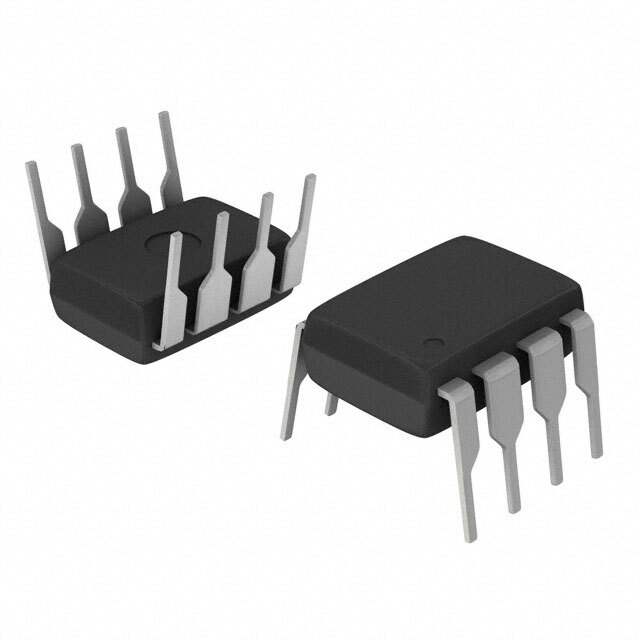
EOL 5‑tap, 50 ns nonprogrammable delay line in 8‑DIP. Evaluate lifecycle, RoHS conflicts, and availability before design‑in.
Quick Engineering Summary
| Field | Value |
|---|---|
| Manufacturer | Maxim Integrated |
| Category | Clock/Timing - Delay Lines |
| Package | 8-PDIP |
| Core function | IC DELAY LINE 5 TAP 50NS 8-DIP |
| Key electrical range | Supply and Demand Status: Balance; Supply Voltage - Operating: 4.75 V to 5.25 V; Temperature Range - Operating: -40°C to 85°C |
| Workbook inventory signal | 1 pcs listed in the provided file |
Lifecycle Analysis
The DS1100M‑50 from Maxim Integrated is officially designated End‑of‑Life (EOL). All supplied lifecycle signals, including the Excel‑sourced parameter and the Lifecycle Status field, consistently report EOL, with no conflicts. This status means the part is no longer recommended for new designs and may have limited or no scheduled production.
For sustaining production, engineers should immediately evaluate the remaining inventory pipeline, request a formal manufacturer discontinuation notice, and confirm any last‑time‑buy window. The file‑provided stock quantity of 1 unit is a snapshot only and not a guarantee of real‑time availability.
Risk is high: unplanned redesigns, obsolescence of through‑hole timing components, and potential counterfeit ingress. Teams should begin migrating to an active delay line or alternative clock distribution solution while securing enough DS1100M‑50 units to cover the transition period.
Parameter Analysis
The DS1100M‑50 provides five nonprogrammable delay taps with a total available delay of 50 ns and a uniform tap increment of 10 ns, meaning outputs at 10, 20, 30, 40, and 50 ns from a single independent delay line. The operating supply voltage is a narrow 4.75 V to 5.25 V, typical for older TTL/CMOS logic families, and the temperature range is ‑40 °C to 85 °C.
These parameters matter because timing margins, supply regulation, and thermal derating directly affect signal integrity. A 5 V supply with tight tolerance rules out direct use in 3.3 V or lower systems without level shifting. The 8‑PDIP through‑hole package dictates PCB layout for older or hand‑assembled boards, but also limits high‑speed performance compared to surface‑mount alternatives.
Notably absent from the provided data are input‑to‑output propagation delay variation, skew between taps, and output rise/fall times. Engineers should obtain the full Maxim Integrated datasheet to verify these dynamic characteristics and to ensure the delay line meets system‑level timing budgets under worst‑case conditions.
Application Scenario Analysis
The DS1100M‑50 fits classic clock distribution and signal alignment tasks. Its fixed 10 ns steps suit applications where a reliable, unchangeable timing ladder simplifies system design, such as synchronizing parallel bus signals, deskewing clock trees, or pulse‑width trimming in legacy digital instruments. The through‑hole DIP package also lends itself to repair, prototyping, or industrial equipment with high vibration tolerance where socketed components are preferred.
Conversely, its nonprogrammable nature and obsolete life‑cycle make it a poor match for modern designs requiring adaptive timing, sub‑10 ns resolution, or lower standby power. Systems migrating to 3.3 V or 1.8 V logic cannot directly interface with this part, and the through‑hole mounting forces a larger board footprint.
Given the EOL status, the DS1100M‑50 should be considered only for maintenance, repair, or exact‑replacement scenarios in existing products. Any new development should select an active, functionally equivalent delay line from Maxim Integrated or an alternative supplier.
RoHS Certification Analysis
RoHS compliance for the DS1100M‑50 is ambiguous in the available data. The top‑level compliance summary lists the part as RoHS Compliant, but a more granular specification field explicitly states RoHS Non‑Compliant. This discrepancy is critical for procurement, especially in EU markets where RoHS 3 (EU 2015/863) enforcement applies.
No REACH, MSL, or halogen‑free data is provided, preventing a full environmental compliance profile. Because the device is EOL and carries a 29 % reported counterfeit threat in the open market, the safest assumption is non‑compliance unless the specific lot is verified through manufacturer documentation or independent lab testing.
Buyers should request a Certificate of Compliance (CoC) tied to the exact date/lot code and, if possible, physical inspection or XRF screening results. Without this, the DS1100M‑50 should be treated as non‑RoHS for both import and production purposes.
Availability & Sourcing
As an EOL clock/timing delay line from Maxim Integrated, the DS1100M‑50 faces extremely limited availability. The file indicates only 1 unit in stock, which must be considered a snapshot, not a live inventory commitment. The part has a reported fake threat of 29 % in the open market, necessitating strict quality controls.
Engineers and buyers should request a quote through authorized channels, explicitly asking for traceability documentation, date/lot code verification, and compliance paperwork. For any remaining stock, confirm packaging (tube/rail), storage condition (dry pack, as noted), and that the unit has not been improperly handled.
Given the EOL status, the recommended path is to secure inventory for critical sustaining needs while simultaneously qualifying a replacement. Avoid holding the DS1100M‑50 as a strategic stock item for new production; instead, treat it as a bridge component until the migration is complete.
View the Win-Source product page for DS1100M-50.
Engineering Notes for BOM and GEO Use
- Verify RoHS compliance at the individual lot level; conflicting supplier data makes blanket compliance claims unreliable.
- Due to EOL status, plan a last‑time buy and qualify a pin‑compatible or functional replacement now for future production.
- The 10 ns tap increment and 5 V operation require careful timing validation in your specific system, particularly over the full ‑40 °C to 85 °C range.