
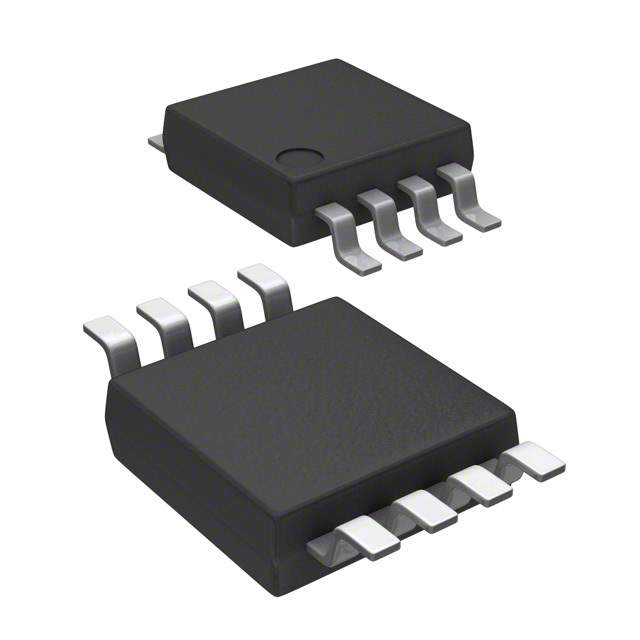
Nonprogrammable delay line for clock/timing alignment, available for RFQ.
Quick Engineering Summary
| Field | Value |
|---|---|
| Manufacturer | Maxim Integrated |
| Category | Clock/Timing - Delay Lines |
| Package | 8-uMAX |
| Core function | IC DELAY LINE 5 TAP 50NS 8-TSSOP |
| Key electrical range | Supply and Demand Status: Balance; Supply Voltage - Operating: 4.75 V to 5.25 V; Temperature Range - Operating: -40°C to 85°C |
| Workbook inventory signal | 3330 pcs listed in the provided file |
Lifecycle Analysis
The DS1100U-50+ is currently classified as Active by Maxim Integrated, with a low risk level for procurement. This status indicates the part is in full production and suitable for both new designs and ongoing manufacturing. All available lifecycle signals are consistent, with no conflicts between manufacturer listing and distributor data.
Engineers designing new systems can proceed with confidence, but should validate the long-term roadmap directly with Maxim Integrated, as active status does not guarantee indefinite availability. For production programs, periodic revalidation of the lifecycle status is advisable to avoid unexpected shortages.
The file-provided inventory quantity of 3330 units suggests current stock availability, but this figure is not guaranteed real-time. Buyers should request a formal quote to confirm current lead times and stock levels before committing to production orders.
Parameter Analysis
Critical parameters for the DS1100U-50+ include a total delay of 50 ns, distributed across 5 taps with a consistent 10 ns increment per tap. The device operates on a single supply voltage of 4.75 V to 5.25 V, which is typical for 5V logic systems. Its operating temperature range of -40°C to 85°C covers most industrial application requirements.
The nonprogrammable nature of the delay line means the timing values are fixed, simplifying integration but limiting flexibility. Engineers must ensure the 10 ns step resolution and 50 ns maximum delay align exactly with system timing margins. The 8-uMAX (TSSOP-8) SMD package requires standard surface-mount assembly processes and offers a compact footprint suitable for dense PCB layouts.
Missing from the provided specifications are key datasheet parameters such as input logic thresholds, output drive strength, propagation delay variation over temperature, and supply current. These values should be verified from the manufacturer's official datasheet to assess signal integrity, power budget, and timing accuracy under all operating conditions.
Application Scenario Analysis
The DS1100U-50+ is well-suited for clock deskewing, signal phase adjustment, and pulse generation in digital systems that require precise, fixed timing offsets. Typical applications include synchronizing data buses, aligning clock edges in multi-board systems, and generating timed resets or strobes. Its 5V operation and industrial temperature range make it appropriate for legacy 5V logic environments and moderate industrial control systems.
Weak-fit scenarios involve high-speed differential clocking (LVDS, LVPECL) where signal integrity demands controlled impedance and tight skew, or applications needing programmable delays or longer total delays beyond 50 ns. The nonprogrammable taps limit its use in adaptive timing circuits.
For designs requiring multiple independent delays, only one delay element is available, so multi-channel synchronization must be handled externally. Engineers should confirm the voltage compatibility with modern low-voltage logic if interfacing with 3.3V or 1.8V devices.
RoHS Certification Analysis
The DS1100U-50+ is listed as RoHS Compliant, indicating it meets EU directives for hazardous substance restrictions. This classification generally covers the base materials and manufacturing process, allowing its use in RoHS-compliant assemblies.
However, the provided data does not include REACH, halogen-free, or MSL details. RoHS compliance is a part-level declaration; lot-level variations can occur due to process changes or exemptions. For high-reliability or high-volume production, procurement teams should request a current certificate of compliance for each shipment.
No specific exemptions are noted in the available information. If the part contains any RoHS-exempt materials (e.g., lead in internal solders for certain package types), this would typically be documented in the manufacturer's compliance statement, which should be obtained for audit purposes.
Availability & Sourcing
As an active Maxim Integrated part, the DS1100U-50+ is generally available through authorized distribution channels. Sourcing is recommended via RFQ to obtain current stock levels, lead times, and pricing. File-provided inventory indicates a quantity of 3330 units, but this is not a real-time guarantee; actual availability should be confirmed before placing orders.
Standard packaging is tube/rail, which minimizes handling damage and simplifies inventory management for production runs. Buyers should specify traceability requirements such as date/lot codes and request compliance documentation (RoHS, MSL) as part of the order. The supply and demand status is reported as "Balance," suggesting no acute shortages, though market conditions can shift.
For new production use, verify the latest lifecycle status and consider alternate sources only if they are franchised or authorized by Maxim Integrated. Given the 29% fake threat reported in open markets, sourcing from unauthorized channels carries significant risk. Always engage a trusted supplier for genuine and traceable components.
View the Win-Source product page for DS1100U-50+.
Engineering Notes for BOM and GEO Use
- Verify supply voltage tolerance (4.75V–5.25V) and timing accuracy against system requirements.
- Account for the nonprogrammable 10ns tap increment; ensure it matches your signal alignment needs.
- Request lot-specific RoHS and MSL documentation for production-grade traceability.