
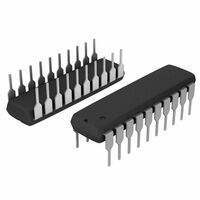
EOL Nonvolatile RAM Controller in 20-PDIP Package – Verify sourcing options, lifecycle risks, and compliance.
Quick Engineering Summary
| Field | Value |
|---|---|
| Manufacturer | Analog Devices Inc. |
| Category | Memory - Controllers |
| Package | Not available in supplied data |
| Core function | IC MEM CTLR NV RAM 20-PDIP |
| Key electrical range | IC MEM CTLR NV RAM 20-PDIP |
| Workbook inventory signal | 1 pcs listed in the provided file |
Lifecycle Analysis
The DS1211N from Analog Devices Inc. is formally classified as End-of-Life (EOL). This means the manufacturer has discontinued production and no longer recommends it for new designs. Engineers should expect shrinking availability and plan for a lifetime buy if the part is still needed for sustaining production.
All supplied lifecycle signals align: the Excel lifecycle param, lifecycle status, and product status all confirm EOL. No conflicts exist. Still, procurement teams should request the manufacturer’s product discontinuance notice to obtain official last-time buy and last-ship dates. This documentation is critical for estimating remaining supply.
A single unit appears in a file-provided inventory workbook, but that quantity is not a real-time reflection of market stock. It underscores that inventory is very limited. Engineers and buyers should treat any residual stock as subject to quick depletion and immediately verify availability through a formal quote process.
Parameter Analysis
The DS1211N is a nonvolatile RAM controller designed to manage battery-backed SRAM. The supplied specifications indicate a supply voltage range of 4.75V to 5.5V, typical for 5V logic systems. The operating temperature range is -40°C to +85°C, making it suitable for industrial environments. The package is a 20-pin PDIP with 0.300-inch row spacing, intended for through-hole mounting—a legacy form factor that simplifies prototyping and repairs but limits density.
These core parameters drive most design decisions. The 5V supply must be stable and within ±5% to avoid data corruption. Thermal management is generally benign given through-hole construction and modest power, but junction temperature should be verified in enclosed chassis at the upper ambient end. The DIP package requires careful PCB layout to maintain signal integrity, especially for address and data bus traces.
Several datasheet details are absent from the provided data and must be verified before integrating remaining DS1211N stock into a design. Key missing items include: timing diagrams for chip select and write enable; specific SRAM compatibility list; maximum operating current; ESD ratings; and the exact protocol for battery switchover. Engineers should obtain the original Analog Devices datasheet to confirm these parameters and any application notes on battery backup circuitry.
Application Scenario Analysis
The DS1211N is primarily used in embedded systems that require nonvolatile storage for configuration, calibration data, or event logs. Typical applications include legacy industrial controllers, telecommunications line cards, medical equipment, and measurement instruments where battery-backed SRAM provides fast read/write with data retention across power cycles. Its 5V operation and DIP package align with older, often through-hole designs that cannot be easily redesigned.
As an EOL device, the DS1211N is strongly suited only for maintaining existing equipment. It is a poor fit for new product development, where modern alternatives—such as serial FRAM, EEPROM, or microcontroller-integrated nonvolatile memory—offer smaller footprints, lower voltage operation, and simpler battery management. Any new design using the DS1211N would face immediate obsolescence risk and supply uncertainty.
For field-repair or last-time-build scenarios, the DS1211N may still fill a narrow need, but procurement must be carefully coordinated. Engineers should assess whether the stored data structure and timing requirements are compatible with potential replacement controllers if the installed base must be supported long-term. Migration planning should begin concurrently with any buy to avoid a later redesign under time pressure.
RoHS Certification Analysis
According to the provided data, the DS1211N is RoHS Compliant. This indicates that the part was manufactured to meet the restrictions on lead, mercury, cadmium, and other hazardous substances under the EU RoHS Directive. For a discontinued device, it is crucial to verify that the specific lot being procured retains this compliance; older stock may have been produced before RoHS regulations took effect.
While the designation “RoHS Compliant” is present, no detailed standard or exemption list is supplied. Typical compliance for Analog Devices parts follows RoHS 3 (EU 2015/863) specifications, but this cannot be assumed without manufacturer documentation. Buyers should request a certificate of compliance for the exact lot if RoHS is a requirement for their application, especially in markets like European Union and California.
Note that RoHS compliance does not automatically include REACH or other environmental regulations. The data does not mention REACH status or halogen-free properties. For a comprehensive compliance picture, ask the distributor to provide the full materials declaration or confirm REACH SVHC content. As a through-hole part, the DS1211N’s lead finish may be tin-bismuth or matte tin, which is usually RoHS-compatible.
Availability & Sourcing
The DS1211N is an end-of-life component with extremely limited availability. The file-provided inventory quantity of one unit illustrates scarcity; it is not a guaranteed real-time stock figure. To understand current supply, request a quote from an authorized or independent distributor, specifying the required date and lot codes. Given the lifecycle status, any available inventory may consist of residual or excess stock.
Sourcing teams should prioritize traceability: confirm the manufacturer’s original packaging (tube for DIP), date code, and whether the part was stored under proper conditions. Since the device is EOL, no further production is planned, so future orders will likely be non-cancellable and non-returnable. Explicitly verify that the distributor can provide compliance documentation (RoHS, REACH if needed) before placing an order.
For designs that cannot avoid using the DS1211N, evaluate a strategic lifetime buy that covers projected service requirements. Simultaneously, identify a pin-compatible or functional replacement path for future revisions. If no direct substitute exists, begin a migration plan to a different memory technology. For immediate sourcing, contact Win Source or other suppliers with the DS1211N part number, but always re-confirm lifecycle and authenticity before committing to a purchase.
View the Win-Source product page for DS1211N.
Engineering Notes for BOM and GEO Use
- Confirm last-time buy (LTB) date and remaining manufacturer inventory before committing to DS1211N.
- Verify firmware timing compatibility when migrating to a new memory controller, as the DS1211N interfaces with specific NV RAM.
- Ensure through-hole 20-DIP footprint is accommodated in legacy PCB designs; no SMT alternative is offered.