
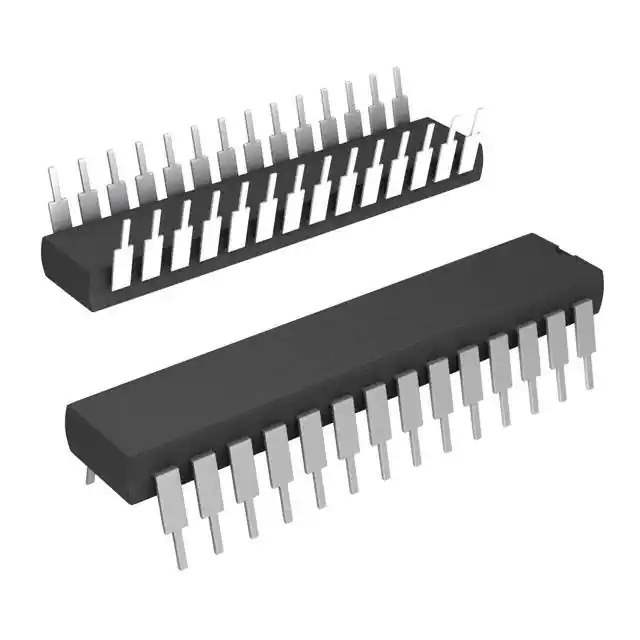
Discontinued Smartsocket SRAM controller in 28-DIP package – technical specs, lifecycle risks, and sourcing advice for legacy systems.
Quick Engineering Summary
| Field | Value |
|---|---|
| Manufacturer | Maxim Integrated |
| Category | Memory - Controllers |
| Package | Tube |
| Core function | IC MEM CTLR SMARTSOC SRAM 28PDIP |
| Key electrical range | Temperature Range - Operating: 0°C ~ 70°C; Voltage - Supply: 4.75V ~ 5.5V |
| Workbook inventory signal | 1 pcs listed in the provided file |
Lifecycle Analysis
The Maxim Integrated DS1213B is officially discontinued, marking a high-risk lifecycle status for both new designs and ongoing production. Internal data shows conflicting signals (EOL versus Discontinued), but all point to end-of-life. Engineers must treat this part as unavailable for new projects and focus on last-time-buy options or redesigns for existing systems.
The discontinuity means no further manufacturing, limited distributor stock, and potential obsolescence-driven price inflation. The workbook-reported quantity of 1 unit should be considered a snapshot only; real-time availability must be confirmed through a request for quote. Long-term support is not guaranteed, and any remaining inventory is likely from residual stock or broker channels.
For sustaining production, the recommended path is to validate the lifecycle directly with Maxim Integrated and source any remaining factory-authorized inventory. Where no stock exists, users should evaluate an alternative Smartsocket SRAM controller or a modern nonvolatile memory solution.
Parameter Analysis
The DS1213B is a Smartsocket SRAM controller implemented in a 28-pin DIP through-hole package, suited for 5V systems (4.75V to 5.5V supply) and commercial temperature range (0°C to 70°C). The controller type defines its role in enabling nonvolatile operation for standard SRAM devices by integrating a power-fail detection, battery switchover, and chip-enable gating. Engineers should verify the supported SRAM densities and access timing from the full Maxim datasheet, as these are not provided in the available specifications.
The through-hole DIP-28 form factor limits modern design applicability, requiring careful PCB layout consideration if used in legacy maintenance. The MSL rating of 1 (unlimited) confirms no moisture sensitivity concerns, but this is secondary for an obsolete part. Key missing parameters include standby current, switchover threshold accuracy, battery backup requirements, and SRAM interface timing; all must be retrieved from the original datasheet to qualify a replacement or assess exact function.
Supply voltage tolerance is narrow, and using this part outside the specified 4.75V–5.5V range may cause data corruption. The commercial temperature range restricts usage to indoor, non‑harsh environments. Designers attempting a drop‑in replacement should match these electrical and mechanical characteristics precisely or evaluate a newer nonvolatile memory controller with broader specifications.
Application Scenario Analysis
The DS1213B is intended for legacy embedded systems where standard SRAM must be made nonvolatile without relying on software save/restore. Typical strong-fit applications are industrial controllers, telecommunication line cards, and older medical instruments that used socketed SRAM with battery backup. In these systems, the DS1213B replaced discrete power‑fail and battery‑management circuits, simplifying board design and ensuring data retention during power loss.
Weak-fit scenarios include any new design requiring surface‑mount components, wide temperature range (−40°C to +85°C), or low‑voltage operation (3.3V or below). The DIP‑28 package is not compatible with modern automated assembly, and the 5V‑only supply excludes battery‑powered or energy‑conscious applications. Additionally, the commercial temperature rating makes outdoor or automotive use unreliable.
For repair and maintenance of existing equipment, the DS1213B remains a necessary component, but the high counterfeit threat (39%) demands careful authentication. Systems that must remain in service may consider redesigning with a contemporary nonvolatile SRAM or an FRAM‑based solution to eliminate the dependency on this discontinued part.
RoHS Certification Analysis
RoHS compliance for the DS1213B is ambiguous. While a top‑level compliance field indicates 'RoHS Compliant', the detailed specification list assigns 'RoHS Non‑Compliant'. This contradiction requires immediate verification before procurement for any market enforcing RoHS directives (e.g., EU, China RoHS). The available data does not clarify which RoHS standard was evaluated, nor whether the non‑compliant classification stems from a specific material such as lead in the DIP package finishes.
Buyers should request a full material declaration or RoHS certificate for the exact lot code under consideration. REACH status is recorded as 'Unaffected', but this does not confirm RoHS compliance; they are separate regulatory frameworks. The absence of an explicit ROHS exemption field suggests no known exemptions are associated with this part number, but that does not guarantee all homogeneous materials meet thresholds.
Until lot‑specific documentation is obtained, treat the part as RoHS Non‑Compliant to avoid compliance risk. For non‑EU markets or legacy exemptions, this may be acceptable, but design‑in for new products should not proceed without confirmed compliance.
Availability & Sourcing
Availability of the DS1213B is critically low. The part is discontinued, with the file‑provided quantity showing only 1 unit, and no guarantee of real‑time stock. The standard package was 13 pieces per tube, but replenishment is no longer possible from Maxim Integrated. A counterfeit threat rating of 39% in the open market further complicates sourcing; any non‑authorized channel poses significant authenticity risk.
For urgent legacy system repair, users should submit a request for quote to authorized distributors or the manufacturer to verify any residual inventory. All purchases must include traceability documents, date/lot codes, and RoHS/REACH status confirmation specific to the shipped units. Visual inspection and, where possible, electrical verification against the original datasheet are recommended due to the high counterfeit probability.
Long‑term strategy should focus on migration to an active alternative. The DS1213B’s discontinuation means even if small quantities are found, sustained supply is impossible. Engineering teams should begin redesigning the memory backup circuit using a newer nonvolatile controller or integrated NVRAM solution, and plan a validation cycle to ensure functional equivalence before the last available DS1213B stock is exhausted.
View the Win-Source product page for DS1213B.
Engineering Notes for BOM and GEO Use
- DS1213B is discontinued; do not design into new products. Source only for legacy system repair and validate authenticity rigorously.
- The device provides nonvolatile control for standard SRAM in a 5V through-hole DIP form factor, but verify datasheet for supported SRAM densities and timing.
- RoHS compliance is inconsistent across available data; request lot-specific certification before purchase to avoid compliance issues.