
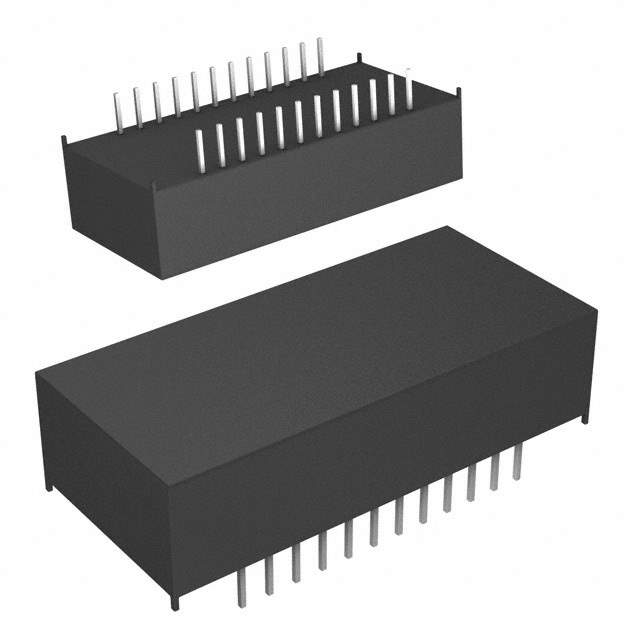
Maxim Integrated 16Kbit Non-Volatile SRAM (NVSRAM), Parallel Interface, Discontinued
Quick Engineering Summary
| Field | Value |
|---|---|
| Manufacturer | Maxim Integrated |
| Category | Memory |
| Package | Tube |
| Core function | IC NVSRAM 16KBIT PARALLEL 24EDIP |
| Key electrical range | Temperature Range - Operating: -40°C ~ 85°C (TA); Voltage - Supply: 4.75V ~ 5.25V |
| Workbook inventory signal | 1 pcs listed in the provided file |
Lifecycle Analysis
The DS1220AB-100IND has been discontinued by Maxim Integrated, with no conflicting lifecycle signals. This status means the manufacturer no longer produces the part, and no authorized distribution channels are guaranteed to have remaining stock. For new designs, this part must be avoided entirely—selecting a discontinued component introduces supply chain risk and complicates long-term product support.
For existing production or repair of legacy equipment, immediate action is required. First, verify the authenticity and date codes of any available stock, as the open market carries a high counterfeit risk (49% fake threat reported). Second, contact the manufacturer to confirm the official discontinuance notice and any last-time-buy terms that may have expired. Without such confirmation, procurement should assume zero future availability.
Given the high risk level, engineers should evaluate pin-compatible alternatives or modern replacements like FRAM or MRAM from active product lines. Any continued use of the DS1220AB-100IND must include a detailed obsolescence management plan, including stockpiling verified inventory and scheduling a redesign before current supplies are exhausted.
Parameter Analysis
The DS1220AB-100IND delivers a 100 ns access time, making it suitable for moderate-speed embedded systems that require non-volatile data retention. Its memory organization of 2K x 8 and 16Kbit total capacity are modest by modern standards, indicating the part is typically found in older designs where data logging or configuration storage needs are limited.
Operating from a 4.75V to 5.25V supply, this device is strictly a 5V component, incompatible with newer 3.3V or lower systems without level translation. The industrial temperature range (-40°C to +85°C) allows deployment in harsh environments, a common requirement in factory automation or outdoor equipment. The through-hole 24-DIP module package may be a requirement for legacy PCB layouts or prototyping, but it consumes more board space than surface-mount alternatives.
Several critical parameters are absent from the supplied data and must be confirmed from the original datasheet before any design-in or replacement: data retention time (how long data persists without power), endurance cycles (number of write cycles), active and standby current consumption, and the specific NVSRAM internal architecture (e.g., SRAM with EEPROM backup or battery-backed). Without these, a thorough electrical and reliability assessment is impossible, especially for a discontinued part where margin validation is essential.
Application Scenario Analysis
NVSRAM technology like the DS1220AB-100IND is traditionally used where fast, byte-addressable read/write performance must be combined with non-volatile storage, eliminating the need for batteries or supercapacitors. Strong-fit applications include industrial controllers, medical diagnostic equipment, point-of-sale terminals, and legacy test instrumentation that were designed with this specific memory type and cannot be easily modified.
In these scenarios, the part provides a drop-in solution for repairs or continued production of existing equipment. However, the parallel interface and 5V requirement often tie the device to mature microcontroller or microprocessor buses, such as Z80 or 8051 derivatives, which are also likely aging. The through-hole package further suggests use in older PCB designs or socketed systems where field replacement is anticipated.
Weak-fit or unsuitable scenarios include any new product development, where modern serial NVSRAM, FRAM, or battery-backed SRAM offer better density, lower power, and active supply continuity. Mobile or battery-operated devices would also struggle with the 5V rail and the relatively high current draw typical of older parallel NVSRAMs. Engineers considering this part for a new design should instead evaluate active alternatives that meet current design and compliance requirements.
RoHS Certification Analysis
The DS1220AB-100IND is listed as RoHS Compliant, which suggests that at the time of manufacture it met the European Union's Restriction of Hazardous Substances directive. This is critical for products sold in or into the EU, as non-RoHS components can halt shipments. The part also carries a REACH Unaffected status, meaning no identified Substances of Very High Concern (SVHC) are present above the threshold.
However, since the part is discontinued, this compliance data may originate from the manufacturer's original qualification and not reflect potential variations across production lots. For any lot purchased on the secondary market, compliance documentation (such as a Certificate of Analysis or a full material declaration) should be requested and verified against the actual date code. Counterfeit parts frequently lack proper RoHS adherence, so testing may be warranted.
The Moisture Sensitivity Level (MSL) is 1 (Unlimited), indicating no special handling or baking is required prior to soldering, as long as the package integrity is maintained. This is a practical benefit when using remaining stock, but it does not substitute for full environmental compliance verification.
Availability & Sourcing
Because the DS1220AB-100IND is discontinued, availability is limited to remaining stock at distributors, brokers, or surplus suppliers. The file-provided quantity of one unit must not be interpreted as guaranteed real-time inventory; always request a current quote. When contacting suppliers, explicitly ask for date/lot codes, original packaging, and a certificate of conformity to combat counterfeiting risks.
Sourcing workflow for discontinued parts demands additional scrutiny. First, attempt to locate stock from authorized Maxim Integrated (or Analog Devices) franchise distributors even after end-of-life—they may have residual inventory or be able to trace previous purchases. If no authorized channels exist, carefully vet independent distributors by checking their ISO certifications, return policies, and whether they support third-party lab testing.
Given the 49% open-market counterfeit threat, any incoming lot should undergo visual inspection for lead finish and marking irregularities, followed by X-ray or decapsulation if quantities justify it. For production use, secure a sufficient quantity of known-genuine devices to cover the product's remaining lifetime, and promptly begin the transition to a modern, active component. Do not rely on spot-buy expectations for continued manufacturing.
View the Win-Source product page for DS1220AB-100IND.
Engineering Notes for BOM and GEO Use
- Discontinued part: not for new designs; secure existing inventory and plan migration.
- 49% open-market counterfeit threat requires lot-code verification and physical inspection.
- 5V industrial temperature range (-40 to +85°C) suits legacy systems but not modern low-voltage designs.