
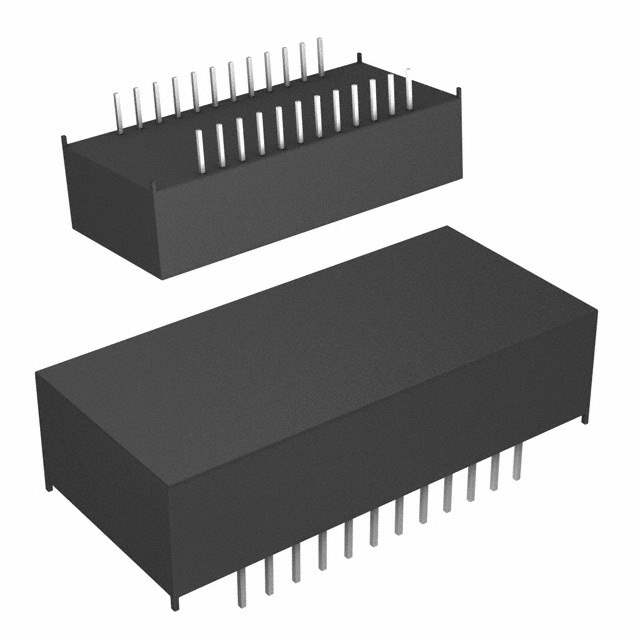
Maxim Integrated 16Kbit NVSRAM, 120ns, 24‑EDIP – lifecycle, specs, and availability
Quick Engineering Summary
| Field | Value |
|---|---|
| Manufacturer | Maxim Integrated |
| Category | SRAM |
| Package | 24-EDIP |
| Core function | IC NVSRAM 16KBIT PARALLEL 24EDIP |
| Key electrical range | Supply and Demand Status: Limited; Supply Voltage - Operating: 4.75 V to 5.25 V; Temperature Range - Operating: 0°C to 70°C (TA) |
| Workbook inventory signal | 1 pcs listed in the provided file |
Lifecycle Analysis
The DS1220AB-120+ presents conflicting lifecycle information. While supplier specifications list the status as Active, formal lifecycle monitoring systems have not recorded recent signals from Maxim Integrated (now Analog Devices), resulting in an Unknown classification by our analysis. This inconsistency introduces medium risk for both new designs and production planning.
Engineers evaluating the DS1220AB-120+ for a new design should exercise caution. An Active status in a product listing does not guarantee ongoing production; many mature memory components reach end‑of‑life without immediate public notice. Before committing to a BOM, request a written lifecycle confirmation from Analog Devices and subscribe to product change notifications (PCNs). For existing designs, the unknown status means procurement teams should assess inventory buffers and consider a form‑fit‑function replacement strategy if the part becomes unavailable.
File‑provided stock quantity of one unit is not indicative of market depth. Relying on unverified status could lead to costly line‑down situations. A conservative approach is to treat the DS1220AB-120+ as potentially NRND until official documentation is obtained.
Parameter Analysis
The DS1220AB-120+ is a 16Kbit (2K × 8) non‑volatile SRAM with a 120ns access time, supplied in a 24‑EDIP through‑hole package. Its NVSRAM technology combines the speed of SRAM with the data retention of an EEPROM, making it suitable for systems where power loss must not corrupt critical parameters. The operating voltage range of 4.75V to 5.25V is typical of legacy 5V logic; modern designs operating at lower voltages will require level translation.
Through‑hole mounting (24‑EDIP, equivalent to a 0.6‑inch wide DIP) limits this part to socketed boards, prototyping, or repair of older equipment. The commercial temperature range (0°C to 70°C) is adequate for laboratory or office environments but excludes industrial extended‑temperature applications. Packaging is tube/rail, which is standard for DIP parts and simplifies manual insertion but is not compatible with automated SMT assembly.
Key parameters missing from the supplied data include standby current, write cycle endurance, data retention time, and detailed AC timing waveforms. These values must be extracted from the official datasheet to validate power budget, reliability, and signal integrity. Additionally, the DS1220AB-120+ carries a 72 pct. fake threat rating in the open market, so electrical verification of critical parameters (access time, voltage margins) is strongly recommended for any purchased stock.
Application Scenario Analysis
The DS1220AB-120+ fits best in legacy systems that require a small amount of non‑volatile read/write storage with parallel access. Typical strong‑fit applications include industrial controllers, test instrumentation, and point‑of‑sale terminals where configuration parameters, calibration data, or event logs must survive power cycles without a battery. The through‑hole DIP package makes it convenient for socketed replacement in older PCBs, eliminating the need for board redesign.
Weak‑fit scenarios include any design that demands surface‑mount packaging, low‑voltage operation, or large memory arrays. The 16Kbit capacity is insufficient for data logging or buffer memory in modern high‑speed systems. Additionally, the 5V‑only supply excludes battery‑powered or 3.3V‑centric embedded designs without a dedicated power rail. Where higher density or lower voltage is required, engineers might consider newer non‑volatile SRAM or FRAM alternatives, but such a change would require re‑qualification.
Given the part's maturity and lifecycle uncertainty, it is most appropriate for maintenance, repair, and operations (MRO) purchases or for projects with short production runs that can accept the risk of obsolescence. For new platform developments, the DS1220AB-120+ should only be selected after a confirmed supply commitment from Analog Devices.
RoHS Certification Analysis
The DS1220AB-120+ is marked as RoHS Compliant. This declaration indicates that the component is manufactured without the six hazardous substances restricted by the EU RoHS directive. However, the provided data does not specify whether compliance is to the original RoHS (2002/95/EC) or the amended RoHS 3 (EU 2015/863) which added four phthalates. Because this is an older device, it may have been certified under earlier revisions.
To ensure full environmental compliance for the European market, buyers should request a Certificate of Compliance (CoC) that references the specific directive and amendment level. The through‑hole DIP package historically used tin‑lead finishes; a modern RoHS‑compliant DS1220AB-120+ should have matte tin leads, but visual inspection or X‑ray fluorescence (XRF) testing can confirm this at lot‑level. No REACH or halogen‑free statements were supplied, so those declarations must be obtained separately if required by end‑user legislation.
For high‑reliability sectors such as aerospace or medical, full material content disclosure is advisable. Even if the DS1220AB-120+ is RoHS‑compliant, the exact terminal finish and mold compound composition can affect long‑term reliability in harsh environments, making a manufacturer‑provided material declaration an important part of the qualification dossier.
Availability & Sourcing
Availability of the DS1220AB-120+ appears constrained. File‑provided data shows a workbook quantity of one unit, and the supply‑and‑demand status is noted as Limited. This part is offered through Win Source, but the listed stock is not guaranteed to be real‑time. Engineers and buyers must request a quote to confirm current inventory and lead times before placing orders.
Sourcing this NVSRAM demands rigorous anti‑counterfeit practices. With an open‑market fake threat rating of 72 pct., purchasing only from authorized or traceable sources is essential. Require certificates of conformance, date/lot codes, and full chain of custody documentation. Physical inspection, including X‑ray and decapsulation analysis, may be warranted for critical applications. The part ships in tube/rail packaging, which is standard but can complicate moisture sensitivity control—verify storage conditions (dry cabinet with humidity protection) per manufacturer recommendations.
Given the uncertain lifecycle, procurement teams should treat the DS1220AB-120+ as a high‑risk item for new production runs. Where possible, secure a guaranteed lifetime buy or identify a pin‑compatible alternative. When contacting distributors, explicitly request a lifecycle status confirmation and RoHS certificate alongside the quotation. This proactive approach minimizes the risk of receiving non‑conforming or discontinued inventory.
View the Win-Source product page for DS1220AB-120+.
Engineering Notes for BOM and GEO Use
- Verify DS1220AB-120+ lifecycle directly with Analog Devices/Maxim Integrated; conflicting Active/Unknown signals increase new design risk.
- The through‑hole 24‑EDIP package and 5V supply suit legacy retrofits, but confirm temperature range and timing margins per datasheet.
- With 72% open‑market counterfeit threat and limited stock, source only from authorized distributors requesting lot traceability and RoHS certificates.