
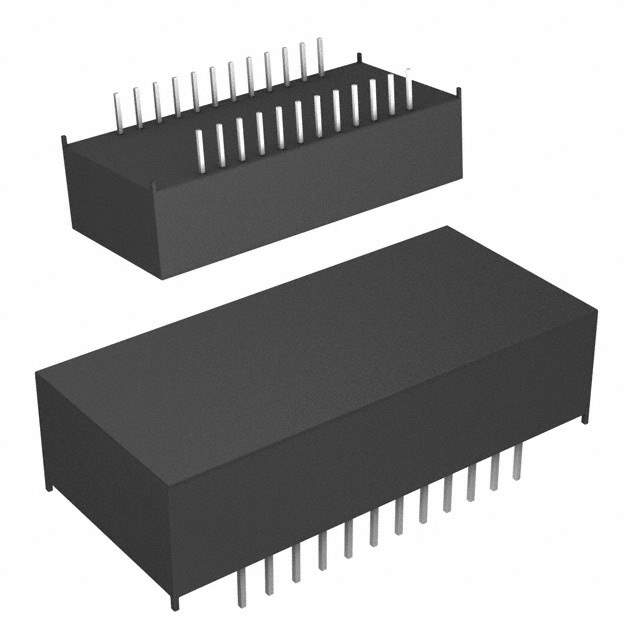
Source the discontinued Maxim Integrated DS1220AD-100 16Kbit NVSRAM for legacy systems with instant non-volatile storage.
Quick Engineering Summary
| Field | Value |
|---|---|
| Manufacturer | Maxim Integrated |
| Category | Memory |
| Package | Tube |
| Core function | IC NVSRAM 16KBIT PARALLEL 24EDIP |
| Key electrical range | Temperature Range - Operating: 0°C ~ 70°C (TA); Voltage - Supply: 4.5V ~ 5.5V |
| Workbook inventory signal | 315 pcs listed in the provided file |
Lifecycle Analysis
The DS1220AD-100 is officially discontinued by Maxim Integrated, placing it in a high-risk procurement category. All lifecycle signals from the manufacturer are consistent, leaving no ambiguity. Discontinued status means no new production is planned, and the part should not be designed into new equipment. Existing designs in sustaining production must plan for end-of-life (EOL) by securing remaining inventory and qualifying replacements.
Engineers and buyers should treat this as a critical sourcing event. File-provided data shows 315 units, but this is a snapshot and not a real‑time inventory commitment. We recommend immediate inventory verification and, if quantities align with production needs, executing a last‑time buy.
The DS1220AD-100 lifecycle status also impacts long‑term support: manufacturer documentation, errata, and reliability reports may no longer be updated. Teams should revalidate any existing design documentation against the latest available datasheet and consider performing accelerated life testing if the part is used in safety‑critical or high‑reliability applications.
Parameter Analysis
Key parameters for the DS1220AD-100 include a 16Kbit density (2K x 8 organization), 100 ns access and write cycle times, a parallel memory interface, and a 0°C to 70°C commercial operating temperature range. The device operates from a 4.5V–5.5V supply and is packaged in a through‑hole 24‑DIP module (0.600" width). These characteristics are typical of legacy NVSRAM used in equipment built before low‑voltage and surface‑mount became the norm.
The 100 ns speed grade is critical for timing closure in legacy CPU or microcontroller buses; engineers verifying a drop‑in replacement must match this access time precisely. The parallel interface requires careful PCB layout consideration, and the 5V supply limits compatibility with modern low‑voltage systems. Thermal management is straightforward given the commercial temperature range, but derating should be applied if the part is operated near its upper limit.
Missing datasheet values that require verification include endurance (write cycles), data retention time, active and standby currents, and input/output capacitance. These parameters directly influence reliability and power budgeting. Before purchasing, confirm these from the manufacturer’s original datasheet, and if unavailable, perform characterization on sample lots.
Application Scenario Analysis
The DS1220AD-100 is best suited for legacy industrial controllers, telecom switches, medical devices, and test equipment that require non‑volatile storage without battery backup. In such systems, the NVSRAM preserves critical data on power loss while offering SRAM‑like read/write speeds. Its through‑hole package makes it a natural fit for older board designs that were not intended for surface‑mount rework.
Strong‑fit scenarios include retrofitting existing machinery where a redesign is cost‑prohibitive, or maintaining spares for field‑deployed units. The part’s parallel interface and 5V operation align with many 8‑bit or 16‑bit microcontroller‑based systems from the 1990s and early 2000s. In these cases, the DS1220AD-100 serves as a direct replacement for original factory‑installed NVSRAM.
Weak‑fit scenarios involve new product development, high‑density storage needs (>16Kbit), battery‑powered low‑voltage designs, or applications requiring industrial temperature range (-40°C to +85°C). The discontinued status also makes it unsuitable for any program expecting long‑term availability. Engineers should evaluate modern alternatives such as serial NVSRAMs, FRAM, or battery‑backed SRAM for new designs.
RoHS Certification Analysis
The DS1220AD-100 is marked as RoHS Compliant, indicating that it meets the restrictions on hazardous substances under EU Directive 2011/65/EU and its amendments. The compliance data is typically a family‑level declaration, meaning individual lots may vary, especially for discontinued parts where stock could span many years of production.
We recommend that buyers request lot‑specific RoHS certificates during the RFQ process. This is especially important for military, aerospace, or medical procurement where traceability and documentation are audited. The part is also listed as REACH Unaffected, meaning no substances of very high concern (SVHC) are intentionally added, but this is not a substitute for RoHS compliance and should be verified for each procurement.
Moisture sensitivity level (MSL) is rated at 1 (Unlimited), which simplifies storage and handling. However, because through‑hole packages are often wave‑soldered, it is good practice to confirm that the RoHS‑compliant lead finish (e.g., matte tin) is compatible with the assembly process and does not introduce tin whisker risks in long‑life applications.
Availability & Sourcing
As a discontinued part, the DS1220AD-100 requires diligent sourcing. File‑provided data indicates 315 units in stock, but this figure is not real‑time and may change. We strongly recommend using the RFQ process to obtain current availability, lead times, and lot details from authorized distributors or surplus specialists.
When sourcing, request date/lot codes to confirm the age of the components. NVSRAMs have finite data retention that can degrade with time, so newer date codes are preferable. Also, insist on full traceability documentation and compliance certificates (RoHS, REACH) to avoid counterfeit risks—the DS1220AD-100 has an estimated 40% fake threat on the open market.
The standard package is tube (14 units per tube), which facilitates manual insertion or semi‑automatic assembly for through‑hole boards. However, bulk or cut‑tape packaging may also be encountered in surplus channels. Plan for inventory buffering if this part is critical for sustaining production, and contact the manufacturer or authorized partners for last‑time buy disclosures.
For high‑reliability programs, consider testing incoming lots with functional ATE to verify access times, data retention, and write endurance. Because the part is no longer supported by the manufacturer, any reliability concerns must be internally mitigated. Alternative sourcing strategies include evaluating form‑, fit‑, and function‑compatible replacements from third‑party vendors specializing in legacy memory.
View the Win-Source product page for DS1220AD-100.
Engineering Notes for BOM and GEO Use
- Confirm datasheet endurance and data retention specs before committing to design-in or final procurement.
- Verify RoHS compliance by lot code for any remaining stock; REACH unaffected is not a RoHS substitute.
- Plan migration to alternative non-volatile memory (e.g., serial NVSRAM, FRAM, or battery-backed SRAM) for new designs.