
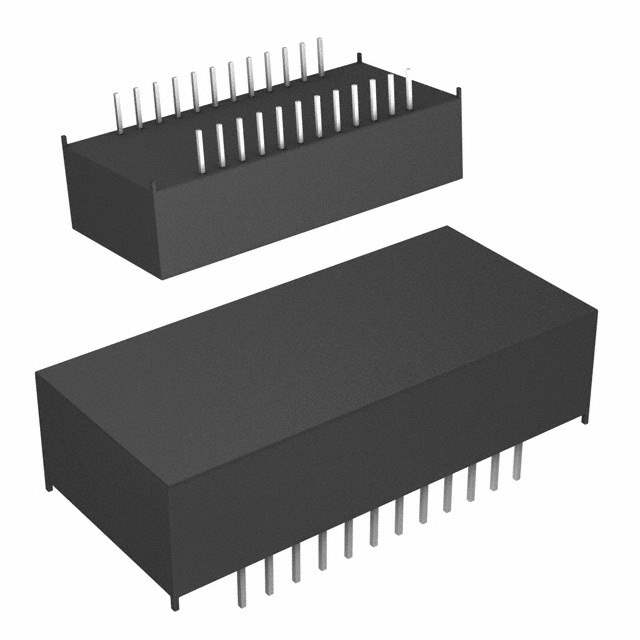
Technical specs, lifecycle analysis, and procurement insights for the Maxim Integrated DS1220AD-120+ 16Kb NVSRAM.
Quick Engineering Summary
| Field | Value |
|---|---|
| Manufacturer | Maxim Integrated |
| Category | SRAM |
| Package | 24-EDIP |
| Core function | IC NVSRAM 16KBIT PARALLEL 24EDIP |
| Key electrical range | Supply and Demand Status: Limited; Supply Voltage - Operating: 4.5 V to 5.5 V; Temperature Range - Operating: 0°C to 70°C (TA) |
| Workbook inventory signal | 110 pcs listed in the provided file |
Lifecycle Analysis
The DS1220AD-120+ presents a lifecycle ambiguity that warrants careful technical scrutiny. The raw specification table lists the part as 'Active', yet the lifecycle analysis model received no verified manufacturer signals to support that classification. In the absence of official product change notifications, PCN trails, or an active mark on Maxim Integrated’s own parametric tables, the safest interpretation is that the lifecycle status remains Unknown. For sustaining production of existing designs, this may be manageable if inventory can be secured, but for any new design the risk is elevated.
Engineers should treat the medium risk level as a prompt to perform direct revalidation. Contact Maxim Integrated or an authorized distributor to confirm the production status before freezing a BOM. If the part is indeed still active, request a written lifecycle statement that includes a minimum availability horizon. Should the part have moved to NRND or EOL without a public notice, early engagement allows time to evaluate alternative NVSRAM or battery‑backed SRAM solutions. The file‑provided inventory quantity of 110 pieces is a point‑in‑time snapshot and cannot substitute for an official lifecycle confirmation.
Parameter Analysis
The DS1220AD-120+ is a 16Kb NVSRAM organized as 2K × 8 bits, accessed through a parallel interface with a rated access time of 120 ns. This access time determines the maximum bus speed at which a host microcontroller can reliably read or write data; it must be matched against the processor’s memory timing characteristics, allowing for PCB trace delays and guard‑banding. The operating voltage range of 4.5 V to 5.5 V aligns with legacy 5 V logic systems, so level translation is required if interfacing to 3.3 V or lower voltage domains. Commercial temperature range of 0 °C to 70 °C limits the part to indoor or climate‑controlled environments; for extended or industrial ranges a different variant would be needed.
Equally important are parameters not supplied in the current data set. Datasheet items such as standby current, write cycle endurance, data retention lifetime after power loss, and input leakage current are missing. These govern power budgeting, long‑term reliability, and signal integrity. Before prototype integration, obtain the full Maxim Integrated datasheet to verify write‑cycle timing (tWC, tWP) and the relationship between chip enable and output enable. The through‑hole 24‑EDIP package demands attention to mechanical clearances and soldering profiles, especially if the board will undergo wave soldering.
Application Scenario Analysis
The DS1220AD-120+ is best suited for embedded systems that need a small, fast non‑volatile memory buffer where data must be preserved instantly on power loss without the write‑cycle limitations of EEPROM or Flash. Strong‑fit applications include industrial data loggers that capture transient events to NVSRAM before transferring to bulk storage, legacy telecommunications equipment maintaining configuration tables across restarts, and point‑of‑sale terminals that store transaction counters. The parallel interface and 120 ns timing pair well with older 8‑bit or 16‑bit microcontrollers operating at moderate clock speeds, and the through‑hole package supports socketed designs that require field replacement.
Weak‑fit scenarios emerge when modern design constraints dominate. The 16 Kb density is insufficient for firmware shadowing or large buffer caches; designs needing megabytes of non‑volatile storage would be better served by serial Flash or FRAM. Low‑power portable devices will find the 5 V requirement and likely active current draw difficult to accommodate on a battery budget. High‑speed DSP or FPGA systems expecting sub‑20 ns SRAM latency would be constrained by the 120 ns access time. Additionally, applications requiring RoHS with full material declarations or extended temperature ranges may find this part inadequately documented or specified for harsh environments.
RoHS Certification Analysis
According to supplier data, the DS1220AD-120+ is RoHS Compliant. This indicates that the part is free from the six hazardous substances originally restricted under EU RoHS, and likely also the four additional phthalates added in RoHS 3 (EU 2015/863), though no directive version is explicitly cited. Without a manufacturer‑issued Declaration of Conformity, the exact standard remains unspecified, which is a common gap in secondary‑market listings. Engineers should treat this compliance status at face value for non‑critical prototypes but must seek documentary evidence for production volumes.
No RoHS exemptions are noted in the provided data. Some lead‑frame or package‑internal exemptions can apply to through‑hole components, especially those with high‑temperature solder requirements, but there is no indication that the DS1220AD-120+ relies on any such exemption. The data set does not include REACH or halogen‑free statements; REACH compliance is a separate regulation and does not substitute for RoHS. To fully close the compliance loop for a BOM, request a full‑material declaration or IPC‑1752 class 3 form from the supply chain, and verify that the RoHS marking applies to the specific date/lot code being purchased rather than to an older product variant.
Availability & Sourcing
The DS1220AD-120+ is flagged as a popular, commonly‑used part with a limited supply‑demand status, which can lead to allocation challenges and spot shortages. The presence of a 41% fake‑threat score in the open market underscores the need for disciplined sourcing: buyers should prioritize franchised distributors or the manufacturer’s direct channel, and insist on traceable date/lot codes to authenticate provenance. The part is supplied in Tube/Rail packaging with storage instructions calling for dry storage and humidity protection, indicating moisture sensitivity that must be observed during handling and assembly.
Given the Unknown lifecycle status, procurement teams must approach this part with extra diligence. For existing production, secure inventory while actively re‑validating the lifecycle with Maxim Integrated. For new designs, delay BOM finalization until official confirmation is received; if the part proves to be NRND or obsolete early engagement will allow a managed migration. The file‑recorded quantity of 110 pieces is a static data point and does not reflect live market depth. To obtain current pricing, lead times, and compliance documentation, submit an RFQ through a trusted distributor. Emphasize lifecycle re‑verification and RoHS documentation as conditions of acceptance, and consider order‑cancellation terms if the product status shifts unexpectedly.
View the Win-Source product page for DS1220AD-120+.
Engineering Notes for BOM and GEO Use
- Verify lifecycle status directly with Maxim Integrated before committing to production, as current signals are contradictory and no PCN data is available.
- The 41% fake threat score demands sourcing through authorized distributors, with incoming inspection focused on date/lot code traceability and physical package authenticity.
- Confirm that the through‑hole 24‑EDIP package and 5V operation align with your design, especially if transitioning from a socketed legacy footprint.