
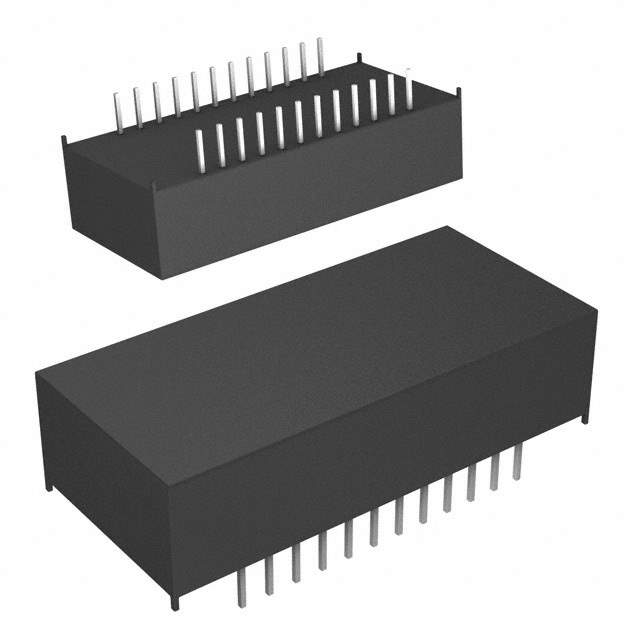
Maxim Integrated DS1220AD-150+ is an active non-volatile SRAM offering 16Kb capacity with 150ns access time in a through-hole 24-EDIP package.
Quick Engineering Summary
| Field | Value |
|---|---|
| Manufacturer | Maxim Integrated |
| Category | SRAM |
| Package | 24-EDIP |
| Core function | IC NVSRAM 16KBIT PARALLEL 24EDIP |
| Key electrical range | Operating Supply Voltage: 4.5 V ~ 5.5 V; Operating Temperature Range: 0°C ~ 70°C (TA); Supply and Demand Status: Balance |
| Workbook inventory signal | 1060 pcs listed in the provided file |
Lifecycle Analysis
The DS1220AD-150+ is currently listed as Active by Maxim Integrated, indicating the part is in full production and supported for new designs. This lifecycle status suggests stable supply and ongoing manufacturer support, making it suitable for both prototyping and production runs. However, the data also includes an estimated EOL date of 2025, which implies that Maxim may transition this part to NRND or EOL within the next few years. Engineers planning long-lifecycle products should contact Maxim directly to confirm the production roadmap and avoid surprises.
File-reported inventory of 1060 units exists, but this is not a real-time guarantee. The supply-and-demand status is balanced, and factory lead times should be verified during procurement. For high-volume production, early engagement with authorized distributors is recommended to secure allocation and mitigate any future EOL risk.
Parameter Analysis
Key decision-driving parameters for the DS1220AD-150+ include its 150ns access time, 16Kb (2K x 8) density, NVSRAM technology, parallel interface, and through-hole 24-EDIP package. The 150ns access time is critical for system timing closure; designers must ensure their memory controller can meet setup and hold requirements at this speed grade. NVSRAM integrates an EEPROM shadow array that automatically saves SRAM content on power-down, eliminating the need for external batteries and ensuring data integrity across power cycles—a primary value proposition over standard SRAM.
The 4.5V–5.5V supply range matches legacy 5V systems, and the commercial temperature range (0°C to 70°C) limits use to indoor or benign environments. The through-hole DIP package suits prototyping, repair, and through-hole assembly lines but is not suitable for space-constrained SMT designs. Critical missing datasheet specifications include NVSRAM data retention time, write endurance cycles, and active/standby current. These should be verified directly from the Maxim Integrated datasheet for power budget and reliability calculations.
Application Scenario Analysis
The DS1220AD-150+ is well suited for applications requiring a small non-volatile memory with fast parallel access and automatic data retention without a battery. Strong-fit scenarios include parameter storage in industrial controllers, configuration tables in RAID adapters, event logs in gaming machines, and non-volatile scratchpad memory in medical devices. Its through-hole DIP form factor makes it particularly attractive for legacy system maintenance, development boards, and environments where socketed or hand-soldered parts are preferred.
Weak-fit scenarios encompass high-density memory arrays where larger SMT NVSRAM or FRAM options offer better board utilization, and high-vibration or extended-temperature environments that demand industrial or automotive-grade ratings. The commercial temperature range (0°C to 70°C) further restricts outdoor or factory-floor applications without supplemental thermal management. If the design must operate outside this range, engineers should evaluate whether an extended-temperature version exists or consider alternative memory technologies.
RoHS Certification Analysis
The DS1220AD-150+ is marked as RoHS Compliant, indicating that it meets the substance restrictions of the EU RoHS directive. The data provided does not specify the exact directive revision, but for current EU market access, RoHS 3 (2015/863) compliance is typically expected. No exemptions are noted, which is common for a through‑hole DIP module as these usually avoid problematic exemptions. However, this certification is likely declared at the family level, and lot‑level compliance may vary.
No REACH or halogen‑free data is included in the source information. For applications requiring full material declaration (e.g., medical or aerospace), purchasers should request a certificate of compliance and verify that the specific production lot meets all required environmental standards. The lack of REACH information is not a substitute for RoHS and should be addressed separately if the design requires REACH SVHC documentation.
Availability & Sourcing
File‑reported inventory shows 1060 units of the DS1220AD-150+ available in tube packaging with dry storage conditions. This stock level is not guaranteed real‑time and should be confirmed with the distributor before placing orders. The part is currently listed as Active with a balanced supply‑and‑demand status, suggesting that standard lead times apply. To obtain current pricing and availability, request a quote from a Maxim Integrated authorized distributor.
With a counterfeit threat rating of 67% on the open market, procurement teams must exercise stringent sourcing practices. Always purchase through franchised or authorized channels, and insist on full traceability documentation including date/lot codes and manufacturer certificates. Given the estimated EOL date of 2025, for long‑term production consider securing a buffer stock or discussing last‑time buy options with Maxim. Incoming quality inspection should include visual and electrical verification to mitigate counterfeit risk.
View the Win-Source product page for DS1220AD-150+.
Engineering Notes for BOM and GEO Use
- Confirm data retention specifications directly from the Maxim datasheet; NVSRAM endurance and retention determine mission-critical reliability.
- The through-hole 24-DIP package requires adequate PCB clearance and may limit high-density designs; verify mechanical fit.
- High counterfeit risk (67%) makes authorized sourcing and incoming inspection essential; request traceability from the distributor.