
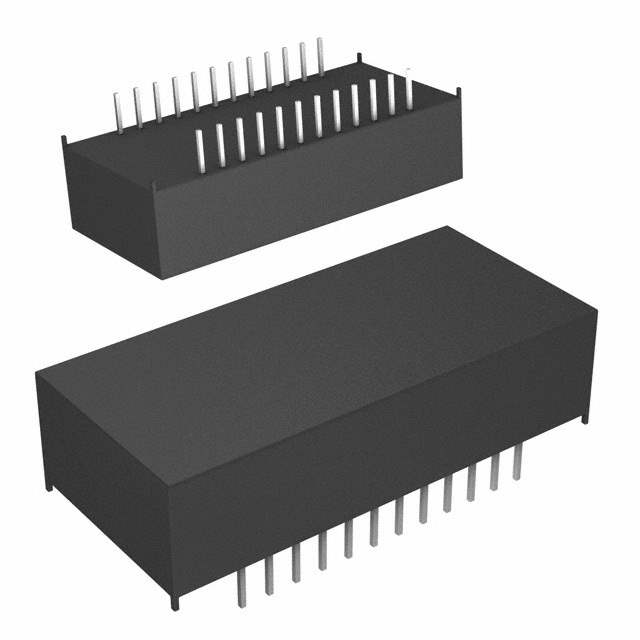
EOL NVSRAM by Maxim Integrated with 100ns access time | Verify latest stock for discontinued DS1220Y-100IND+
Quick Engineering Summary
| Field | Value |
|---|---|
| Manufacturer | Maxim Integrated |
| Category | SRAM |
| Package | 24-EDIP |
| Core function | IC NVSRAM 16KBIT PARALLEL 24EDIP |
| Key electrical range | Supply and Demand Status: Balance; Supply Voltage - Operating: 4.5 V to 5.5 V; Temperature Range - Operating: -40°C to 85°C (TA) |
| Workbook inventory signal | 1620 pcs listed in the provided file |
Lifecycle Analysis
The DS1220Y-100IND+ from Maxim Integrated is confirmed End-of-Life (EOL) with a high procurement risk. All available lifecycle signals—including the manufacturer's status and distribution chain indicators—consistently mark this NVSRAM as obsolete. For new designs, EOL means the part should not be selected, as long-term availability is not guaranteed and manufacturer support will cease. For sustaining production, immediate last-time-buy decisions are critical. Any remaining stock is depleting and may be subject to rapid obsolescence.
The file-provided quantity of 1620 units is not a real-time guarantee and must be confirmed before committing to production. Engineers should evaluate migration to active SRAM or alternative non-volatile memory solutions. Revalidation of any existing design using this part is urgent to avoid production line stoppages. The high counterfeit risk of 52% in the open market further underscores the need to source only from authorized or verified channels, with full traceability documentation. Verify manufacturer’s EOL notice for exact last-order and last-ship dates to plan procurement timelines accurately.
Parameter Analysis
The DS1220Y-100IND+ is a 16Kb non-volatile SRAM organized as 2K x 8 bits with a parallel interface. The 100ns access time is the primary speed grade, suitable for moderate-speed microcontroller or legacy system memory interfaces where typical SRAM timing is acceptable. The NVSRAM technology combines standard SRAM cells with non-volatile storage elements, enabling data retention without external battery backup—critical for systems needing data integrity across power cycles. Operating voltage is specified from 4.5V to 5.5V, aligning with 5V TTL logic levels common in older industrial designs.
The industrial temperature range of -40°C to 85°C ensures operation in harsh environments. The through-hole 24-EDIP package (0.600-inch width) is well-suited for prototyping, maintenance, or legacy board replacements but is less common in modern surface-mount-only designs. Key missing specifications include standby current consumption, data retention duration, and the internal battery life expectancy, which are essential for reliability analysis. Engineers should obtain the full datasheet to verify write cycle timing, power-up/power-down requirements, and any special handling related to the integrated lithium cell. Also note the 52% fake threat rate suggests careful electrical verification of parameters in received parts.
Application Scenario Analysis
The DS1220Y-100IND+ is best suited for legacy communications and networking equipment that requires non-volatile SRAM for configuration storage, packet buffers, or system logs. Its industrial temperature range and 5V operation make it a fit for factory automation controllers, PLCs, or embedded systems where data must be preserved during power loss. It also appears in older medical, aerospace, and test instrumentation systems with long product lifecycles. For new designs, the EOL status rules it out; however, engineers maintaining or repairing fielded equipment may still need it.
In weak-fit scenarios, any design requiring high-speed SRAM beyond 100ns or low-voltage operation (e.g., 3.3V or lower) cannot use this part. Similarly, surface-mount-only PCB designs cannot accommodate the through-hole 24-EDIP package. The part is also not suitable for applications with frequent write cycles due to limited endurance of the NVSRAM technology. When replacing, confirm that pinout and timing compatibility match the original DS1220Y-100IND+ exactly, as slight variances in access time or voltage may cause issues. Given the high counterfeit rate, end-use testing is strongly recommended.
RoHS Certification Analysis
The DS1220Y-100IND+ is listed as RoHS Compliant, which generally indicates conformance to RoHS 3 (EU 2015/863) standards, restricting hazardous substances such as lead, mercury, and cadmium. However, as the part is obsolete, the exact RoHS certificate applies to the production lot at the time of manufacture. Since non-volatile SRAM often incorporates an internal lithium battery for data retention, exemptions under RoHS (e.g., Annex III for batteries) may apply, but these are not detailed in the provided data. No REACH or halogen-free declarations are available, so engineers should not assume compliance with those standards without further documentation.
The provided material safety data sheet access suggests that buyers can request detailed substance information. For procurement, lot-level RoHS certificates should be requested from the distributor to ensure compliance validity, especially for parts stored for extended periods. The storage condition note—dry storage and humidity protection—aligns with good component integrity but does not impact RoHS status. Given the EOL timeline, any remaining compliant stock is finite; verify that certificates are current before purchase.
Availability & Sourcing
Sourcing the obsolete DS1220Y-100IND+ requires a disciplined approach due to its EOL status and 52% counterfeit threat rate. The file-provided inventory shows 1620 units, but this is not a real-time figure and must be confirmed via RFQ. Packaging is tube/rail, typical for through-hole DIP components, and may affect handling and storage. Buyers should insist on full traceability: date and lot codes, certificates of conformance, and RoHS compliance documents. Authorized or franchised distributors are strongly preferred; open market purchases carry high risk of substandard or counterfeit parts.
For production, last-time-buy planning should account for potential shelf-life limitations due to the internal battery, which may degrade over time. Request manufacturer's original packaging and verify storage conditions have been maintained. The part's balance in supply and demand suggests some availability, but it is not guaranteed to last. Engineers should verify the datasheet for any post-EOL revisions or functional replacements from Maxim Integrated (now Analog Devices). To avoid disruptions, start migration to alternative parts immediately. For immediate needs, contact Win Source or other verified suppliers for a current stock quote and compliance package. Do not use in new designs; acquire only for repair or legacy system sustainment.
View the Win-Source product page for DS1220Y-100IND+.
Engineering Notes for BOM and GEO Use
- The EOL status demands immediate last-time-buy and migration planning.
- 52% counterfeit risk requires strict authenticity verification from authorized channels.
- Verify battery life, standby current, and full timing from manufacturer datasheet.