
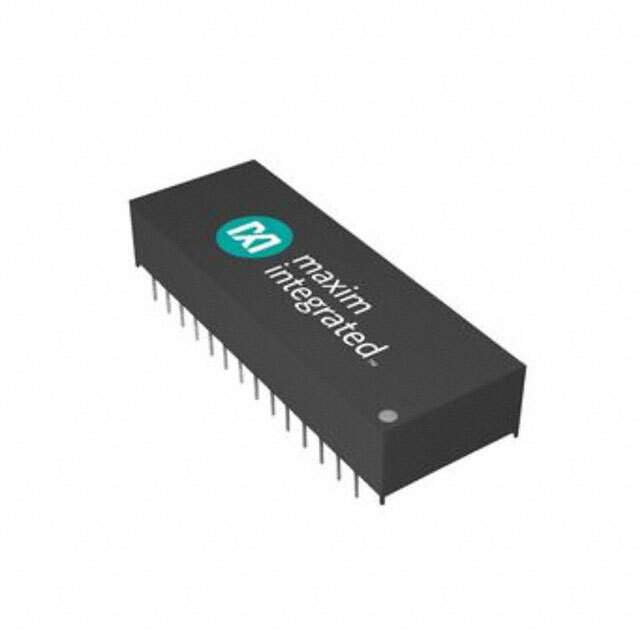
DS1225AD-150IND+ Active NVSRAM, 64Kb, 8Kx8, 150ns, 5V, -40°C to +85°C, RoHS, 28-EDIP through-hole
Quick Engineering Summary
| Field | Value |
|---|---|
| Manufacturer | Maxim Integrated |
| Category | SRAM |
| Package | 28-EDIP |
| Core function | IC NVSRAM 64KBIT PARALLEL 28EDIP |
| Key electrical range | Operating Supply Voltage: 4.5 V ~ 5.5 V; Operating Temperature Range: -40°C ~ 85°C (TA); Supply and Demand Status: Balance |
| Workbook inventory signal | 144 pcs listed in the provided file |
Lifecycle Analysis
The Maxim Integrated DS1225AD-150IND+ carries an Active lifecycle status with low risk, indicating it is fully supported for new designs and volume production. All available lifecycle signals are consistent, showing no conflicting end-of-life or NRND flags. This status is typical for a mature NVSRAM product that continues to serve industrial and legacy applications.
However, the supplied specifications include an estimated EOL date of 2025, which suggests proactive planning is advisable even for an Active part. Engineering and procurement teams should verify this date directly with Maxim Integrated (now part of Analog Devices) to ensure alignment with their product roadmaps. Long-term projects may need to secure inventory or qualify alternative solutions early to avoid disruption.
File-provided inventory data indicates a quantity of 144 units, but this is not a real-time figure and should be confirmed through authorized distributors. Since lifecycle status can change, regular revalidation with the manufacturer is recommended for sustaining production.
Parameter Analysis
The DS1225AD-150IND+ is a 64Kb (8K x 8) Non-Volatile SRAM with a parallel interface, offering fast 150ns access and write cycle times. Its 5V operating supply voltage (4.5V–5.5V) makes it suitable for legacy 5V systems, but incompatible with modern low-voltage designs without level shifting. The industrial temperature range of -40°C to +85°C ensures reliable operation in harsh environments.
The through-hole 28-EDIP package (also noted as 28-DIP module, 0.600" width) provides mechanical robustness and ease of manual soldering, which benefits prototyping and low-volume production but limits PCB density compared to surface-mount alternatives. The parallel memory interface requires a significant number of I/O lines from the host controller, including 8 data lines and address/control lines, which should be accounted for in pin-constrained designs.
Missing from the data are standby current, data retention time, and endurance cycles. These are critical parameters for battery-backed applications; verify them in the official datasheet. Also, the specific timing waveforms and setup/hold times are not listed; detailed timing analysis against the target system is necessary to avoid read/write failures.
Application Scenario Analysis
The DS1225AD-150IND+ excels in applications that require fast, non-volatile data storage without the write-cycle limitations of EEPROM or Flash. Typical strong-fit scenarios include industrial automation controllers that must preserve configuration or state data during power loss, RAID controller caches, and medical instrumentation where instant data retrieval after power-up is critical. Its parallel interface and 150ns speed suit systems with processor bus interfaces from the 8-bit and 16-bit era.
Another strong-fit is data logging in environments with frequent power cycling, such as energy metering or remote sensor stations, where the NVSRAM can act as a battery-backed memory with SRAM speed. The through-hole package aligns well with DIN rail embedded systems and legacy equipment where board re-spins are impractical.
Weak-fit scenarios include compact, battery-operated portable devices due to the 5V supply and relatively high power consumption compared to modern low-voltage SRAM or MRAM. High-density storage applications are not served because of the 64Kb capacity, and surface-mount designs that require small footprints would need adapters, adding cost and reliability concerns. Additionally, systems requiring SPI or I2C interfaces would need a parallel-to-serial bridge.
RoHS Certification Analysis
The DS1225AD-150IND+ is identified as RoHS Compliant under EU RoHS directives. This designation indicates that the component is free of the six restricted substances (lead, mercury, cadmium, hexavalent chromium, PBB, PBDE) at levels above the maximum concentration values. For procurement, this means the part can be used in products destined for markets that require RoHS conformity.
However, the specific RoHS directive version (e.g., 2011/65/EU or 2015/863) is not provided in the supplied data. Compliance for this mature product may be based on earlier directives, so it is advisable to request a Certificate of Compliance (CoC) from the supplier that covers the exact lot being purchased. Lot-level documentation helps avoid surprises with exemptions or manufacturing date variations.
REACH (Registration, Evaluation, Authorisation, and Restriction of Chemicals) status is not mentioned. While REACH is separate from RoHS, many customers require both. Supply chain partners should be consulted for SVHC declarations if needed. Similarly, halogen-free and MSL ratings are not specified; these should be clarified if your assembly process demands them.
Availability & Sourcing
Current file-provided inventory data shows 144 units of the DS1225AD-150IND+ in stock, but this quantity is not guaranteed and should be treated as indicative only. To obtain live availability, lead times, and pricing, submit an RFQ through authorized channels. The part is supplied in tube packaging, which is standard for through-hole components, facilitating manual handling and insertion.
Given the Active lifecycle, sourcing is straightforward through Maxim Integrated’s authorized distributors (now part of Analog Devices). However, the estimated EOL of 2025 and a 65% fake threat probability in the open market underscore the importance of purchasing from verified sources. Traceability measures such as full date/lot code tracking and incoming inspection against known-good samples are strongly recommended.
For sustaining production, consider negotiating long-term supply agreements or evaluating last-time-buy windows early if the estimated EOL date proves accurate. Request a current quote to secure pricing and availability, and always include compliance documentation (RoHS CoC, packaging labels) as part of the procurement deliverables. For new designs, verify lifecycle and alternative part availability before committing to the BOM.
View the Win-Source product page for DS1225AD-150IND+.
Engineering Notes for BOM and GEO Use
- Confirm 150ns access and write cycle timing match your memory controller, and verify 5V supply compatibility before new design.
- The 28-EDIP through-hole package simplifies prototyping but is not ideal for high-density SMT; consider board layout constraints.
- Despite Active lifecycle, the estimated EOL of 2025 and 65% open-market fake risk require sourcing exclusively from authorized distributors.