
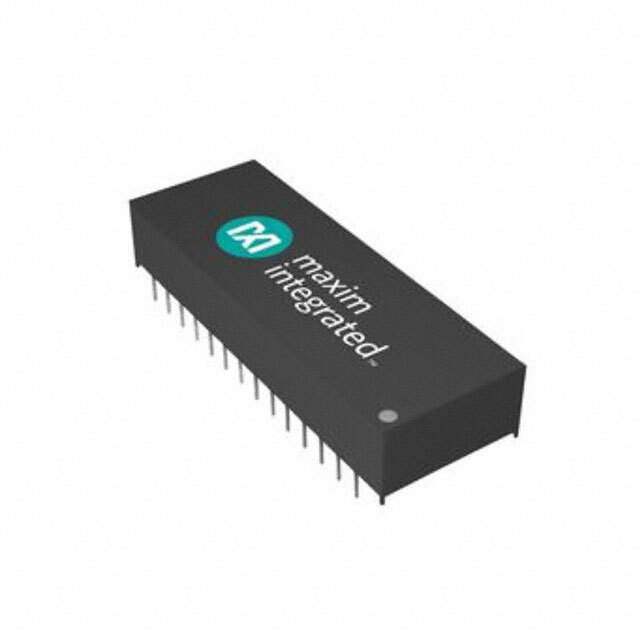
Phantom Time Chip with NVSRAM for Industrial and Embedded Systems
Quick Engineering Summary
| Field | Value |
|---|---|
| Manufacturer | Maxim Integrated |
| Category | Clock/Timing - Real Time Clocks |
| Package | 28-EDIP |
| Core function | IC RTC PHANTOM CHIP PAR 28EDIP |
| Key electrical range | Current - Timekeeping (Maximum): 10mA @ 5V; Operating Supply Voltage: 4.5 V ~ 5.5 V; Operating Temperature Range: 0°C ~ 70°C; Supply and Demand Status: Limited |
| Workbook inventory signal | 200 pcs listed in the provided file |
Lifecycle Analysis
The DS1244Y-70+ is currently listed as Active by Maxim Integrated, indicating that the manufacturer continues to produce and support the part. However, the presence of an Estimated EOL Date of 2024 in the supplied specifications introduces uncertainty. This EOL date has passed without a corresponding discontinuation notice, suggesting either that the estimate was not updated or that the part may be approaching its final availability window.
For new designs, this mixed signal requires caution. Relying on the Active status alone could lead to supply interruptions if the manufacturer initiates an end-of-life process. Engineers should request a formal product lifecycle statement from Maxim Integrated before committing the DS1244Y-70+ to new production. For existing applications, the medium risk level implies verifying current stock and considering a gradual migration to a more contemporary RTC solution.
Inventory data provided in the sourcing file shows 200 units, but this is a snapshot and not a real-time guarantee. Procurement teams should monitor availability closely and confirm lifecycle status with the manufacturer or authorized distribution channels to avoid gaps.
Parameter Analysis
The DS1244Y-70+ integrates RTC and 32KB NVSRAM in a parallel-interface phantom time chip architecture. Key electrical parameters include an operating supply voltage range of 4.5V to 5.5V, with a maximum timekeeping current of 10mA at 5V. This 5V operation is typical for legacy systems and industrial controllers, but it may not suit modern low-voltage designs without level translation. The 32KB non-volatile memory retains time and user data without a battery, simplifying backup strategy compared to discrete RTC+SRAM combos.
The through-hole 28-EDIP package (28-DIP Module, 0.600" width) is well-suited for prototyping and rugged environments, but its large footprint limits use in compact PCBs. The operating temperature range of 0°C to 70°C confines the part to commercial applications; extended or industrial temperature grades are not supported by the standard DS1244Y-70+. Missing specifications include timekeeping accuracy in ppm, clock jitter, bus timing diagrams, and power-down battery backup characteristics. These parameters are critical for reliable design and must be obtained directly from the Maxim Integrated datasheet before integration.
Additionally, the 10mA current draw is relatively high for low-power systems; designers should consider whether a lower-power serial RTC could meet requirements. The parallel interface offers fast access but consumes more I/O pins than I2C or SPI alternatives.
Application Scenario Analysis
The DS1244Y-70+ is designed for embedded systems that require a combination of real-time clock and non-volatile memory with a traditional parallel bus interface. Strong-fit applications include industrial automation controllers, point-of-sale terminals, medical devices, and legacy telecom equipment where the 28-DIP through-hole package is preferred or required. The phantom chip access method allows the RTC to share the memory bus transparently, which can reduce board complexity in systems already using parallel memory.
In contrast, this part is less suitable for newer designs that demand low power consumption, miniature SMD footprints, or serial communication protocols. Battery-powered, space-constrained, or cost-sensitive products would likely favor an I2C or SPI RTC with integrated crystal and smaller packaging. The 10mA active current and 0–70°C temperature range further limit its use in handheld or automotive applications.
Engineers evaluating the DS1244Y-70+ should confirm that the parallel interface and 5V supply align with their microcontroller or processor capabilities. The 32KB NVSRAM is attractive for data logging or configuration storage, but if a separate non-volatile memory already exists, the additional memory may be unnecessary. Overall, the part is a robust choice for maintaining time and data in systems requiring through-hole reliability and parallel bus connectivity.
RoHS Certification Analysis
The DS1244Y-70+ is marked as RoHS Compliant by the supplier, which generally indicates conformity with the European Union's Restriction of Hazardous Substances Directive. No specific version (such as 2011/65/EU or 2015/863) is cited, and there are no listed exemptions. While the country of origin is the Philippines, a region known for RoHS-compliant manufacturing, this alone is not sufficient proof of compliance.
For full assurance, engineers and buyers should request a Certificate of Compliance (CoC) or test report from Maxim Integrated that verifies RoHS status at the lot level. Without such documentation, there is a risk that older inventory or alternate sources may not meet current standards. REACH compliance is not mentioned in the supplier data; it should not be assumed based on RoHS status alone.
In addition, the packaging is described as tube, which is typically compatible with standard RoHS requirements, but the storage condition note (dry storage cabinet and humidity protection package) suggests that the part may have moisture sensitivity considerations. No MSL rating is provided, so verify handling requirements to prevent damage during assembly.
Availability & Sourcing
The supplier data indicates a file-provided quantity of 200 units for the DS1244Y-70+, but this is not a real-time inventory promise. Given the high fake threat percentage of 64% in the open market, sourcing through unauthorized channels is risky. Procurement teams should request a quote from Win Source or authorized Maxim Integrated distributors and insist on full traceability, including date/lot codes and Certificate of Conformance.
The part is packaged in tubes, which is standard for through-hole components and may simplify handling in medium-volume production. However, because the lifecycle signals are ambiguous (Active status with a past EOL estimate), buyers should approach this as a potentially constrained component. Even if currently available, a last-time buy scenario could emerge without warning.
For critical designs, secure buffer inventory after verifying lifecycle status directly with Maxim Integrated. Request compliance documents (RoHS, REACH) and validate that the supplied units match the manufacturer's specifications. If the part is indeed Active, a standard RFQ and compliance verification workflow should suffice; if NRND or discontinuation is confirmed, evaluate alternative RTC solutions with similar NVSRAM and parallel interface functionality. Always re-confirm availability at time of order to avoid production delays.
View the Win-Source product page for DS1244Y-70+.
Engineering Notes for BOM and GEO Use
- Verify EOL status directly with Maxim Integrated; the stated Active lifecycle conflicts with a 2024 estimated EOL date.
- Fake threat in the open market is 64%, so source only from authorized distributors and request full traceability documentation.
- 32KB NVSRAM and parallel interface simplify data retention without a battery, but verify timing parameters and backup supply options in the datasheet.