
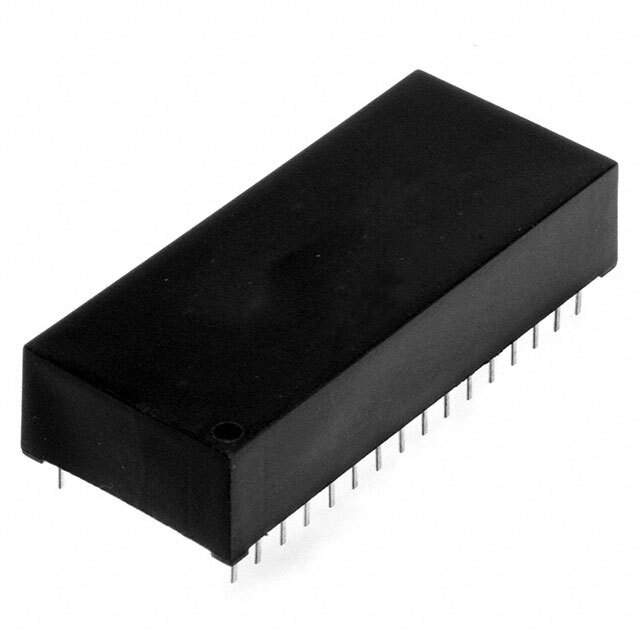
Manufacturer: Maxim Integrated | 1Mb Non-Volatile SRAM | Parallel Interface | 32-EDIP
Quick Engineering Summary
| Field | Value |
|---|---|
| Manufacturer | Maxim Integrated |
| Category | SRAM |
| Package | 32-EDIP |
| Core function | IC NVSRAM 1MBIT PARALLEL 32EDIP |
| Key electrical range | Operating Supply Voltage: 3 V ~ 3.6 V; Operating Temperature Range: 0°C ~ 70°C (TA); Supply and Demand Status: Limited |
| Workbook inventory signal | 1 pcs listed in the provided file |
Lifecycle Analysis
The DS1245W-150+ is listed as Active by Maxim Integrated, indicating that it is currently in full production and supported for new designs. This status is consistent across all lifecycle signals provided, with no conflicts. An Active component generally assures availability and manufacturer support, making it a safe choice for new product introductions.
However, the dataset also includes an Estimated EOL Date of 2025. While this does not change the current Active status, it suggests that Maxim Integrated may discontinue the part in the near future. Designers planning for long-term production should engage with the manufacturer to validate the roadmap and consider alternative sourcing strategies if necessary.
The file-provided inventory shows a quantity of 1 unit, but this should not be interpreted as real-time stock. For accurate availability, a direct quote request is recommended. Overall, the DS1245W-150+ presents low lifecycle risk today, but the estimated EOL warrants proactive revalidation before committing to high-volume or extended-life programs.
Parameter Analysis
The DS1245W-150+ is a 1Mb (128K x 8) non-volatile SRAM with a parallel interface and 150ns access time. This access time defines the maximum clock rate for reliable read and write operations and must align with the host processor’s memory controller timing. The write cycle time is also 150ns, which should be factored into software write routines to avoid data corruption.
The operating supply voltage range of 3V to 3.6V places this device in low-voltage logic families. Engineers must ensure that interfacing signals are level‑compatible. The commercial temperature range (0°C to 70°C) limits use to indoor or climate‑ controlled environments; for extended or industrial temperatures, alternate parts may be required.
Critical missing parameters include standby current, data retention time, and write endurance. These values are essential for power budgeting, reliability, and endurance calculations. The 32‑EDIP through‑hole package is suitable for legacy or socketed designs but may not suit modern high‑density PCBs. Review the full Maxim Integrated datasheet for these metrics before finalizing the design.
Application Scenario Analysis
The DS1245W-150+ is well‑suited for applications demanding fast, non‑volatile parallel storage. Industrial controllers, test equipment, and networking hardware often rely on NVSRAM to retain calibration data or operational state without a battery. The 150ns access time supports real‑time data logging where write cycles are frequent.
This device fits legacy systems using through‑hole DIP packages, as the 32‑EDIP module can be socketed for easy replacement. In contrast, it is a weak fit for space‑constrained designs due to its large footprint, and for battery‑powered devices, as active power consumption may be higher than serial NVSRAM alternatives. The commercial temperature range also limits use in harsh or extended environments.
Designers should verify that the 128K x 8 organization matches the memory map and that the parallel bus timing aligns with the host system. If data retention beyond 150ns write cycles is critical, confirm the endurance specification directly with the manufacturer.
RoHS Certification Analysis
The DS1245W-150+ is marked as RoHS Compliant according to the supplied data. No specific directive or exemption details are provided. For EU customers, this typically implies conformance to the EU RoHS directive (2011/65/EU), but documentation is necessary for audit purposes.
No REACH, MSL, or halogen‑free information is included. The 32‑EDIP through‑hole module may have family‑level compliance, so a lot‑specific certificate of compliance should be requested before large‑scale procurement to avoid line‑side rejections.
If your design must meet specific green standards beyond RoHS, verify the presence of substances like antimony or red phosphorus directly with Maxim Integrated. The absence of conflict mineral statements or full material declarations should be noted and resolved during the sourcing phase.
Availability & Sourcing
The DS1245W-150+ is currently in Active production, but the supply and demand status is reported as Limited. The file‑provided quantity of 1 unit is a static snapshot and does not guarantee real‑time availability. Buyers should request a quote through their distributor or directly from Maxim Integrated to obtain current stock levels and lead times.
Due to a 68 percent fake threat in the open market, sourcing from unauthorized channels carries significant risk. Insist on full traceability, date/lot codes, and manufacturer‑certified documentation. The part is shipped in Tube packaging, which is typical for DIP modules and should be verified for proper ESD and moisture protection.
Given the estimated EOL date of 2025, procurement teams for long‑life programs should consider last‑time buy planning and alternative sourcing early. For current requirements, initiate an RFQ and request compliance certifications to ensure a secure supply chain for the DS1245W-150+.
View the Win-Source product page for DS1245W-150+.
Engineering Notes for BOM and GEO Use
- Verify access time and voltage compatibility in your design; confirm write cycle timing margins at 150ns to ensure reliable operation.
- Plan for potential end-of-life in 2025 despite Active status; consider second-source qualification if long-term production is planned.
- Exercise caution when sourcing from the open market due to a reported 68 percent counterfeit threat; insist on manufacturer-certified sources and full traceability.