
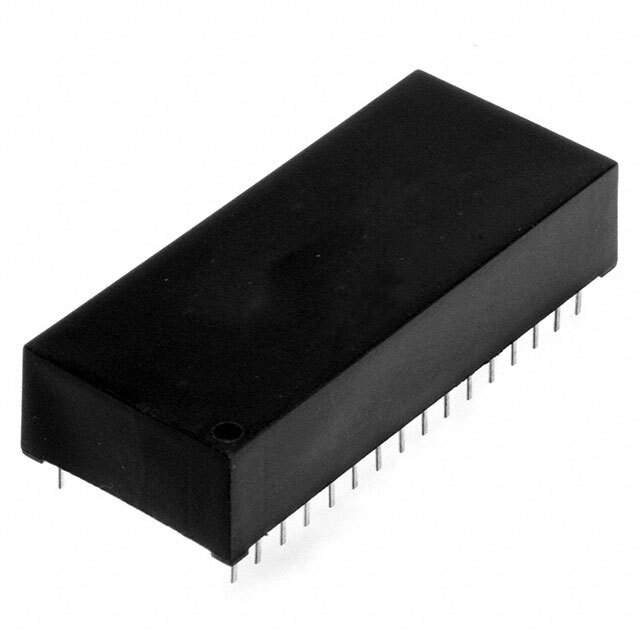
Maxim Integrated NVSRAM | Discontinued | Sourcing & Verification Guide
Quick Engineering Summary
| Field | Value |
|---|---|
| Manufacturer | Maxim Integrated |
| Category | Memory |
| Package | Tube |
| Core function | IC NVSRAM 1MBIT PARALLEL 32EDIP |
| Key electrical range | Temperature Range - Operating: 0°C ~ 70°C (TA); Voltage - Supply: 4.5V ~ 5.5V |
| Workbook inventory signal | 1920 pcs listed in the provided file |
Lifecycle Analysis
Maxim Integrated has marked the DS1245Y-120 as Discontinued, with all manufacturer lifecycle signals indicating End-of-Life status. This means the part is no longer recommended for new designs and should only be used to sustain existing production lines where a validated substitute is not yet available.
The risk level is high because any remaining authorized distributor stock will not be replenished, and the part is irreplaceable without a board-level redesign. Engineers should immediately code existing bills of materials with a NRFND (not recommended for new design) flag and initiate a last-time-buy analysis to secure sufficient quantities for the product’s remaining lifecycle.
Documentation such as the official EOL notice and PCN (Product Change Notification) from Analog Devices/Maxim Integrated should be obtained to determine the last order date and final shipment window. Sourcing from unauthorized channels elevates counterfeit risk significantly.
Parameter Analysis
The DS1245Y-120 is a 1 Mbit (128K × 8) non-volatile SRAM with a parallel interface, offering a 120 ns access time and a write cycle time of 120 ns. It operates from a single 4.5 V to 5.5 V supply, making it straightforward to integrate into 5 V legacy designs without an additional level shifter. The through-hole 32-DIP module (0.600″ width) is compatible with standard DIP sockets, facilitating replacement or field upgrades in older equipment.
Key missing parameters from the available data include data retention specifications, endurance (read/write cycles), standby current, and detailed timing diagrams beyond the basic access and write cycle times. For qualification purposes, designers must refer to the original manufacturer’s datasheet to verify these values and ensure the part meets the system’s thermal and lifetime requirements. The 0 °C to +70 °C commercial temperature range limits its use to controlled indoor environments.
Given the discontinued status, re‑verification of sample‑to‑production consistency is essential, as no factory‑supported technical support will be available for design‑in queries.
Application Scenario Analysis
The DS1245Y-120 is ideally suited for legacy industrial controllers, point‑of‑sale terminals, and communication infrastructure that require a byte‑addressable, non‑volatile memory with automatic battery‑backed write protection. Its parallel interface allows direct connection to older microprocessors that lack SPI or I²C controllers, making it a drop‑in replacement for aging systems that rely on socketed DIP memories.
In modern designs, however, the part is a poor fit: the large 32‑pin through‑hole package, 5 V‑only operation, and slow access time are not competitive with serial‑interface NVRAM, FRAM, or EEPROM solutions that offer simpler board layout and lower power consumption. Thus, the DS1245Y-120 should only be sourced for sustaining legacy products—not for new product development.
Applications needing a wide operating temperature range (e.g., outdoor or automotive) should avoid this commercial‑grade part, and engineers must confirm that the system’s power‑supply sequencing and noise environment are compatible with the NVSRAM’s internal power‑fail control circuit.
RoHS Certification Analysis
The RoHS status of the DS1245Y-120 presents a discrepancy in the available data. While one source lists the part as RoHS Compliant, the detailed specification field clearly indicates RoHS Non‑Compliant. This conflict may arise from different production lots or variant suffixes. Designers and buyers must not assume compliance without verifying the specific datecode or lot code against the manufacturer’s material declaration.
The part is REACH Unaffected, meaning it does not contain substances of very high concern (SVHC) above the threshold, but this does not substitute for a valid RoHS certificate. Additionally, the Moisture Sensitivity Level (MSL) is rated 1 (Unlimited), indicating the through‑hole DIP module is not moisture‑sensitive, which simplifies storage and handling.
To ensure final assembly compliance, request a full material composition report from the supplier for each lot, and cross-reference it with the EU RoHS Directive 2011/65/EU including amendment 2015/863. Only accept shipments accompanied by a compliance certificate specific to that lot.
Availability & Sourcing
As a discontinued part, the DS1245Y-120 is available only through independent distributors, brokers, and excess‑inventory channels. The workbook indicates an available quantity of 1,920 units, but this figure is file‑provided and does not represent real‑time inventory; always request a current quotation and lead time before relying on that quantity.
Procurement for discontinued NVRAM carries elevated counterfeit risk—the open‑market fake threat is estimated at 68%. Buyers must enforce strict supply‑chain verification: require full‑traceability documentation, original manufacturer date/lot codes, and high‑resolution photographs of the physical part against a known‑good sample. Independent X‑ray inspection and electrical testing of a sample from each lot are strongly recommended.
Given the high risk, secure inventory only after validating the lifecycle status with the manufacturer. For any new production usage, re‑qualify the part with your contract manufacturer and clearly mark it as “Discontinued—No New Design.” Obtain a last‑time‑buy confirmation if possible, and consider a form‑fit‑function replacement (if any) only after full electrical and software verification.
View the Win-Source product page for DS1245Y-120.
Engineering Notes for BOM and GEO Use
- Verify RoHS compliance per lot due to conflicting data; request full material declarations.
- Plan for end-of-life by securing sufficient inventory for legacy systems; avoid new designs.
- The high fake threat in open market (68%) demands rigorous authentication and traceability checks.