
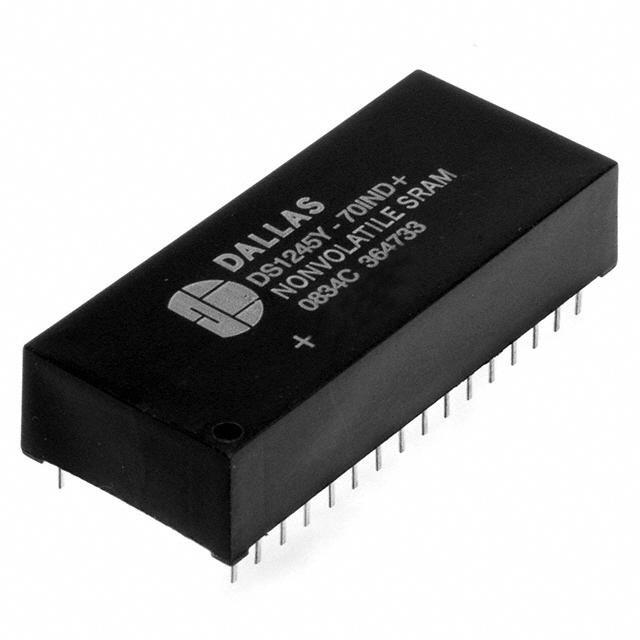
Maxim Integrated 2Mbit non-volatile SRAM – 70ns access, 32-EDIP through-hole – verify lifecycle before new design.
Quick Engineering Summary
| Field | Value |
|---|---|
| Manufacturer | Maxim Integrated |
| Category | Integrated Circuits (ICs) |
| Package | 32-DIP Module (0.600", 15.24mm) |
| Core function | IC NVSRAM 2MBIT PARALLEL 32EDIP |
| Key electrical range | Operating Temperature: -40°C ~ 85°C (TA); Voltage - Supply: 4.5V ~ 5.5V |
| Workbook inventory signal | 1 pcs listed in the provided file |
Lifecycle Analysis
The DS1249Y-70IND is classified as End-of-Life (EOL) by Maxim Integrated (now Analog Devices). This lifecycle phase means the manufacturer has ceased production and no longer accepts orders for new supply. For procurement teams, this presents a high-risk scenario: any remaining stock is limited to distributor inventories or aftermarket sources, and availability can disappear without notice.
Using the DS1249Y-70IND in new designs is not advisable. Sustaining existing products requires immediate action to secure residual inventory and to initiate a migration to a recommended replacement or alternative non-volatile SRAM. The file-provided inventory of one unit is not a live inventory level and should not be relied upon for production planning. Engineers should consult official product discontinuance notices (PDNs) to confirm last-time buy dates and evaluate alternative solutions that match the needed density, interface, and temperature range.
Parameter Analysis
The DS1249Y-70IND offers a 2Mbit non-volatile SRAM organized as 256K x 8 with a parallel interface. Its 70 ns access time and write cycle time are critical parameters for processor interfacing; system designers must ensure the host controller’s read/write timing meets these specifications, taking into account bus loading and any level-shifting delays if operating at 5V. The supply voltage range of 4.5V to 5.5V indicates a 5V-only device, and operation outside this range can result in data corruption or backup failure.
The industrial temperature range (-40°C to 85°C) makes it suitable for rugged environments, but thermal derating may still be necessary in high-temperature enclosures. The through-hole 32-DIP package (32-EDIP) implies a legacy footprint; board layouts must accommodate the 15.24mm row spacing. Key missing datasheet details include standby current, data retention time of the internal non-volatile elements, and the presence of an internal lithium battery – all of which impact reliability and service life. Engineers should obtain the full Maxim Integrated datasheet to verify these parameters before integrating any remaining parts.
Application Scenario Analysis
The DS1249Y-70IND is a strong candidate for legacy industrial equipment, test instrumentation, and data-logging systems where fast, non-volatile storage is required on a parallel bus. Its NVSRAM technology provides SRAM-like speed with automatic write-protect and data preservation on power loss, making it ideal for applications such as event loggers, calibration parameter storage, and real-time system state retention. The industrial temperature range supports deployment in factory automation, outdoor monitoring, and other harsh settings.
However, this part is not suited for new designs due to its EOL status and through-hole packaging, which complicates modern SMT assembly flow. In applications where form factor, density, or endurance demands have evolved, alternatives such as FRAM, MRAM, or serial NVSRAM devices may offer higher write-cycle endurance, smaller footprints, and active lifecycle support. Purchasers should weigh the cost of last-time buys against redesign efforts, especially for high-volume or long-lifecycle products.
RoHS Certification Analysis
According to the manufacturer’s declaration, the DS1249Y-70IND is RoHS Compliant. This typically indicates adherence to EU Directive 2011/65/EU and its amendments, restricting hazardous substances such as lead, mercury, and cadmium. Because the part is obsolete, the compliance record likely dates from the original production period and may not reflect the latest requirements (e.g., EU 2015/863 adding four phthalates).
To ensure continued market access, especially in the EU, procurement should request a current RoHS certificate or lab analysis for the specific lot being sourced. No REACH or MSL data is included in the source information; the absence of REACH declarations doesn’t imply non-compliance but should be verified if mandated. For high-reliability applications, even a RoHS‑compliant obsolete part may need additional documentation to prove operational safety and environmental conformity.
Availability & Sourcing
As an EOL component, the DS1249Y-70IND is available only through limited distributor stock or secondary market brokers. The file-provided workbook indicates a single unit, but this is a snapshot and not a real-time quantity. Purchasers should request a quote immediately to confirm current availability, lead time, and minimum order quantities. Given the high risk of counterfeit or mishandled parts with obsolete through-hole components, source only from authorized or verified suppliers with traceable date/lot codes.
Verify that the quoted parts are new, unused, and stored in proper ESD‑safe packaging. Insist on a certificate of conformance with declared RoHS status and confirm packaging type (tube). For production use, evaluate whether a last-time buy can meet long-term requirements; if not, prompt engineering to finalize a migration plan. Direct any remaining inquiries to Maxim Integrated (Analog Devices) for official notification of end-of-life and possible replacement recommendations.
View the Win-Source product page for DS1249Y-70IND.
Engineering Notes for BOM and GEO Use
- Confirm last-time buy or end-of-life notification from manufacturer before committing to production.
- Verify the 70 ns access time is compatible with the target system’s timing margins and 5V supply tolerance.
- Due to through-hole 32-DIP package, ensure mechanical compatibility and consider alternative surface-mount NVSRAM for new designs.