
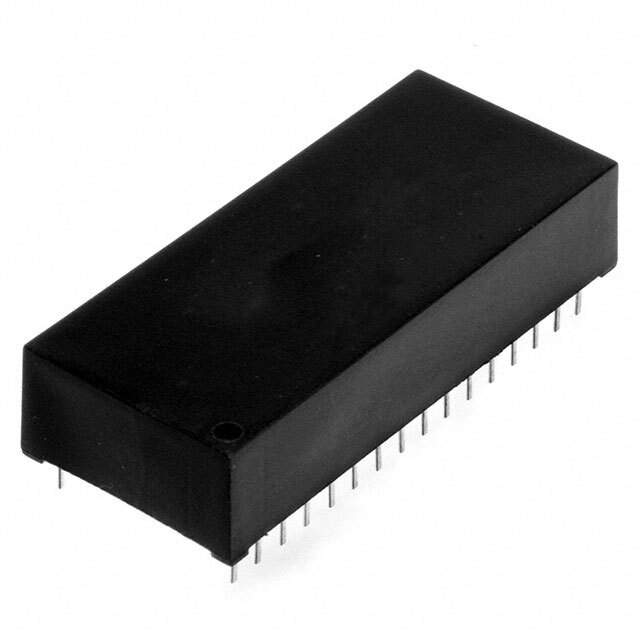
Discontinued Maxim Integrated Phantom Time Chip with 512KB NVSRAM. Verify availability before design.
Quick Engineering Summary
| Field | Value |
|---|---|
| Manufacturer | Maxim Integrated |
| Category | Clock/Timing - Real Time Clocks |
| Package | Tube |
| Core function | IC RTC PHANTOM CHIP PAR 32EDIP |
| Key electrical range | Current - Timekeeping (Max): 7mA @ 3.3V; Temperature Range - Operating: 0°C ~ 70°C; Voltage - Supply: 2.97V ~ 3.63V |
| Workbook inventory signal | 10 pcs listed in the provided file |
Lifecycle Analysis
The DS1251W-120 is confirmed discontinued by Maxim Integrated, with multiple sources indicating end-of-life. This status carries high procurement risk for new designs. The part should not be considered for volume production; instead, it is suitable only for sustaining existing systems that cannot be redesigned immediately.
Engineers must verify the discontinuation timeline directly with Analog Devices (which absorbed Maxim) to understand last-time buy opportunities or authorized aftermarket support. File-provided inventory showing 10 units is a snapshot and does not guarantee real-time availability.
Any purchase should include lifecycle documentation from the distributor to confirm authenticity and that the stock is not from unauthorized gray-market channels. For new projects, a migration to an active RTC with similar NVSRAM features is strongly advised.
Parameter Analysis
The DS1251W-120 integrates a real-time clock and 512KB of non-volatile SRAM in a parallel-interface, through-hole 32-DIP module. Key parameters include a supply voltage range of 2.97V to 3.63V and timekeeping current of 7mA at 3.3V, which is moderate for RTC modules. The parallel interface is legacy, making it incompatible with modern serial-interface designs, but it fits into older microprocessor buses.
The 512KB NVSRAM is critical for applications needing non-volatile data storage without battery backup on the RTC itself. Features like leap year compensation and date format YY-MM-DD-dd are standard. Missing datasheet details to verify include: battery-backed timekeeping support (often a separate pin), crystal accuracy over temperature, and write cycle endurance for the SRAM. Designers should confirm these from the original Maxim datasheet before integration.
Thermal management is straightforward with commercial temperature range 0–70°C, but MSL 1 means no special moisture sensitivity precautions are needed for rework.
Application Scenario Analysis
Strong-fit applications for the DS1251W-120 are legacy industrial controllers, medical equipment, or communications gear that require precise time-stamping and non-volatile parameter storage on a parallel bus. The through-hole DIP package suits older PCB designs and service-friendly repairs.
Weak-fit scenarios include any new product development due to the discontinued status, surface-mount-only layouts, or low-power embedded devices where 7mA is excessive. The commercial temperature range excludes outdoor or automotive uses. The parallel interface also limits integration with modern microcontrollers that lack a parallel bus.
Engineers considering this part must weigh the risk of relying on a discontinued component against the cost of redesign. Its phantom time chip architecture and large NVSRAM were competitive in their era but have been superseded by serial RTCs with integrated flash.
RoHS Certification Analysis
The DS1251W-120 is marked as RoHS Compliant, indicating that it meets EU Directive 2011/65/EU restrictions on hazardous substances. This status typically applies to the base material set and should be confirmed with the specific lot being procured.
Additionally, the REACH status is reported as unaffected, which is separate from RoHS and covers chemical substances. The MSL rating of 1 (Unlimited) suggests the DIP module is not moisture-sensitive, simplifying storage and soldering.
For compliance documentation, request a certificate of conformance from the distributor verifying RoHS compliance for the exact date code and manufacturer packaging. Family-level declarations may not cover variations in subcomponents, so lot-level validation is prudent given the part's age and discontinuation.
Availability & Sourcing
As a discontinued part, DS1251W-120 availability is limited. File-provided inventory shows 10 units, but this is not a live stock guarantee. Procurement should start with a request for quote (RFQ) to verify current quantities, date codes, and packaging (tube).
The open market fake threat is 61%, so sourcing from non-authorized channels carries high risk. Always demand traceability documentation, including manufacturer certificate of origin and RoHS conformity. Consider third-party testing if sourcing from brokers.
Since the part is end-of-life, buyers should explore last-time buy options or aftermarket authorized distributors. For long-term needs, an obsolescence mitigation strategy—such as lifetime buys or redesign—is essential. Contact your supplier to secure stock and validate lifecycle status before committing.
View the Win-Source product page for DS1251W-120.
Engineering Notes for BOM and GEO Use
- Verify manufacturer discontinuation notice before committing to new design.
- Counterfeit risk is elevated at 61% in open market; source only from authorized channels.
- Operating temperature limited to 0–70°C; check MSL 1 for proper handling.