
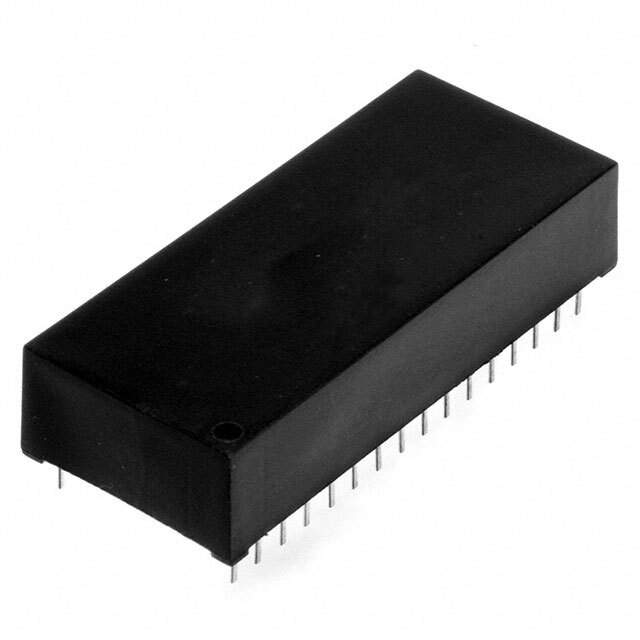
Obsolete 512kb Phantom Time Chip RTC in 32-DIP – Verify Lifecycle & Authenticity Before Buying
Quick Engineering Summary
| Field | Value |
|---|---|
| Manufacturer | Maxim Integrated |
| Category | Clock/Timing - Real Time Clocks |
| Package | 32-DIP Module (0.600", 15.24mm) |
| Core function | IC RTC PHANTOM CHIP PAR 32EDIP |
| Key electrical range | Current - Timekeeping (Maximum): 10mA at 5V; Supply and Demand Status: Limited; Supply Voltage (V): 4.5V ~ 5.5V; Temperature Range - Operating: 0°C ~ 70°C |
| Workbook inventory signal | 1 pcs listed in the provided file |
Lifecycle Analysis
The Maxim Integrated DS1251Y-70 is classified as Obsolete (End of Life), with all manufacturer lifecycle signals confirming this status. This means the part is no longer in active production and cannot be ordered directly from the factory. For new designs, engineers must select an alternative RTC solution immediately; using an EOL part introduces unacceptable supply chain risk.
For existing products in sustaining production, the primary option is a last-time buy (LTB) from authorized distributors, though remaining stock is extremely limited. The file-provided inventory shows only a single unit available, and this is not a real-time guarantee. Given the high fake threat rate of 69% in the open market, any procurement of DS1251Y-70 from non-authorized sources carries a severe risk of counterfeit or substandard devices.
It is critical to revalidate all documentation from Maxim Integrated (now Analog Devices) regarding the discontinuance notice, including last-order and last-ship dates. Without a verified, authorized source, even sustaining production may be jeopardized. Immediate engineering effort should shift toward qualifying a pin-compatible replacement or a functional equivalent, if available, or a board redesign using a current-generation RTC.
Parameter Analysis
The DS1251Y-70's key parameters center on its phantom time chip architecture, which uses an embedded lithium energy source and NVSRAM to maintain time and data without an external battery. The parallel interface and 512kb memory size are critical for system integration, especially in legacy embedded designs that map the RTC and SRAM into memory or I/O space. The supply voltage range of 4.5V to 5.5V and maximum timekeeping current of 10mA at 5V must be considered for power budgeting, though the static NVSRAM retention current is typically much lower.
Date format (YY-MM-DD-dd) and features like leap year compensation are standard for RTCs, but the parallel interface and through-hole 32-DIP package limit use to older PCB designs. The operating temperature range of 0°C to 70°C restricts the DS1251Y-70 to commercial applications only; industrial or extended-temperature replacements are not available from this series.
Missing datasheet parameters that should be verified in the original Maxim datasheet include SRAM access time, battery life expectancy, clock accuracy (ppm), and detailed bus timing for the parallel interface. These are essential for integration and should not be assumed from generic RTC specs.
Application Scenario Analysis
The DS1251Y-70 is suited for legacy embedded systems requiring a non-volatile timekeeping solution with integrated RAM, such as industrial controllers, telecom equipment, and older point-of-sale terminals. Its phantom time chip design originally provided a drop-in replacement for socketed SRAMs with a built-in RTC, making it popular in 8-bit and 16-bit bus architectures from the 1990s and early 2000s.
However, modern designs should avoid this part due to its EOL status, high counterfeit risk, and restrictive 5V-only supply. The through-hole 32-DIP is incompatible with surface-mount manufacturing, limiting it to repair or legacy reproduction. Strong-fit scenarios are limited to exact replacement in existing fielded systems where a board redesign is impossible in the short term. Weak-fit or unsuitable scenarios include new low-power IoT devices, 3.3V systems, or any application requiring RoHS compliance without exemptions, given the RoHS conflict. For any new design, a modern I²C or SPI RTC with integrated crystal and lower power is recommended.
RoHS Certification Analysis
RoHS compliance for the DS1251Y-70 presents a critical verification gap. The specification data lists 'RoHS Non-Compliant', while a separate compliance field indicates 'RoHS Compliant'. This conflict means engineers cannot assume EU RoHS (2011/65/EU) conformity without lot-specific documentation. Historically, many DIP-packaged Maxim parts from this era used lead-based solder finishes, so non-compliance is plausible.
For procurement, every lot must be accompanied by a valid RoHS certificate of conformance from an authorized source. Without it, the DS1251Y-70 cannot be used in RoHS-regulated markets without an exemption. The MSL rating of Level 1 (Unlimited) is unrelated to RoHS status. Additionally, REACH compliance is not provided, so that must be verified separately if required. Given the EOL status, the likelihood of obtaining fresh RoHS-compliant stock is low; most remaining units are likely older, non-compliant inventory.
Availability & Sourcing
Sourcing the Maxim Integrated DS1251Y-70 demands extreme caution due to its obsolete status and 69% counterfeit threat rate. The file-provided quantity of 1 unit is not a live stock level and should not be relied upon for procurement planning. Buyers must request a quote (RFQ) from authorized distributors or directly from Analog Devices for any remaining factory stocks, but availability is expected to be near zero.
Any purchase from the open market requires rigorous traceability: date/lot codes must be verifiable against manufacturer records, and physical inspection with X-ray or decapsulation may be necessary to confirm authenticity. Packaging should be original tube from Maxim to reduce the risk of remarking. Compliance documentation for RoHS (see conflict analysis) must be provided at the lot level.
For engineers and buyers, the best path forward is to treat the DS1251Y-70 as unavailable for new production. For urgent repair or replacement, engage with specialized broker networks that offer authenticity guarantees, but always verify lifecycle status and consider the high risk. Ultimately, migrating to a current-generation RTC is the only sustainable solution.
View the Win-Source product page for DS1251Y-70.
Engineering Notes for BOM and GEO Use
- Verify RoHS compliance at lot level due to conflicting data; treat as non-compliant until proven otherwise.
- High 69% counterfeit risk demands authorized source traceability, date/lot code checks, and electrical verification.
- Immediate migration required: no new designs; secure last-time-buy inventory from factory-authorized channels only.