
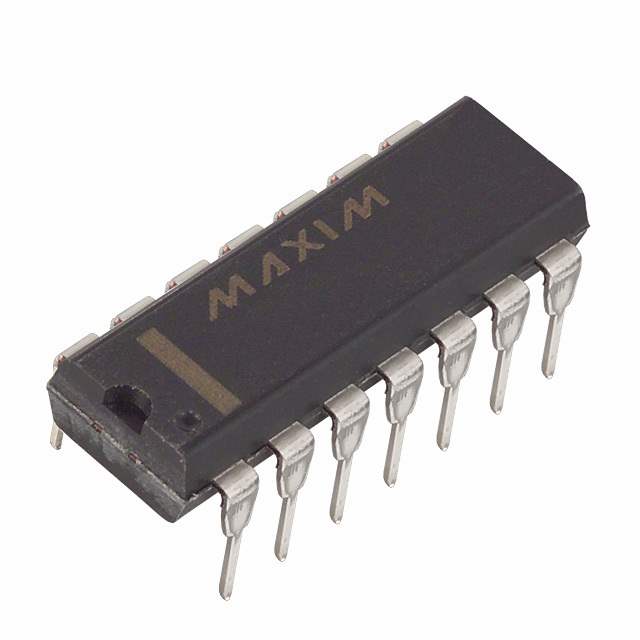
Maxim Integrated DS1267-100: 100kΩ, 256-tap, dual digital potentiometer in 14-PDIP package. EOL status requires careful procurement.
Quick Engineering Summary
| Field | Value |
|---|---|
| Manufacturer | Maxim Integrated |
| Category | Data Acquisition - Digital Potentiometers |
| Package | 14-PDIP |
| Core function | IC DGT POT 100KOHM 256TAP 14DIP |
| Key electrical range | Resistance (Ohms): 100k; Resistance - Wiper (Ohms) (Typ): 400; Supply and Demand Status: Limited; Supply Voltage - Operating: 5V |
| Workbook inventory signal | 1 pcs listed in the provided file |
Lifecycle Analysis
The DS1267-100 digital potentiometer from Maxim Integrated has an end-of-life (EOL) lifecycle status. All lifecycle indicators in the supplied data align on EOL, signaling that the manufacturer has discontinued this part. For new designs, using an EOL component introduces significant risk; a replacement or alternate part should be selected from the outset. For existing production, an immediate plan is necessary.
The reported file-provided inventory of one unit is a snapshot and not a guarantee of real-time availability. Engineers and buyers should verify with Maxim Integrated or authorized distributors whether a last-time-buy (LTB) window is still open. Without confirmation, procuring stock for sustaining production is challenging. Any stock sourced from the open market carries a reported counterfeit risk of 45%, so authentication becomes critical.
It is advisable to review the manufacturer’s discontinuation notice for exact dates and recommended migration paths. In summary, the DS1267-100 should not be designed into new products, and current users must act quickly to secure genuine inventory.
Parameter Analysis
The DS1267-100 features two independent potentiometer circuits with 100kΩ end-to-end resistance and 256 taps, providing 8-bit resolution. The configuration is potentiometer, not rheostat, meaning all three terminals are accessible. The resistance tolerance is ±20%, which is typical for digital pots but must be accounted for in calibration. The wiper resistance is typically 400Ω, which affects linearity in low-impedance paths. The temperature coefficient of 750 ppm/°C is relatively high; for precision applications, thermal drift should be evaluated.
The operating temperature range is -40°C to 85°C, adequate for many industrial environments. Supply voltage is 5V, and the memory is volatile, so the wiper position resets on power loss—critical if non-volatile settings are needed. The cascade pin feature allows multiple devices to be daisy-chained for expanded channels.
Key missing datasheet parameters that should be verified: the serial interface protocol (likely 3-wire, but not confirmed), the wiper current rating, the maximum supply current, and the digital logic thresholds. For designs where these parameters are marginal, bench testing or a detailed datasheet review is essential.
Application Scenario Analysis
The DS1267-100 is suited for applications requiring dual-channel adjustable resistance, such as programmable gain amplifiers, offset trimming, and sensor calibration. Its linear taper is appropriate for feedback networks and voltage dividers. The cascade capability makes it viable for multi-channel systems, though the 5V supply and volatile memory limit its use in low-power or non-volatile applications.
Given its EOL status, it is a strong fit only for legacy systems that already use the DS1267-100 and require exact drop-in replacements to avoid requalification. For new designs, it is a weak fit because of the EOL risk, the counterfeit threat, and the availability constraints.
If a design must replicate the DS1267-100's function, alternatives with similar resistance and tap count from Maxim Integrated or other vendors should be evaluated, with attention to memory type and interface compatibility. In any case, verify that the package and pinout match before substitution.
RoHS Certification Analysis
The DS1267-100 RoHS status is ambiguous. One data field indicates RoHS Compliant, while another explicitly states RoHS Non-Compliant. This conflict likely stems from different production lots or database errors. Without clear manufacturer documentation, it is risky to assume full compliance. The part may contain lead in the terminations if it is non-compliant.
For European Union customers, RoHS non-compliance prohibits import unless an exemption applies. No specific exemption is listed, and REACH status is not provided. Buyers should request a certificate of compliance for the specific batch. If RoHS compliance is mandatory, verify directly with Maxim Integrated or test samples.
Lot-level testing can reveal whether the part meets RoHS 3 (EU 2015/863) thresholds. Until verified, consider this part as potentially non-compliant to avoid regulatory issues.
Availability & Sourcing
Sourcing the DS1267-100 requires caution due to its EOL status and the 45% open-market counterfeit risk. The file-provided inventory shows one unit, but this is not a live stock level. Interested buyers should request a quote for current availability and lead time. The part is supplied in tube/rail packaging, and storage condition guidance recommends a dry storage cabinet with humidity protection, suggesting moisture sensitivity.
When procuring, insist on date/lot code traceability and original manufacturer packaging. Verify the lifecycle with Maxim Integrated to confirm there is no remaining factory inventory. Compliance documentation, especially for RoHS, should be validated per the batch.
For production, evaluate whether enough stock can be secured for the entire product lifetime; if not, accelerate design migration to a successor component. The high counterfeit risk underscores the need to purchase only from authorized or long-established distributors with rigorous quality control. Do not rely on unverified sources.
View the Win-Source product page for DS1267-100.
Engineering Notes for BOM and GEO Use
- Do not use DS1267-100 in new designs; it is end-of-life with high counterfeit risk (45%).
- Verify RoHS compliance for each lot, as conflicting data suggests potential non-compliance.
- For legacy systems, secure inventory promptly and consider a migration path to avoid shortages.