
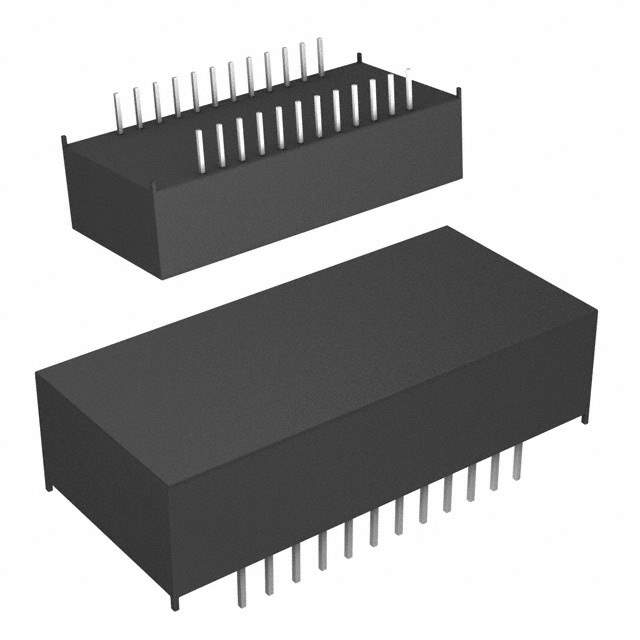
EOL RTC with parallel interface, 114B NVSRAM, alarm, and through-hole 24-DIP module. Verify compliance and availability.
Quick Engineering Summary
| Field | Value |
|---|---|
| Manufacturer | Maxim Integrated |
| Category | Clock/Timing - Real Time Clocks |
| Package | 24-DIP Module (0.600", 15.24mm) |
| Core function | IC RTC CLK/CALENDAR PAR 24EDIP |
| Key electrical range | Current - Timekeeping (Maximum): 15mA at 4.5V ~ 5.5V; Supply and Demand Status: Limited; Supply Voltage (V): 4.5V ~ 5.5V; Temperature Range - Operating: 0°C ~ 70°C |
| Workbook inventory signal | 335 pcs listed in the provided file |
Lifecycle Analysis
The DS12887 is an End-of-Life (EOL) part from Maxim Integrated, meaning it is no longer in production and available only through remaining inventory. All lifecycle indicators in the supplied data align on this status, confirming the part is obsolete. For new designs, the DS12887 must not be used due to the high risk of supply shortages and the absence of future manufacturing. Engineers maintaining legacy systems should secure sufficient stock for forecasted production runs and immediately begin evaluating alternative real-time clock ICs.
Because EOL parts are prime targets for counterfeiting, procurement teams must exercise extreme diligence. The fake threat rate for the DS12887 in the open market is reported as 36%, underscoring the importance of sourcing only from authorized or fully vetted distributors. Requesting date codes, lot tracking, and traceability documentation is critical to verify authenticity. Proactive migration to an active part like the DS12885 can mitigate long-term availability risks.
Parameter Analysis
The DS12887 is a parallel-interface real-time clock/calendar IC housed in a 24-pin DIP module. Key parameters include a timekeeping current of up to 15mA from a 4.5V–5.5V supply, a separate battery backup voltage range of 2.5V–4V, and 114 bytes of NVSRAM for data retention during power loss. The device features alarm, daylight savings adjustment, leap year compensation, and a square wave output. These parameters are critical for low-power, always-on timekeeping in embedded systems. The parallel interface simplifies connection to legacy microcontrollers or processors, but it demands multiple I/O pins and adds layout complexity compared to serial RTCs.
The 0°C–70°C operating temperature range limits the part to commercial environments. For designs requiring extended temperature range, alternative parts should be considered. The through-hole 24-DIP module is suitable for prototyping and socketed applications but is less common in modern high-density SMT designs. Engineers must also verify the maximum timekeeping current under the actual supply voltage, as higher current can impact battery life. The datasheet should be consulted for detailed timing diagrams and register maps.
Application Scenario Analysis
The DS12887 is well-suited for legacy embedded systems that require a parallel real-time clock with integrated NVSRAM, such as industrial controllers, point-of-sale terminals, and older networking equipment. Its 5V operation and through-hole package make it appropriate for systems that are not space-constrained and use 5V logic levels. The built-in battery backup and alarm features support applications like scheduled power-on, data logging timestamps, and maintenance reminders.
However, due to its EOL status and limited availability, the DS12887 is not recommended for new designs. For applications with tighter PCB space or lower voltage requirements, modern serial RTCs (I2C or SPI) offer smaller footprints and lower power consumption. The part is less suited for battery-powered portable devices because of its 15mA timekeeping current and 5V supply voltage, which would drain batteries quickly. Engineers maintaining legacy systems should verify that the parallel interface timing is compatible with their microcontroller, as modern MCUs may require voltage level translation or complex bus sharing.
RoHS Certification Analysis
The DS12887’s RoHS compliance is inconsistent across available data. The source includes a high-level compliance flag as 'RoHS Compliant', yet a detailed specification field lists 'RoHS Non-Compliant'. This discrepancy likely reflects variations between production lots or changes over the part’s lifecycle. Since the DS12887 is EOL, available stock may originate from different manufacturing periods with differing environmental compliance statuses. Purchasing teams must request a valid RoHS certificate for the specific batch being sourced.
It is possible that some units were manufactured before RoHS directives took effect or that exemptions apply (e.g., lead in glass of electronic components), but no specific exemptions are documented here. For compliance-sensitive applications, consider that the part is through-hole, which may use lead-based finishes unless specifically designated as lead-free. The MSL level is 1 (unlimited), indicating no special moisture handling is required, but this does not relate to RoHS. REACH status is not provided, so verification is needed if required. In summary, do not assume RoHS compliance; always confirm per lot to meet regulatory requirements.
Availability & Sourcing
The DS12887 is an EOL part with limited remaining stock. The file-provided inventory shows 335 units, but this quantity is not guaranteed and may change rapidly. Given the high fake threat rate of 36% in the open market, only authorized or reputable distributors should be used. Request a formal quote to confirm current availability, date codes, and packaging. Verify that the parts are in original manufacturer’s tube packaging to avoid damage or counterfeits.
For production, secure enough inventory to cover your product’s remaining lifecycle or accelerate migration to an alternate part. The DS12885 (active RTC) may serve as a functional replacement, but careful datasheet comparison is required. Include compliance certification requests in your RFQ to ensure RoHS and other regulatory requirements are met. If considering grey market sources, implement incoming inspection for visual, X-ray, and electrical testing to mitigate counterfeits. Plan a transition schedule now to avoid line-down situations as inventory depletes.
View the Win-Source product page for DS12887.
Engineering Notes for BOM and GEO Use
- Verify RoHS compliance per lot; data shows both compliant and non-compliant entries. Request certification for the specific date code before purchase.
- For new designs, migrate to an active Maxim RTC with similar parallel interface and NVSRAM to avoid EOL risks; the DS12885 may be a candidate.
- Given the 36% fake threat rate, only source from authorized distributors or thoroughly test samples for functionality and date codes.