
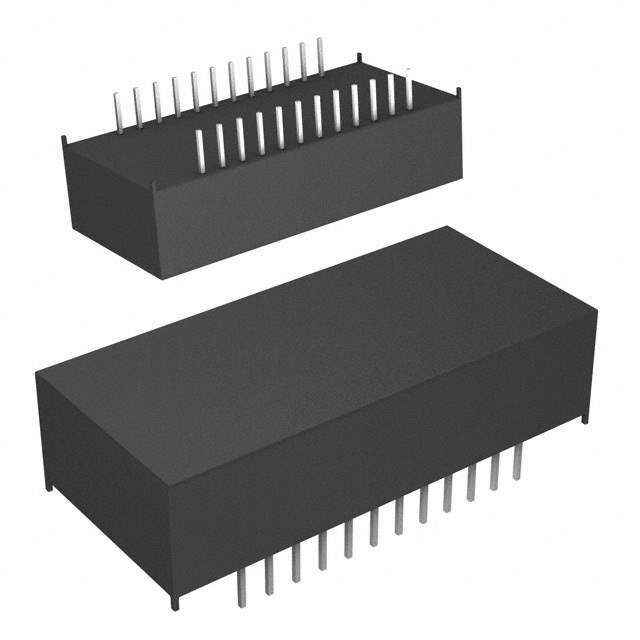
Technical sourcing analysis for Maxim Integrated DS12887A including lifecycle, parameters, and compliance.
Quick Engineering Summary
| Field | Value |
|---|---|
| Manufacturer | Maxim Integrated |
| Category | Clock/Timing - Real Time Clocks |
| Package | 24-DIP Module (0.600", 15.24mm) |
| Core function | IC RTC CLK/CALENDAR PAR 24EDIP |
| Key electrical range | Current - Timekeeping (Maximum): 15mA at 4.5V ~ 5.5V; Supply and Demand Status: Limited; Supply Voltage (V): 4.5V ~ 5.5V; Temperature Range - Operating: 0°C ~ 70°C |
| Workbook inventory signal | 1 pcs listed in the provided file |
Lifecycle Analysis
The DS12887A has been designated End-of-Life (EOL) by Maxim Integrated. This status means the part is no longer recommended for new designs and may only be available as residual stock. Engineers should immediately begin migration to a functionally equivalent active product for any new development.
For sustaining production, it is essential to confirm the last-time buy (LTB) window with Analog Devices (which acquired Maxim). The file-provided inventory shows one unit, but this is not a real-time guarantee. Actual availability may already be exhausted in the supply chain.
Given the high risk level, all procurement should be accompanied by manufacturer revalidation of the lifecycle notice and order deadlines. Avoid single-source dependence and evaluate drop-in replacements from authorized distributors.
Parameter Analysis
The DS12887A integrates a complete real-time clock/calendar with 114 bytes of NVSRAM, alarm, leap year compensation, daylight savings adjustment, and a square wave output. It operates from a 4.5V to 5.5V supply with a maximum timekeeping current of 15mA, making it suitable for 5V legacy systems. The parallel interface requires a multi-bit bus, which simplifies integration into microcontroller or microprocessor designs that already have a parallel port.
The integrated battery input (2.5V to 4V) allows on-module backup, preserving timekeeping during primary power loss. The operating temperature range of 0°C to 70°C restricts use to commercial-grade environments. Key missing parameters to verify from the original datasheet include timekeeping accuracy (sec/day), crystal frequency tolerance, and I/O timing characteristics (read/write cycle timing). These parameters directly impact firmware compatibility and precision. Additionally, the 24-DIP through-hole package lends itself to prototyping and repair but demands careful PCB layout for noise immunity.
Application Scenario Analysis
Ideal use cases for the DS12887A include legacy industrial controllers, embedded test equipment, and alarm systems that were originally designed with this exact RTC module and parallel bus. Its integrated battery and RAM make it a self-contained timekeeping solution for systems requiring event time-stamping or scheduled operation.
It is less suited for modern low-power designs that utilize I2C or SPI serial interfaces, as the parallel bus consumes more pins and power. High-reliability applications requiring extended temperature ranges (-40°C to +85°C) or very low standby current are also poor fits. Finally, any new high-volume production should avoid this part due to its EOL status and limited supply; instead, evaluate active RTCs from Analog Devices with similar features.
RoHS Certification Analysis
The DS12887A exhibits conflicting RoHS compliance signals. The general compliance database entry indicates 'RoHS Compliant', while the detailed specification list explicitly states 'RoHS Non-Compliant'. This discrepancy is not uncommon for older, EOL components whose compliance status may have been updated or misapplied in secondary databases. Engineers must not rely on either signal without verification; obtain the official Analog Devices Material Declaration or RoHS certificate for the specific lot.
The part carries an MSL rating of 1 (unlimited), which addresses moisture sensitivity but not hazardous substance content. A formal EU RoHS 2011/65/EU (or later 2015/863) declaration should be requested from the supplier to ensure no restricted substances exceed limits. Without a lot-specific certificate, assume non-compliance until proven otherwise to avoid regulatory risk in EU markets.
Availability & Sourcing
Sourcing the DS12887A requires careful attention due to its EOL and obsolete status. The file indicates only one unit in stock, and the open market carries a 55% fake threat level. Buyers should request a quote for current availability and insist on full traceability documentation including date/lot codes and original manufacturer packaging (tube, 14 units per tube).
For new orders, verify the part’s lifecycle directly with Analog Devices and obtain a written EOL notice if possible. When purchasing from independent distributors, demand compliance certificates and consider third-party testing for authenticity. Since this is an EOL part, prioritize securing enough inventory to cover your production lifetime, or evaluate active alternatives like the DS1685 or DS1687 series. Always request a quote to obtain up-to-date stock information and lead times.
View the Win-Source product page for DS12887A.
Engineering Notes for BOM and GEO Use
- Verify RoHS compliance directly with Maxim Integrated documentation due to conflicting status signals; assume non-compliance until a formal certificate is obtained.
- Plan for EOL migration immediately; limited remaining stock may require last-time buy authorization and can disappear quickly.
- Counterfeit risk is 55% in open market; only source from authorized channels with full traceability and date/lot code verification.