
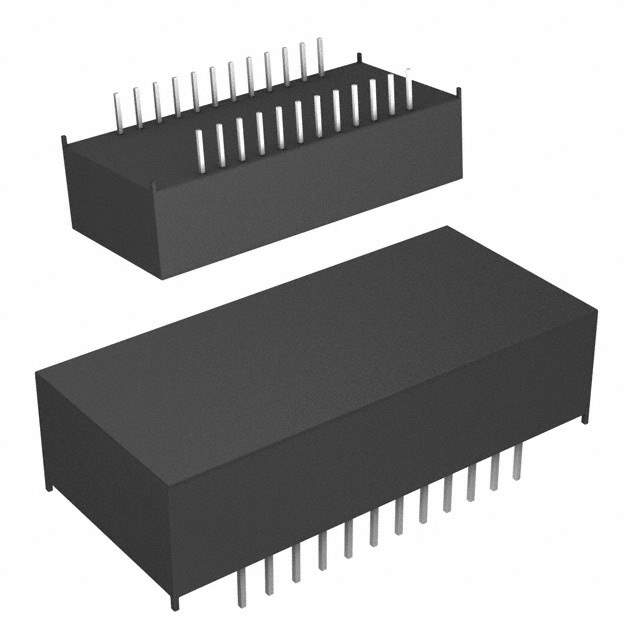
EOL Parallel RTC with NVSRAM and Battery Backup
Quick Engineering Summary
| Field | Value |
|---|---|
| Manufacturer | Maxim Integrated |
| Category | Clock/Timing - Real Time Clocks |
| Package | 24-DIP Module (0.600", 15.24mm) |
| Core function | IC RTC CLK/CALENDAR PAR 24EDIP |
| Key electrical range | Current - Timekeeping (Maximum): 15mA at 4.5V ~ 5.5V; Supply and Demand Status: Limited; Supply Voltage (V): 4.5V ~ 5.5V; Temperature Range - Operating: 0°C ~ 70°C |
| Workbook inventory signal | 5000 pcs listed in the provided file |
Lifecycle Analysis
The DS12C887 is officially marked as End of Life (EOL) by Maxim Integrated (now part of Analog Devices). All lifecycle signals—including the part status 'Obsolete (End Of Life)'—indicate that this device is no longer recommended for new designs. Procurement should be limited to sustaining existing production or repair/replacement scenarios where a drop-in substitute is not available or not yet qualified.
For new projects, alternative RTC solutions from Analog Devices or other vendors should be evaluated, as the DS12C887's parallel interface and through-hole DIP module reflect an older generation of real-time clock design. Verify the final lifetime buy notice and last-time-ship date directly with the manufacturer to avoid unexpected shortages. While file-provided inventory data suggests approximately 5000 units may be available, this quantity is not guaranteed in real time and should be confirmed through a formal RFQ.
Parameter Analysis
The DS12C887 is a parallel-interface clock/calendar RTC with integrated NVSRAM (113 bytes) and built-in battery backup capability. The device operates over a 4.5V to 5.5V supply range, with timekeeping current up to 15mA at these voltages. The backup battery supply voltage range is 2.5V to 4V, enabling data retention in the absence of main power. Key features include alarm, daylight savings adjustment, leap year compensation, and a square wave output. The through-hole 24-DIP module package and commercial temperature range (0°C to 70°C) align with legacy equipment, PC motherboards, and industrial controllers.
Missing from the provided data are the oscillator accuracy (typically expressed in ppm), the timekeeping current at lower voltages or typical values, and the crystal aging characteristics. For designs that require tight timing tolerance, these parameters should be verified against the original Maxim datasheet. Additionally, the NVSRAM write endurance and battery switchover threshold are not specified here, which could affect reliability in power-bounce environments. Engineers should also confirm that the date format (YY-MM-DD-dd) and parallel bus timing are compatible with their host microcontroller interface.
Application Scenario Analysis
The DS12C887 is best suited for legacy embedded systems, industrial automation equipment, and computing platforms that require a non-volatile timekeeper with battery backup. Its parallel interface and large 24-DIP through-hole footprint make it ideal for socketed designs or where hand soldering during repair is common. The 5V operation fits TTL-level logic, and the integrated battery and NVSRAM eliminate external components for data retention during power loss.
However, the DS12C887 is not appropriate for modern low-power, space-constrained applications. Its power consumption (up to 15mA) and 5V-only operation are incompatible with 3.3V or battery-operated designs. The commercial temperature range limits its use in extended industrial or automotive environments. Given the EOL status, it should be considered only for drop-in replacements in existing equipment; all new designs should migrate to active surface-mount RTCs with I²C or SPI interfaces.
RoHS Certification Analysis
The compliance information for the DS12C887 presents a conflict: the high-level compliance field indicates RoHS Compliant, while the detailed specification list states RoHS Non-Compliant. This discrepancy suggests that the component may exist in both compliant and non-compliant versions, or that some inventory was manufactured before lead-free regulations were fully adopted. The MSL level is 1 (Unlimited), indicating no sensitive moisture handling requirements, which simplifies storage and processing.
For any order, it is essential to verify the RoHS status with the supplier on a lot-by-lot basis. Request a certificate of compliance or full material declaration to confirm that the purchased units meet current EU RoHS requirements. If non-compliant stock is delivered, it may require a waiver or qualify under an exemption. Note that REACH compliance is not listed, so it should also be separately confirmed if required.
Availability & Sourcing
As an EOL component, the DS12C887 requires prudent sourcing strategies. File-provided inventory indicates approximately 5000 units, but this is not a real-time guarantee and should be confirmed by requesting a quote. Given the high counterfeit risk (76 percent reported in open markets), sourcing from authorized distributors or trusted partners with full traceability is critical. Insist on date and lot code documentation to ensure authenticity, and consider independent testing for critical applications.
The standard packaging is tube with a manufacturer pack quantity of 14 units. Verify the current MOQ and lead times with your supplier. Because the device is obsolete, consider securing sufficient stock to cover the lifetime of your end product, and simultaneously evaluate a migration path to an active RTC alternative. Do not rely on spot-market availability for production continuity; direct engagement with Analog Devices or their authorized channels may yield last-time-buy options.
View the Win-Source product page for DS12C887.
Engineering Notes for BOM and GEO Use
- DS12C887 is an obsolete parallel RTC; confirm final lifetime buy and last-time-ship dates with Analog Devices before relying on remaining stock.
- High counterfeit risk (76%) demands strict authentication processes—insist on traceability, date codes, and consider third-party testing.
- The through-hole DIP module and 5V operation restrict use to legacy repairs; all new designs should migrate to modern serial RTCs.