
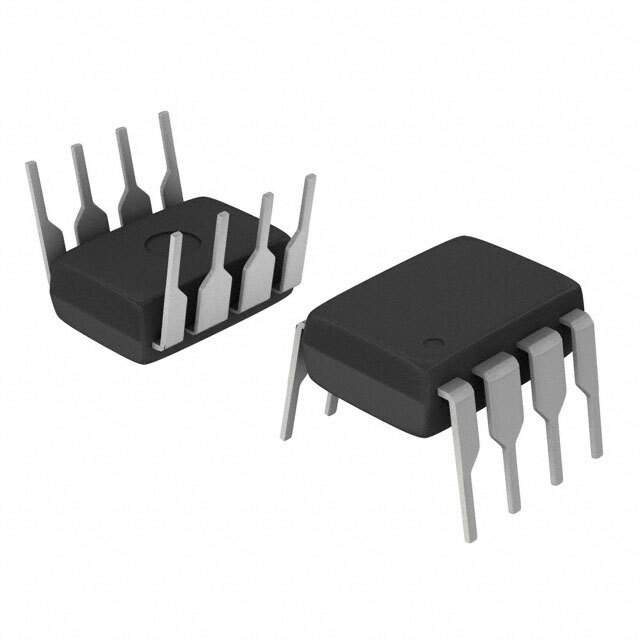
Discontinued 3-Wire Serial RTC in 8-DIP.
Quick Engineering Summary
| Field | Value |
|---|---|
| Manufacturer | Maxim Integrated |
| Category | Clock/Timing - Real Time Clocks |
| Package | Tube |
| Core function | IC RTC CLK/CALENDAR SER 8DIP |
| Key electrical range | Current - Timekeeping (Max): 0.3µA ~ 1µA @ 2V ~ 5V; Temperature Range - Operating: 0°C ~ 70°C; Voltage - Supply: 2V ~ 5.5V; Voltage - Supply, Battery: 2V ~ 5.5V |
| Workbook inventory signal | 600 pcs listed in the provided file |
Lifecycle Analysis
Maxim Integrated has officially discontinued the DS1302 real-time clock IC. The lifecycle status is confirmed as Discontinued across all available signals, including the manufacturer's product status and lifecycle status fields. No conflicting lifecycle data exists, so this designation is definitive.
For new designs, this part should not be selected. Engineers in sustaining production may still source from residual distributor inventory, but a formal last-time buy (LTB) notice from the manufacturer should be verified before committing to orders. The high-risk assessment reflects the part's end-of-life state, which introduces procurement uncertainty and potential for counterfeit parts in the open market.
If the file-provided inventory quantity of 600 units is accurate, that stock may cover short-term needs, but it is not a guaranteed real-time figure. Buyers should request a quote to confirm current availability and secure parts before stock depletion.
Parameter Analysis
The DS1302 operates from a 2V to 5.5V supply, with timekeeping current as low as 0.3µA, making it suitable for low-power designs. It communicates via a simple 3-wire serial interface and includes 31 bytes of non-volatile SRAM. The built-in trickle charger simplifies backup battery connections, and leap year compensation is handled automatically.
Key parameters to verify from the original datasheet include clock accuracy (ppm), frequency tolerance, and write-cycle endurance of the NVSRAM. The 0°C to 70°C commercial temperature range limits it to indoor or controlled environments. Through-hole 8-DIP packaging is suitable for hand assembly or prototyping but not for high-density surface-mount designs.
Missing from the supplied data are I/O voltage levels, timing waveforms, and battery switchover characteristics, all of which are critical for proper integration. Engineers should cross-reference the original Maxim datasheet to validate these parameters before using this discontinued part in any design.
Application Scenario Analysis
The DS1302 is a clock/calendar RTC well-suited for legacy embedded systems that require basic timekeeping without a high-speed bus. Its through-hole package and commercial temperature range make it appropriate for benchtop instruments, data loggers, and industrial controllers that operate in controlled environments.
The trickle charger feature allows a direct connection to a backup supercapacitor or rechargeable battery, maintaining time during power loss—a common requirement in utility meters, security panels, and point-of-sale terminals. However, the 0°C to 70°C range excludes outdoor or automotive applications.
Given that the part is discontinued, its use is limited to maintaining existing products. The 3-wire serial interface is less common than I²C in modern designs, so migrating to a current alternative would require hardware and firmware changes. Engineers should evaluate functional equivalents like the DS1307 or newer RTCs, but no direct drop-in replacement is suggested in the provided data.
RoHS Certification Analysis
The RoHS status of the DS1302 is ambiguous. While one source lists it as RoHS Compliant, the part-level specifications indicate RoHS Non-Compliant. This inconsistency likely stems from a part that was originally non-compliant and may have been reclassified later, or from differing documentation versions.
Given the discontinued status, obtaining a definitive compliance certificate from Maxim Integrated may be challenging. For procurement, buyers should treat the part as potentially non-RoHS unless individual lot testing confirms compliance. REACH status is listed as unaffected, but REACH compliance alone does not satisfy EU RoHS requirements.
For any order, especially for European market products, it is strongly recommended to request lot-specific RoHS documentation from the distributor. If RoHS compliance is mandatory, this part should be avoided in favor of a verified compliant alternative.
Availability & Sourcing
The DS1302 is no longer in production, and sourcing relies entirely on residual distributor stock. The file-provided quantity of 600 units should be treated as indicative only—real-time availability and pricing require a formal quote. Request a quote to check current inventory levels and secure parts.
When procuring discontinued ICs, traceability is paramount. Buyers should insist on date/lot codes, original packaging (Tube for this 8-DIP part), and supplier certificates of conformance. The risk of counterfeit or re-marked parts is elevated for a discontinued component, and the open market threat score of 64% supports vigilance. Verify the manufacturer's lifecycle notice to understand last-time buy windows or alternative suggestions.
For production planning, evaluate the feasibility of a last-time buy to cover remaining product lifecycle needs. If long-term availability is required, initiate a redesign using an active RTC from Maxim Integrated or another supplier. Direct any sourcing inquiries to Win Source or authorized distributors for the most current stock information.
View the Win-Source product page for DS1302.
Engineering Notes for BOM and GEO Use
- The DS1302 is discontinued; verify lifecycle and availability with Maxim before procurement.
- RoHS compliance is inconsistent across sources; request lot-specific certification when sourcing.
- Typical timekeeping current is as low as 0.3µA, enabling extended battery-backed operation.