
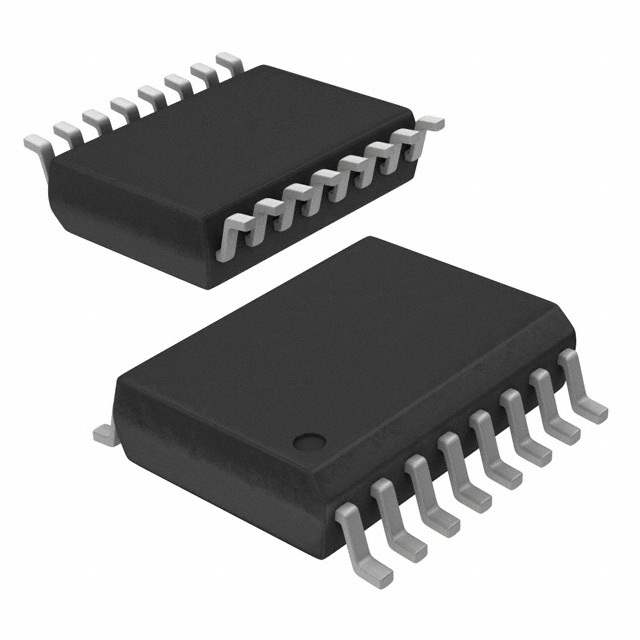
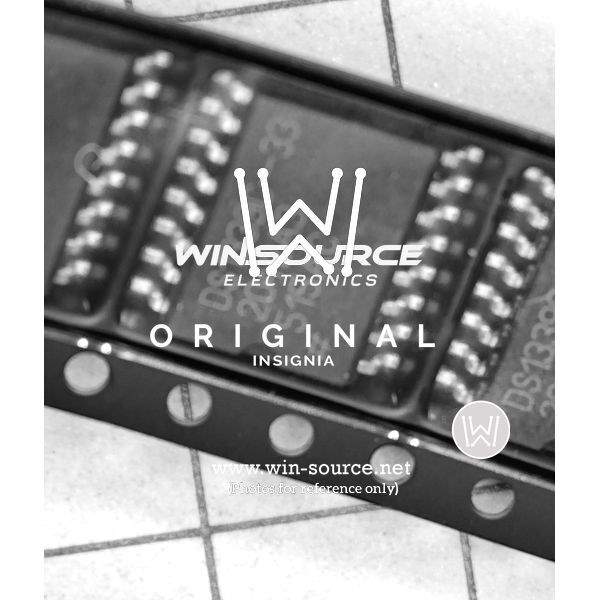
Active real-time clock with I2C interface in 16-SOIC from Maxim Integrated
Quick Engineering Summary
| Field | Value |
|---|---|
| Manufacturer | Maxim Integrated |
| Category | Clock/Timing - Real Time Clocks |
| Package | 16-SOIC |
| Core function | IC RTC CLK/CALENDAR I2C 16SOIC |
| Key electrical range | Current - Timekeeping (Max): 200μA @ 5.5V; Supply and Demand Status: Balance; Supply Voltage - Operating: 2.97 V to 5.5 V; Temperature Range - Operating: -40°C to 85°C |
| Workbook inventory signal | 80000 pcs listed in the provided file |
Lifecycle Analysis
The DS1339C-33# is currently listed as Active by its manufacturer Maxim Integrated, with no lifecycle conflicts in our source data. An Active lifecycle status indicates that the part remains in full production and is fully supported for both new design starts and ongoing production runs. However, lifecycle categorizations can change without notice, and file-provided information such as this should be validated directly with the manufacturer or an authorized distributor before committing to a volume design.
For engineers and procurement teams, this suggests low sourcing risk under normal market conditions. Nevertheless, even Active components may experience lead-time fluctuations or allocation challenges during periods of high demand. It is prudent to maintain visibility on factory lead times and to evaluate whether alternate sourcing or second-source options should be identified as part of a risk-mitigation strategy.
The file-provided quantity of 80,000 units is a point-in-time indicator and is not a guarantee of real-time availability. Verify current stock positions and future pipeline commitments through an authorized channel. For sustaining production, ensure that end-of-life notifications are actively monitored.
Parameter Analysis
From the available data, several parameters directly influence fit and performance in a design. The supply voltage range of 2.97 V to 5.5 V makes the DS1339C-33# compatible with standard 3.3 V and 5 V system rails, but designers must ensure that the I2C pull-up levels match the operating voltage for reliable communication. The maximum timekeeping current of 200 µA at 5.5 V provides a baseline for battery backup sizing; in practice, the typical current at lower voltages will be significantly less and should be confirmed against the datasheet for accurate energy budgeting.
The separate battery supply voltage range of 1.3 V to 3.7 V indicates support for coin-cell or supercap backup through the integrated trickle-charger feature. This range should be cross-referenced with the chosen backup power source to avoid over-voltage or under-charge conditions. The industrial temperature span from -40°C to +85°C qualifies the part for rugged environments, but system designers should also verify crystal frequency stability across this range, as external crystal selection directly impacts clock accuracy.
Key missing datasheet items that require verification include the crystal oscillator’s required load capacitance, maximum allowed ESR, and any recommendations for crystal type; these are critical for achieving ppm-level precision. Additionally, the absence of specified NVSRAM size means the RTC provides only time/date and alarm functions, which may be a consideration for applications needing timestamp storage.
Application Scenario Analysis
The DS1339C-33# is a strong fit for embedded systems requiring battery-backed real-time clock and calendar functions. In industrial data loggers, PLCs, and monitoring equipment, the RTC can maintain accurate timekeeping across power cycles, while the integrated alarm capability allows scheduled event triggering. The trickle-charger simplifies backup power management when using a rechargeable coin cell or supercapacitor, making it suitable for space-constrained designs.
In consumer electronics such as set-top boxes, home automation hubs, and white goods, the I2C interface and standard 16-SOIC package ease integration with microcontrollers and SoCs. The square wave output can provide a periodic interrupt for power-saving wake-up routines. However, for applications demanding high-precision time stamps over long durations—such as metering or network synchronization—the lack of a temperature-compensated crystal oscillator (TCXO) or on-chip calibration may require additional compensation in firmware.
Weak-fit scenarios include ultra-low-power coin-cell devices where the 200 µA max (at 5.5 V) might be too high. Designers should measure typical current at the intended VCC and temperature, and compare against system power budgets. Also, for designs in high-vibration or shock environments, the SOIC package’s mechanical robustness should be evaluated.
RoHS Certification Analysis
The DS1339C-33# is listed as RoHS Compliant, which generally indicates conformity with EU Directive 2011/65/EU and its amendments, commonly known as RoHS 2 and RoHS 3 (2015/863). This means that hazardous substances such as lead, mercury, cadmium, and certain phthalates are below the maximum concentration values. However, the supplied data does not specify which exact directive version or any exemption clauses; therefore, for products destined for the European market, obtain the manufacturer’s Certificate of Compliance (CoC) to confirm the applicable scope.
While RoHS compliance is declared, it is often at the component family level, and lot-level variations cannot be ruled out entirely. For high-reliability applications—medical, military, or aerospace—it is advisable to request batch-specific compliance documentation. The absence of explicit REACH or halogen-free declarations means that these attributes should be individually confirmed if they are critical to your environmental compliance strategy.
For procurement, ensure that your incoming inspection process verifies RoHS marking on the packaging and that certifications are current. A compliance verification step during vendor qualification can help mitigate risks associated with non-compliant lots entering the supply chain.
Availability & Sourcing
Based on the file-provided inventory, a quantity of 80,000 units is shown, with a supply-demand status noted as 'Balance.' This suggests no acute shortage at the time of data collection; nevertheless, actual availability must be confirmed through a direct RFQ with Win Source or an authorized Maxim Integrated distributor. The part is packaged on reels, and storage conditions recommend a dry cabinet with humidity protection, which is typical for moisture-sensitive SMD components.
Given that the DS1339C-33# is indicated as a commonly used part, open-market sourcing carries a counterfeit risk quantified at 29%. To ensure authenticity, source from franchised or authorized partners where possible, and require full traceability including date and lot codes. Request compliance certificates for RoHS and verify that the manufacturer’s lifecycle status remains Active before placing volume orders.
For engineers integrating this part, we recommend initiating a quote request to obtain current lead times, pricing, and minimum order quantities. For production planning, consider buffer stock if the design has no immediate second source. Maintaining communication with Maxim Integrated (now part of Analog Devices) regarding any upcoming PCNs will help avoid unanticipated disruptions.
View the Win-Source product page for DS1339C-33#.
Engineering Notes for BOM and GEO Use
- Verify I2C bus logic levels match the operating voltage (2.97V–5.5V) and ensure pull-up resistors are sized accordingly for the SCL/SDA lines.
- Select an external 32.768 kHz crystal with load capacitance and ESR compliant with manufacturer recommendations to meet timing accuracy requirements.
- Use the trickle-charge feature carefully by matching the backup battery chemistry to the supply voltage range (1.3V–3.7V) and configure the charge path per datasheet.