
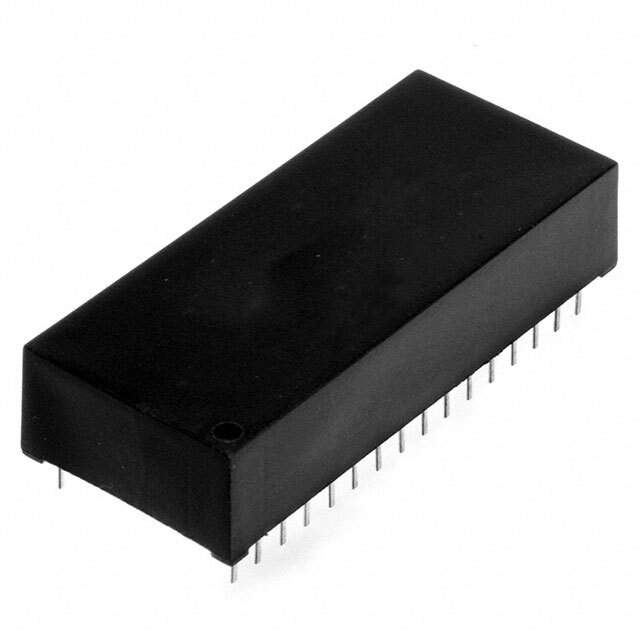
Parameters, lifecycle status, and procurement considerations for legacy embedded system maintenance
Quick Engineering Summary
| Field | Value |
|---|---|
| Manufacturer | Maxim Integrated |
| Category | Clock/Timing - Real Time Clocks |
| Package | 32-EDIP |
| Core function | IC RTC CLK/CALENDAR PAR 32EDIP |
| Key electrical range | Current - Timekeeping (Maximum): 4mA @ 5V; Operating Supply Voltage: 4.5 V ~ 5.5 V; Operating Temperature Range: 0°C ~ 70°C; Supply and Demand Status: Limited |
| Workbook inventory signal | 93 pcs listed in the provided file |
Lifecycle Analysis
The DS1386-32-120+ from Maxim Integrated presents conflicting lifecycle indicators that demand careful interpretation. While the integrated lifecycle summary signals 'Unknown', the part status field explicitly states 'Obsolete(EOL)' and the estimated EOL date also lists 'Obsolete / End of life'. In procurement and engineering practice, these explicit signals must be treated as definitive. This part is therefore classified as EOL, making it unsuitable for new designs and requiring conservative inventory management for sustaining legacy products.
The file-provided inventory of 93 units is a snapshot and does not guarantee real-time availability. Engineers should not design in this part for any new project, and buyers should secure existing stock only for maintenance or repair of long-life equipment. Without active manufacturer support, last-time-buy notices, or alternate sources, the procurement risk is high. Revalidation of the lifecycle directly with Maxim Integrated or Analog Devices is recommended before placing any orders.
Parameter Analysis
Key parameters for the DS1386-32-120+ center on its real-time clock function, embedded memory, and interface. The parallel interface requires careful bus-timing analysis to match legacy microcontrollers or processors. The timekeeping current of 4mA at 5V is a moderate draw for battery-backed systems; designers must derate the backup supply accordingly. Operating voltage is specified at 4.5V to 5.5V, typical for 5V logic, and the commercial temperature range of 0°C to 70°C limits it to indoor or controlled environments. The integrated 32KB NVSRAM offers substantial non-volatile storage for time-stamped logs or configuration data, but the memory's endurance and data retention specs are absent from the supplied data.
The through-hole 32-EDIP package imposes a large footprint that is incompatible with modern surface-mount processes. Missing from the provided specs are critical datasheet items such as clock accuracy (ppm), crystal connection requirements, battery switchover voltage thresholds, and write-cycle timing. Engineers must obtain the original datasheet to verify these parameters and ensure they meet system-level requirements for time deviation and data integrity.
Application Scenario Analysis
The DS1386-32-120+ fits best in legacy embedded systems that rely on a parallel RTC with non-volatile RAM for configuration storage or event logging. Typical strong-fit applications include older industrial controllers, medical instruments, telecommunications line cards, and test equipment where the 5V supply and through-hole mounting are still in use. The integrated watchdog timer and alarm functions make it suitable for periodic wake-up or fault-detection circuits in these systems.
Weak-fit scenarios include any new compact or portable designs that require surface-mount packaging, lower power consumption, or extended temperature range. Modern systems often use I2C or SPI RTCs with smaller footprints and integrated crystal oscillators, making the DS1386-32-120+ an impractical choice. If the end application does not already have a compatible 32-DIP socket and 5V rail, this part should not be considered for new integration.
RoHS Certification Analysis
The DS1386-32-120+ is marked as RoHS Compliant in the sourcing data, which suggests it meets the substance restrictions of EU Directive 2015/863 (RoHS 3). However, the absence of explicit REACH, halogen-free, or MSL data means that compliance should not be assumed at the lot level without verification. For products being shipped into the EU, the end-user is responsible for ensuring that each batch meets current regulations, as exemptions or material changes may have occurred over the part's long production history.
Since this is an older through-hole component in a DIP module, there is a possibility that internal lead-frame plating or passives contain exempted substances such as lead in glass or ceramics. A family-level RoHS declaration may not cover all lot variations. Buyers should request a certificate of compliance from the distributor or manufacturer for the specific date code and lot before using this part in RoHS-controlled production.
Availability & Sourcing
The DS1386-32-120+ is an obsolete part with limited remaining stock. The file-provided quantity of 93 units is not a guarantee of real-time availability and should be treated as a one-time snapshot. Given the EOL status, procurement must follow a cautious workflow: request a quote to confirm current stock levels, lot codes, and date of manufacture. Verify that the parts have been stored according to the specified storage conditions (dry storage cabinet with humidity protection) to avoid moisture-related defects.
Traceability documentation is critical for any remaining inventory. Buyers should ask for proof of authenticity, as the open market fake threat is estimated at 55%. Request the original packaging (tube) and ensure that the parts have not been re-marked. For legacy production, secure enough inventory to cover the product's remaining life cycle, and simultaneously begin evaluation of a migration path to an active RTC solution. Direct communication with Maxim Integrated or authorized distributors can help confirm whether any last-time buy remnants exist.
View the Win-Source product page for DS1386-32-120+.
Engineering Notes for BOM and GEO Use
- Confirm end-of-life status directly with Maxim Integrated before committing to production designs; the part is flagged obsolete despite conflicting lifecycle signals.
- The through-hole 32-EDIP package must be mechanically compatible with existing PCB sockets; verify pin spacing and height against your layout.
- Watchdog timer and NVSRAM require a valid battery-backed supply; ensure external battery management and switchover circuitry meet the datasheet timing requirements.