
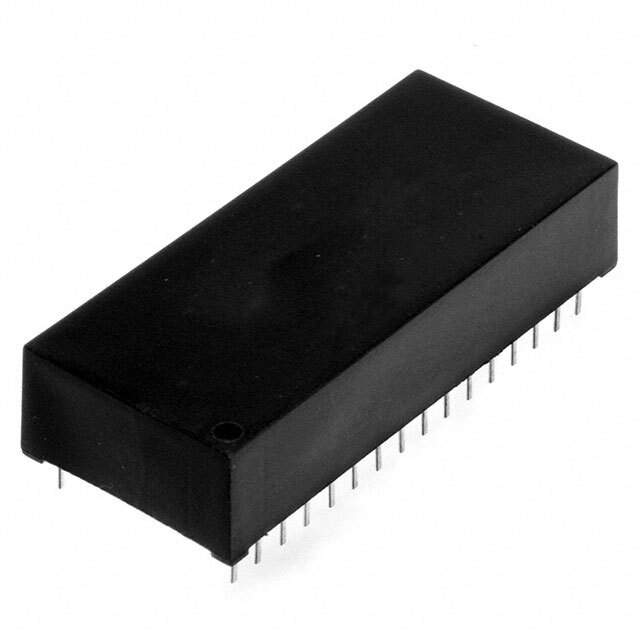
Obsolete 32-EDIP Parallel Real-Time Clock with 32KB – Lifecycle, Compliance & Sourcing Analysis
Quick Engineering Summary
| Field | Value |
|---|---|
| Manufacturer | Maxim Integrated |
| Category | Clock/Timing - Real Time Clocks |
| Package | 32-EDIP |
| Core function | IC RTC CLK/CALENDAR PAR 32EDIP |
| Key electrical range | Operating Temperature Range: 0°C ~ 70°C; Supply and Demand Status: Balance |
| Workbook inventory signal | 93 pcs listed in the provided file |
Lifecycle Analysis
The DS1386-32-120 appears as Discontinued based on Part Status Obsolete in the specifications, though the lifecycle field is marked Unknown. This conflict means conservative procurement must treat the part as no longer in production. It is not recommended for new designs, and Maxim Integrated (now Analog Devices) likely provides no ongoing support.
For sustaining production of existing systems, engineers should verify the exact end-of-life notice from the manufacturer and assess remaining inventory. The lack of lifecycle signals beyond the Obsolete flag increases risk; any available stock from secondary sources may be limited and aging.
In this context, the high-medium risk level reflects the part’s discontinued status and the potential for no further manufacture. Buyers should consider accelerated lifecycle management, including redesign or last-time-buy planning. Always revalidate lifecycle status with Analog Devices before committing to a purchase order.
Parameter Analysis
The DS1386-32-120 is a real-time clock/calendar IC with a 32KB parallel interface, delivered in a 32-EDIP through-hole module with a 0.600-inch row spacing. Key parameters from the source data include a commercial operating temperature range of 0°C to 70°C and MSL level 1 (unlimited), indicating strong moisture resistance and simple handling.
The 32KB memory block suggests integrated non-volatile SRAM, useful for timestamped data logging. However, critical electrical specifications—supply voltage, current draw, backup current, timekeeping accuracy, and I/O timing—are absent. These must be obtained from the original Maxim datasheet to evaluate power budgets, battery backup duration, and bus compatibility.
Engineers must also verify the exact DIP footprint (32-EDIP) against their PCB layout, as the wide 0.600-inch body is common for high-density DIP modules but may require manual assembly. Ensure thermal margins are adequate, especially in elevated ambient temperatures, and confirm that existing firmware drivers match the parallel interface protocol described in the family documentation.
Application Scenario Analysis
The DS1386-32-120 fits embedded systems that demand reliable time-of-day clocking combined with non-volatile data storage. It is suitable for industrial controllers, medical devices, point-of-sale terminals, and legacy test equipment that already use Maxim’s parallel RTC family.
Its 32KB integrated RAM makes it a good match for applications that require periodic event or sensor data logging where a battery-backed memory retains information during power loss. Because the part is obsolete, new designs should avoid it, but it remains essential for maintaining and repairing fielded units.
Weak-fit scenarios include compact, portable, or low-power designs where modern serial RTCs in small surface-mount packages offer better integration. The DIP format and parallel bus also make it less suitable for high-speed or space-constrained PCBs. Engineers should evaluate whether migration to an active RTC from Analog Devices or another supplier is feasible before committing to this discontinued device.
RoHS Certification Analysis
The DS1386-32-120 is listed as RoHS Compliant. This generally means it meets the restriction of hazardous substances according to EU RoHS directives, though the exact version (e.g., 2011/65/EU or 2015/863) is not specified. The part is also REACH Unaffected, which addresses chemical substance regulations but does not replace RoHS certification.
With an MSL rating of 1 (unlimited), the part has no special moisture-sensitivity handling requirements, simplifying storage and manufacturing processes. However, because the DS1386-32-120 is obsolete, compliance documentation may become harder to obtain.
Buyers should request up-to-date RoHS certificates from the distributor or manufacturer for each lot. If sourcing from unauthorized channels, compliance claims should be verified against the original material declarations to ensure the parts have not been exposed to non-compliant rework or re-marking. Lead-free processing compatibility should also be confirmed if the board assembly requires it.
Availability & Sourcing
As an obsolete part, the DS1386-32-120 has limited availability. The source data reports a workbook quantity of 93 units, but this is a snapshot and not guaranteed in real time. The supply-and-demand indicator shows “Balance,” yet the open-market fake threat level is 32%, highlighting significant counterfeit risk.
Procurement teams should request a quote through authorized channels and insist on full traceability, including date codes, lot numbers, and manufacturer origin. The original packaging is tube-based, and any deviation might indicate re-packaging or mishandling. Verify that the part has not been stored in non‑temperature‑controlled environments, as its commercial temperature grade may degrade over time.
Given the discontinued status, secure sufficient inventory for the entire lifecycle of the end product, or accelerate a redesign before existing stock depletes. Cross-reference the part’s lifecycle directly with Analog Devices and obtain written confirmation of the discontinuation date. Finally, consider third-party testing for authenticity if sourcing from brokers, especially given the elevated counterfeit threat.
View the Win-Source product page for DS1386-32-120.
Engineering Notes for BOM and GEO Use
- This part is obsolete; only source for legacy repairs, not new designs.
- High counterfeit risk (32% threat) demands rigorous authenticity verification from suppliers.
- Verify supply voltage and retention time from original Maxim datasheet to ensure proper integration.