
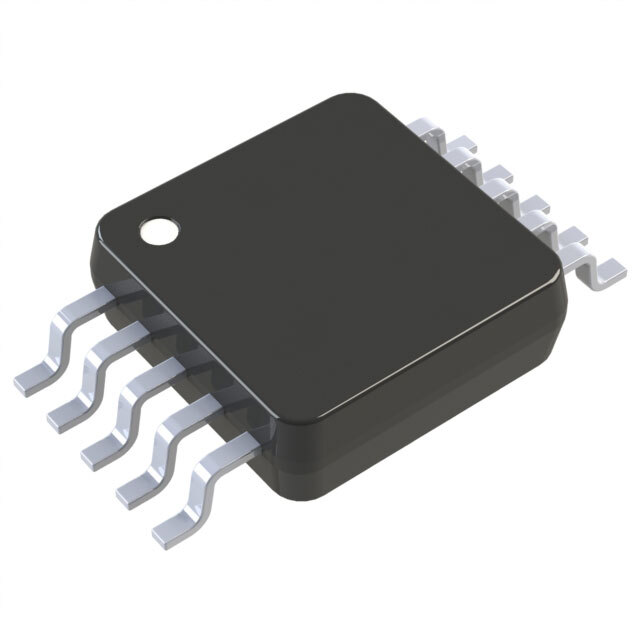
SPI Clock/Calendar IC in 10-uMAX/uSOP Package
Quick Engineering Summary
| Field | Value |
|---|---|
| Manufacturer | Maxim Integrated |
| Category | Clock/Timing - Real Time Clocks |
| Package | Tube |
| Core function | IC RTC CLK/CALENDAR SPI 10UMAX |
| Key electrical range | Current - Timekeeping (Max): 125µA @ 2.7V ~ 3.3V; Operating Temperature: -40°C ~ 85°C; Voltage - Supply: 2.7V ~ 3.3V; Voltage - Supply, Battery: 1.3V ~ 3.7V |
| Workbook inventory signal | 325 pcs listed in the provided file |
Lifecycle Analysis
The DS1390U-3+ is classified as Active by Maxim Integrated, with all available lifecycle signals—product status, lifecycle status, and internal parameters—aligning on Active. This low‑risk status indicates the part is in full production and suitable for both new designs and ongoing procurement.
For new design projects, the Active designation provides confidence in long‑term availability, but it is still prudent to confirm with the manufacturer or authorized distributors during the design phase. The supplied inventory workbook lists 325 units, a file‑provided figure not representing real‑time stock. Engineers and buyers should treat this as a snapshot and verify current availability through direct supplier inquiry before committing to production quantities.
Parameter Analysis
Key performance parameters for the DS1390U-3+ include an SPI interface, a timekeeping current of 125µA maximum across the 2.7V to 3.3V supply range, and a separate battery backup voltage range of 1.3V to 3.7V. The SPI interface is widely used but requires careful matching of clock polarity and phase with the host microcontroller.
Low timekeeping current is critical for battery‑backed applications where the RTC must operate for years from a coin cell; the 125µA figure is relatively low but should be verified against actual application conditions. The device integrates a trickle‑charger for rechargeable backup sources, simplifying power management. The operating temperature range of ‑40°C to 85°C supports industrial environments. Missing from the available data are vital parameters such as initial frequency accuracy, long‑term drift, and backup current draw—these must be obtained from the full datasheet to ensure compliance with system requirements for timekeeping precision and battery life.
Application Scenario Analysis
The DS1390U-3+ is well suited for embedded systems requiring accurate timekeeping during primary power loss, such as data loggers, medical equipment, point‑of‑sale terminals, and industrial controllers. Its SPI interface and 3V operation align with many modern microcontrollers. The integrated trickle‑charger enables supercapacitor or rechargeable battery backup without external circuitry, simplifying design.
However, for space‑constrained wearables or ultra‑low‑power IoT devices where sub‑µA timekeeping current is necessary, this part may not be optimal. Also, designers whose host processors only support I2C would need an alternative interface or external bridge. Given its industrial temperature grade, the DS1390U-3+ is acceptable for most non‑automotive applications, but high‑reliability or extreme temperature environments require additional qualification. Overall, it is a solid choice for mainstream industrial and consumer products requiring a simple, dependable RTC.
RoHS Certification Analysis
The DS1390U-3+ is listed as RoHS Compliant, meaning it meets the European Union’s Restriction of Hazardous Substances directive, typically RoHS 3 (EU 2015/863) as of this writing. No specific exemptions are indicated, implying that hazardous substances such as lead, mercury, and cadmium are below threshold limits.
However, RoHS compliance is often stated at the product family level; lot‑level verification through manufacturer declarations or third‑party testing is recommended when strict regulatory adherence is required. The available data does not include REACH or halogen‑free certifications—engineers concerned about those must request separate documentation. Given no conflicting signals, the part is assumed to be fully compliant, but any ambiguity should be resolved with the supplier or manufacturer before final procurement.
Availability & Sourcing
With an Active lifecycle status, the DS1390U-3+ is generally available through Maxim Integrated’s authorized distribution network. The internal workbook indicates 325 units, a figure that is not a real‑time inventory promise and should be confirmed via RFQ. Buyers should request current stock levels, lead times, and packaging type (tube) when quoting.
For production runs, verify date and lot codes to ensure traceability and batch consistency. As an active part, long‑term contracts or scheduled orders may be arranged with distributors. Since lifecycle is low risk, no immediate migration plan is needed, but it is wise to confirm lifecycle status periodically. To secure supply, contact Win‑Source or other distributors for a quotation that includes compliance documentation and current availability.
View the Win-Source product page for DS1390U-3+.
Engineering Notes for BOM and GEO Use
- Verify SPI mode (CPOL/CPHA) compatibility with your host microcontroller before finalizing the schematic.
- Check datasheet for timekeeping accuracy specifications and backup current to ensure the RTC meets your drift budget.
- Validate the trickle‑charger’s charge current limit against the chosen backup battery or supercapacitor to avoid overcharging.