
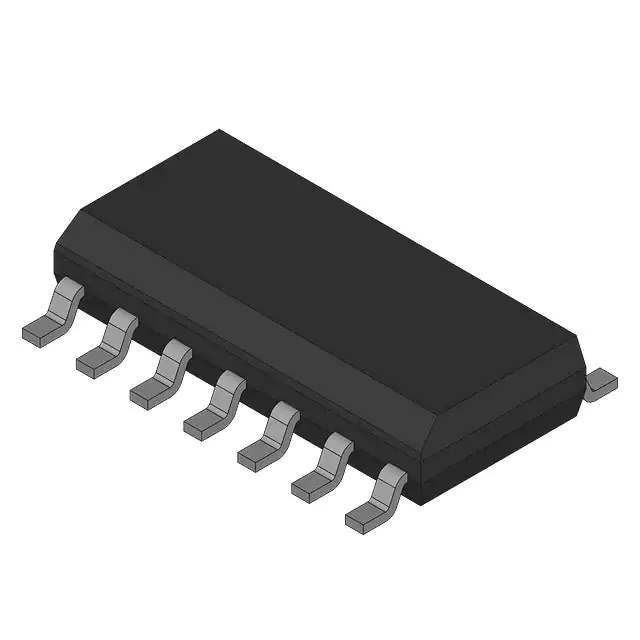
Discontinued RS232 Driver in 14-SOIC Package
Quick Engineering Summary
| Field | Value |
|---|---|
| Manufacturer | National Semiconductor (TI) |
| Category | Interface - Drivers, Receivers, Transceivers |
| Package | Tube |
| Core function | IC TRANSCEIVER 4/0 14SOIC |
| Key electrical range | Voltage - Supply: ±6V ~ 15V |
| Workbook inventory signal | 45000 pcs listed in the provided file |
Lifecycle Analysis
The DS1488M from National Semiconductor (TI) carries a discontinued lifecycle status, indicating that the manufacturer has ceased production and will not supply new orders. This high-risk designation means the part should never be used in new designs. For existing production lines, immediate action is needed to secure remaining inventory and to begin evaluating pin-compatible or functionally equivalent replacements.
A file-provided distributor listing shows a stock quantity of 45,000 units, but this snapshot is not real-time and may not reflect current availability. Any procurement should be preceded by direct confirmation of on-hand stock, date codes, and packaging condition.
Engineering and purchasing teams should treat the DS1488M as non-sustainable. For long-term viability, planning a migration to an active RS232 driver with similar supply voltage range is strongly recommended. Verify the manufacturer’s official product discontinuation notice for any last-time-buy opportunities or support commitments.
Parameter Analysis
The DS1488M is a quad RS232 line driver with 4 drivers and no receivers, supplied in a 14-SOIC surface-mount package. Key parameters include a dual supply voltage range of ±6V to ±15V, which supports both standard 12V and 15V RS232 voltage levels. This range is critical for ensuring proper signal swing and noise margins in legacy industrial and communication interfaces.
The driver-only configuration means the DS1488M cannot support full-duplex communication without an external receiver IC. The SOIC package is widely used but requires careful PCB layout for thermal and signal integrity. Missing datasheet specifications such as maximum data rate, output slew rate, and operating temperature range must be obtained from the original manufacturer documentation to validate performance in target applications.
Given a reported fake threat level of 37% in the open market, parameter verification through sample testing is essential if parts are sourced outside authorized channels. The ECCN classification of EAR99 simplifies export compliance for international procurement.
Application Scenario Analysis
The DS1488M is most suitable for RS232 transmit-only applications requiring level shifting from TTL/CMOS logic levels to RS232 signal levels. Typical use cases include UART output lines in legacy embedded systems, industrial sensors, or point-of-sale terminals where multiple RS232 transmit channels are needed but receive functionality is handled separately.
Because it provides four independent drivers, the DS1488M can consolidate multiple RS232 outputs in a single device, saving board space in dense designs. However, the lack of receiver circuitry and its discontinued lifecycle limit its applicability in new designs. For full-duplex RS232 ports, a complementary receiver IC must be added, increasing BOM complexity.
This part is not recommended for new high-reliability or high-volume products due to supply uncertainty. Legacy repair or small-scale sustaining production remain the only appropriate use cases, provided genuine stock can be reliably sourced.
RoHS Certification Analysis
RoHS compliance for the DS1488M is ambiguous. One data field shows “RoHS Compliant,” while another specification explicitly states “RoHS Non-Compliant.” This conflict must be resolved before the part is used in markets subject to EU RoHS or similar regulations. If the device is indeed non-compliant, its use may be prohibited in many commercial and industrial applications.
Compliance status can vary by manufacturing lot or date code, so even a “Compliant” family-level designation does not guarantee that all units meet current RoHS 3 (EU 2015/863) requirements. Engineering teams should request a certificate of compliance specific to the purchased lot.
No REACH, MSL, or halogen-free declarations are provided in the source data, so those should be separately obtained if required by the end application. Treating the part as non-compliant until verified is the conservative procurement approach.
Availability & Sourcing
The DS1488M is only available through distribution of remaining stock. A single file-provided record indicates approximately 45,000 units in tube packaging from Win Source, but this quantity is not guaranteed and may represent aggregated data rather than live inventory. Standard package quantity is 1,902 pieces per tube.
Sourcing this discontinued part carries significant counterfeit risk—a documented 37% fake threat in the open market. Buyers must insist on full traceability, including manufacturer certificate of origin, date/lot code documentation, and ideally third-party authenticity testing. Request a quote with explicit verification of lifecycle status and RoHS compliance for the specific stock being offered.
For ongoing production needs, the recommended path is to transition to an active alternative. If the DS1488M is absolutely required for a legacy repair, secure enough units to cover the remaining service life and perform incoming inspection to validate electrical performance.
View the Win-Source product page for DS1488M.
Engineering Notes for BOM and GEO Use
- Discontinued status means no future manufacturer supply; only use DS1488M for legacy repairs and verify stock before ordering.
- RoHS compliance is ambiguous; treat as non-compliant until the manufacturer confirms specific lot compliance.
- 37% open-market fake threat requires strict anti-counterfeit measures: authorized sourcing, lot traceability, and electrical testing.