
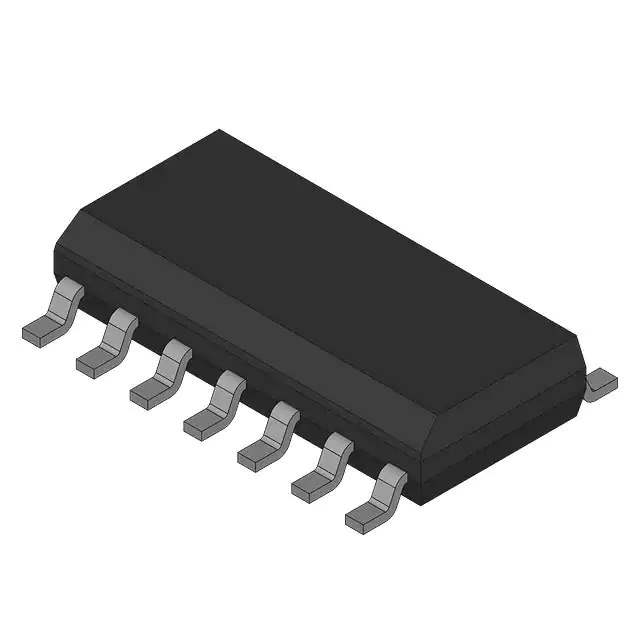
Discontinued 14‑SOIC RS232 receiver from National Semiconductor (TI) – specifications, compliance, and sourcing guidance.
Quick Engineering Summary
| Field | Value |
|---|---|
| Manufacturer | National Semiconductor (TI) |
| Category | Interface - Drivers, Receivers, Transceivers |
| Package | Bulk |
| Core function | IC TRANSCEIVER 0/4 14SOIC |
| Key electrical range | Voltage - Supply: 4.75V ~ 5.25V |
| Workbook inventory signal | 2240 pcs listed in the provided file |
Lifecycle Analysis
The DS1489AMX is a discontinued part from National Semiconductor, now part of Texas Instruments. Discontinued status means the manufacturer no longer produces this device, and no new design activity should rely on it. For existing production lines, this creates a high‑risk procurement situation where only residual stock is available.
File‑provided inventory indicates 2240 units, but this figure is not a real‑time guarantee and may represent a single lot or aggregated data. Engineers and buyers must verify current stock with authorized distributors or via an RFQ. Without a manufacturer‑backed supply, long‑term availability is uncertain, and any last‑time‑buy opportunity has passed.
For sustaining production, immediate inventory assessment is critical. If the DS1489AMX is essential, secure the remaining stock and concurrently evaluate a migration to an active alternative. Ignoring the discontinued lifecycle exposes designs to counterfeit risks and supply disruptions.
Parameter Analysis
The DS1489AMX is a 4‑channel RS232 receiver with zero drivers, operating from a single 4.75V to 5.25V supply. These parameters define its role in legacy logic‑level translation and serial communication. The four receivers suggest a typical application receiving multiple RS232 signals from a host or peripheral. The supply voltage range aligns with standard 5V logic, making it compatible with many industrial and computing platforms of its era.
The 14‑SOIC surface‑mount package (3.90mm width) dictates PCB layout and thermal considerations. The part is classified as a receiver, not a transceiver, because it lacks driver circuits. The RS232 protocol designation implies compliance with the EIA‑232 standard for voltage levels, though exact input thresholds, data rate, and hysteresis are not provided in the sourcing data.
Critical missing parameters include propagation delay, input impedance, ESD classification, and temperature range. Designers must obtain the official National Semiconductor datasheet to verify these values. Without this data, evaluating noise margin, speed, or ruggedness is incomplete. The part should not be deployed in new designs until these specifications are confirmed.
Application Scenario Analysis
Strong‑fit scenarios for the DS1489AMX are legacy RS232 interfaces requiring multiple receivers in a compact footprint. Typical applications include industrial machinery, point‑of‑sale terminals, and older computing equipment where 5V logic and through‑hole or SMD construction were standard. The four receivers make it suitable for monitoring multiple serial lines in a diagnostic or data‑collection node.
Weak‑fit scenarios include modern designs operating at lower voltages (3.3V or below) or requiring integrated transceivers. The part’s discontinued status and limited voltage range make it inappropriate for new, high‑reliability, or cost‑optimized products. Designs needing higher data rates beyond classic RS232 speeds may also find the DS1489AMX insufficient.
Engineers maintaining legacy systems may use the DS1489AMX for repairs, but a formal lifecycle‑management plan is necessary. Without a guaranteed supply, even repair‑only use carries risk. Any new production ambition should be replaced by an active alternative from TI or a second‑source vendor.
RoHS Certification Analysis
The RoHS compliance status of the DS1489AMX presents a conflict within the provided data. The compliance summary reports RoHS Compliant, but the detailed specification list includes a field indicating RoHS Non‑Compliant. This discrepancy may stem from lot‑level variations, data entry errors, or different interpretations of the standard. For procurement decisions, the more conservative reading – non‑compliant – should be adopted unless manufacturer documentation proves otherwise.
Neither REACH status, halogen‑free declarations, nor moisture sensitivity levels are provided. The absence of these environmental compliance markers makes the part unsuitable for designs demanding full material declarations. Buyers must request a current certificate of compliance from the supplier for each shipment.
In the EU, the RoHS 3 directive (2015/863) applies, and any non‑compliant component shipped into the region carries regulatory risk. A conservative approach is to treat the DS1489AMX as non‑compliant and seek an alternative with clear, verifiable compliance for new production.
Availability & Sourcing
The DS1489AMX is discontinued, making availability unpredictable. A file‑reported quantity of 2240 units exists, but this figure does not reflect live stock. The open‑market fake threat is cited at 70%, which is extremely high, demanding rigorous authenticity checks. Buyers should only source through authorized or vetted channels and perform incoming inspection for date/lot code consistency, pin‑one markings, and package integrity.
To obtain real‑time availability, submit an RFQ. Specify required quantity, desired date codes, and request compliance documentation upfront. For discontinued parts, traceability to the original manufacturer’s lot is essential to avoid counterfeit product. Any offer lacking this documentation should be rejected.
Given the high risk, a two‑pronged strategy is recommended: secure immediate inventory for emergency production needs while simultaneously evaluating pin‑compatible alternatives from Texas Instruments or other RS232 receiver suppliers. Do not rely on DS1489AMX stock for long‑term production without a confirmed second source.
View the Win-Source product page for DS1489AMX.
Engineering Notes for BOM and GEO Use
- Request full traceability documentation and visual inspection due to 70% fake threat in open market.
- Confirm RoHS status per lot, as reported data conflicts between compliant and non‑compliant.
- Verify exact electrical parameters from the original National Semiconductor datasheet before PCB layout.