
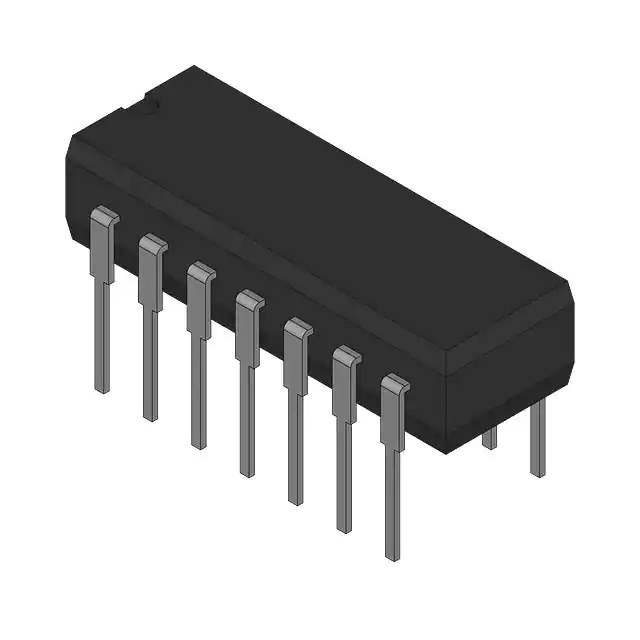
Discontinued through‑hole RS232 receiver in 14‑PDIP; verify lifecycle and RoHS compliance before procurement.
Quick Engineering Summary
| Field | Value |
|---|---|
| Manufacturer | National Semiconductor (TI) |
| Category | Interface - Drivers, Receivers, Transceivers |
| Package | Tube |
| Core function | IC TRANSCEIVER 0/4 14PDIP |
| Key electrical range | Voltage - Supply: 4.75V ~ 5.25V |
| Workbook inventory signal | 7670 pcs listed in the provided file |
Lifecycle Analysis
The DS1489AN is classified as Discontinued across all available lifecycle signals, including Lifecycle Status and Product Status. This means the part is no longer in production by National Semiconductor (now Texas Instruments) and no new orders are being accepted by the manufacturer.
For new designs, the DS1489AN should not be considered. Engineering teams must select an alternative active receiver that meets the RS232 interface requirements and pin‑count needs. Using a discontinued part in new production carries high risk of supply interruption and long‑term unavailability.
For existing sustaining products, immediate action is required. Buyers should secure last‑time buys if still available through authorized channels, while engineering begins qualifying a replacement. The source data references a file‑provided quantity of 7,670 pieces, but this is not a live inventory figure and must be confirmed with a distributor. Also request the manufacturer’s official discontinuation notice to understand the timeline and any extended support options.
Parameter Analysis
Key parameters for the DS1489AN that drive design‑in decisions include its type as a pure receiver (0 drivers, 4 receivers), adherence to the RS232 protocol, and a supply voltage range of 4.75V to 5.25V. The 5V ±5% supply window is typical for legacy RS232 line circuits and requires a stable regulated rail; engineers should derate accordingly for noise margins.
The through‑hole 14‑PDIP package (0.300″ width) dictates PCB layout and assembly process. It is not suited for surface‑mount reflow, limiting its use to boards designed for manual or wave soldering. The 4‑receiver count matches many multi‑channel RS232 applications where only the receive side is needed, such as terminal servers or modem interfaces.
Important datasheet values are missing from the source data and must be verified: maximum data rate, input hysteresis, receiver input thresholds, ESD rating, and operating temperature range. Without these, signal integrity and robustness cannot be guaranteed. Obtain the original National Semiconductor datasheet (possibly under Texas Instruments archives) to confirm those limits before finalizing a design or purchasing substitutes.
Application Scenario Analysis
The DS1489AN finds strong fit in applications that still rely on RS232 communication with through‑hole DIP packaging. Legacy industrial equipment, point‑of‑sale terminals, and telecommunications gear from the 1990s–2000s often used DIP receivers like this. Repair depots, aftermarket service centers, and retrofits where surface‑mount conversion is impractical benefit from the through‑hole form factor. Its 4‑receiver configuration matches multi‑drop or control signal monitoring tasks without needing drivers.
Conversely, the DS1489AN is a weak fit for modern designs. New products requiring miniaturization, high‑density assembly, or high‑speed interfaces should avoid a discontinued through‑hole part. High‑volume manufacturing would suffer from soldering process incompatibility and supply uncertainty. Even low‑volume new designs should migrate to active SMD RS232 transceivers with integrated charge pumps and smaller footprints.
Educational and prototyping labs might still use the DS1489AN due to its easy‑to‑breadboard DIP package and forgiving 5V operation. However, given the discontinuation, instructors and hobbyists should source remaining stock only for non‑critical projects and be aware of counterfeit risks in open‑market purchases.
RoHS Certification Analysis
The compliance record in the source data states that the DS1489AN is RoHS Compliant, while a separate specifications entry lists RoHS Non‑Compliant. This contradiction requires immediate attention during procurement.
Such conflicts often arise from different manufacturing timeframes or incomplete data migration. Early production lots may have been non‑compliant (e.g., leaded terminations), while later lots were converted to meet RoHS. Without lot‑specific documentation, one cannot assume universal compliance.
To resolve this, request a lot‑specific Certificate of Conformance from the seller before purchase. If the part is truly non‑compliant, it cannot be used in EU‑destined equipment under RoHS Directive 2011/65/EU without a valid exemption. No REACH, MSL, or halogen‑free data is provided, so those aspects must also be clarified if required for your end application.
Availability & Sourcing
The DS1489AN is discontinued, so availability is limited to remaining distributor stock or independent brokers. The source data includes a file‑provided quantity of 7,670 units, but this figure is not live and must be verified. Request a quote to obtain real‑time pricing and inventory.
Given the 45% counterfeit threat in the open market, sourcing vigilance is critical. Prioritize authorized Texas Instruments distributors or trusted aftermarket suppliers with documented traceability. Verify date/lot codes, packaging (original tube, standard pack of 25), and obtain compliance certificates (RoHS, CoC) before accepting delivery.
For new procurement, always confirm the lifecycle status with Texas Instruments, as some discontinued products may have extended support or remaining wafer stock. If inventory is secured, perform incoming inspection to detect remarked or re‑used parts. Plan an immediate engineering migration to an active RS232 receiver to ensure long‑term production continuity.
View the Win-Source product page for DS1489AN.
Engineering Notes for BOM and GEO Use
- Verify remaining stock with authorized distributors due to Discontinued status; the file‑provided quantity is not a live inventory.
- Counterfeit risk on the open market is high (45% threat); source only from verified, traceable channels.
- RoHS compliance is inconsistent across data sources; confirm lot‑level compliance to avoid regulatory issues.