
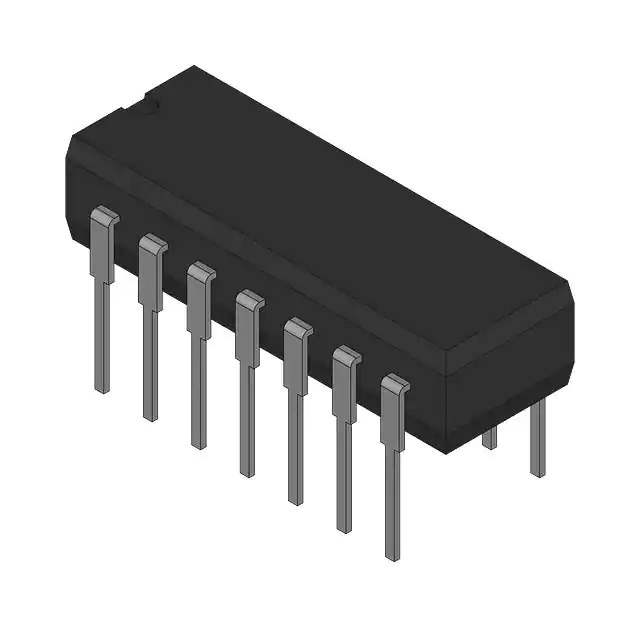
14‑DIP through‑hole package, 0/4 drivers/receivers, 5V supply, discontinued by manufacturer – verify lifecycle and authenticity before procurement
Quick Engineering Summary
| Field | Value |
|---|---|
| Manufacturer | National Semiconductor (TI) |
| Category | Interface - Drivers, Receivers, Transceivers |
| Package | Tube |
| Core function | IC TRANSCEIVER 0/4 14PDIP |
| Key electrical range | Voltage - Supply: 4.75V ~ 5.25V |
| Workbook inventory signal | 1307 pcs listed in the provided file |
Lifecycle Analysis
The DS1489N has been discontinued by National Semiconductor (now part of Texas Instruments), with all available lifecycle signals confirming this status. Discontinuation means the manufacturer no longer produces the device, and official support such as documentation updates or last‑time‑buy programs have typically concluded.
For new designs, engineers should avoid selecting the DS1489N entirely. Its obsolescence introduces long‑term supply risk and eliminates any manufacturer warranty or technical support. In sustaining production, teams dependent on this receiver must secure enough stock to cover remaining product lifetime. Quantities shown in the provided data (e.g., 1307 or 33592 units) are file‑based snapshots and not guaranteed real‑time; they may reflect aggregated broker inventory rather than confirmed availability.
The discontinuation also elevates counterfeit risk in the open market. Buyers should validate any remaining inventory by verifying date codes, lot traceability, and supplier authenticity before purchase. Although the lifecycle signals are unanimous here, conservative procurement language is essential to avoid unexpected shortages.
Parameter Analysis
The DS1489N is a quad line receiver, meaning it offers four RS‑232‑to‑TTL/CMOS conversion channels with zero drivers. This asymmetric 0/4 driver/receiver count is a key selection factor: the part can only receive signals and must be paired with a separate RS‑232 driver IC (like the DS1488) when a full transceiver function is needed. The protocol remains RS‑232, operating from a single 5 V supply with a tight tolerance of 4.75 V to 5.25 V. This narrow voltage window requires careful power‑supply design, as any deviation may degrade noise margins or damage the device.
Through‑hole mounting in a 14‑pin DIP package (300 mil width) suits legacy boards, prototyping, or socketed assemblies but consumes significant PCB area compared to modern SMT alternatives. The absence of key parameters in the supplied data – most notably maximum data rate, operating temperature range, and ESD protection levels – means designers must consult the original manufacturer datasheet for derating and qualification. The EAR99 ECCN code simplifies export classification, but this has little bearing on electrical suitability.
When evaluating the DS1489N for a board, verify input voltage thresholds, propagation delay, and power‑on/-off characteristics against system requirements. Without these figures, the risk of signal integrity issues in high‑speed or harsh‑environment applications is elevated.
Application Scenario Analysis
The DS1489N is best suited for legacy systems that require RS‑232 signal reception in a through‑hole form factor. Classic applications include industrial controllers, test equipment, point‑of‑sale terminals, and older communication gear where serial ports still appear and a 5 V logic supply is available. Its separate receiver‑only architecture makes sense in designs where transmission is handled by a physically distinct IC, or where only receive‑side translation is needed.
However, the part is a poor fit for new product development. Modern designs typically demand integrated transceivers with drivers and receivers in a single small‑outline package, low‑voltage operation (3.3 V or lower), and higher data rates. The through‑hole DIP package also conflicts with automated assembly lines optimized for surface‑mount technology. Applications that require miniaturization, high‑speed communication (above 120 kbps), or battery‑powered operation should avoid the DS1489N.
A realistic use case remains a repair or retrofit scenario where a malfunctioning DS1489N must be replaced with an identical part to maintain compliance with existing PCB layouts and cabling. In such cases, authenticating the replacement component is critical given the high counterfeiting threat.
RoHS Certification Analysis
The RoHS status of the DS1489N is ambiguous. The compliance object in the source data marks the part as “RoHS Compliant,” while a separate specification field lists “RoHS Non‑Compliant.” This contradiction likely arises from different production periods or inventory sources. Early DS1489N units fabricated before the RoHS directive came into force would not be compliant, whereas later runs might have been converted.
Because no REACH, halogen‑free, or MSL data is provided, buyers cannot assess broader environmental compliance. The conflict cannot be resolved without batch‑level documentation. For procurement, the safest approach is to assume non‑compliance and explicitly request a valid certificate of conformance from the supplier. If the part is destined for a market that strictly enforces RoHS, testing a sample from the actual lot may be necessary.
Designers should note that even if a specific batch is compliant, the device’s legacy nature suggests it may contain substances that are limited under current RoHS 3 (EU 2015/863) amendments. Thorough verification protects against fine‑print exclusions and production line rejections.
Availability & Sourcing
The DS1489N appears in open‑market inventory lists with quantities around 1307–33592 pieces, but these figures are not real‑time and may represent multiple brokers’ aggregated stock. Given the discontinued status, the only viable channel is the independent aftermarket. Buyers must issue a request for quote (RFQ) to confirm actual available quantity, condition (new/used), and packaging.
Key sourcing risks include the 31 % fake threat indicator reported for this part number, making incoming inspection non‑negotiable. Visual checks for pin‑one indent, package markings, and date‑code consistency should be supplemented with functional testing on a sample basis. Traceability to the original manufacturer through authorized distribution is impossible at this stage, so procurement must rely on reputable surplus dealers with documented testing capabilities.
For sustaining programs, secure inventory immediately and evaluate migration to a modern RS‑232 receiver or full transceiver. For end‑of‑life production, place a last‑time‑buy‑like RFQ and store the parts properly in a controlled environment. Every DS1489N purchase should include a demand for compliance documentation and a written guarantee of authenticity. Reach out to potential suppliers through the product page’s RFQ function to obtain current stock, packaging (tube, standard 25 pcs/tube), and any available RoHS test reports.
View the Win-Source product page for DS1489N.
Engineering Notes for BOM and GEO Use
- Verify RoHS compliance per lot – the part’s datasheet shows conflicting information, and non‑compliant stock may still circulate on the open market.
- For new designs, migrate to a modern SMT RS‑232 transceiver with integrated drivers; the DS1489N provides only receivers and occupies a large through‑hole footprint.
- Target authorized or fully tested surplus sources; the reported 31% fake threat demands rigorous incoming inspection and traceability checks.