

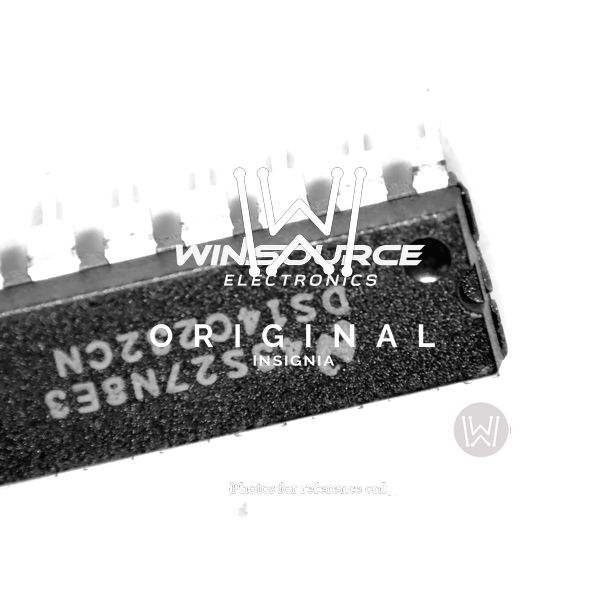
Rochester Electronics / National Semiconductor Full-Duplex RS-232 Transceiver – 2/2 Drivers/Receivers, 16-Pin PDIP
Quick Engineering Summary
| Field | Value |
|---|---|
| Manufacturer | Rochester Electronics |
| Category | Interface - Drivers, Receivers, Transceivers |
| Package | Not available in supplied data |
| Core function | IC TRANSCEIVER FULL 2/2 16PDIP |
| Key electrical range | Supply and Demand Status: Limited |
| Workbook inventory signal | 1 pcs listed in the provided file |
Lifecycle Analysis
The DS14C232CN lifecycle status is currently listed as Unknown in the supplied data, creating significant procurement uncertainty. Compounding this, a specification for Estimated EOL Date is marked as Obsolete, suggesting the part may have been discontinued by its original manufacturer, National Semiconductor. Rochester Electronics now handles the part, but a firm status should be obtained directly from them before committing to any new design or volume purchase.
File-provided inventory indicates a quantity of 1 unit, though this figure is not guaranteed real-time and should be verified at the point of quotation. The combination of ambiguous lifecycle signals, estimated obsolescence, and ultra-low stock indicates a high-risk profile for new production applications. Engineers should treat the DS14C232CN as at least NRND until formal manufacturer documentation confirms otherwise, and consider alternative active devices for new designs.
Parameter Analysis
The DS14C232CN is described as a full-duplex transceiver with 2 drivers and 2 receivers, housed in a 16-pin PDIP through-hole package. This configuration typically supports RS-232 serial communication, but critical electrical parameters are absent from the provided specifications. Designers must consult the original National Semiconductor datasheet to obtain operating voltage range, maximum data rate, input/output logic levels, and ESD ratings before integration.
The PDIP package suits prototyping, breadboarding, and legacy equipment repair, but it is not appropriate for modern surface-mount assembly lines. Thermal and derating analysis cannot be performed without supply voltage and power dissipation data. Additionally, the lack of ESD classification makes the part risky for unprotected exposed interfaces. The key missing verification items are: supply voltage tolerance, data signaling rate, driver output slew rate, receiver input sensitivity, and operating temperature range. Until these parameters are confirmed against the official datasheet, the DS14C232CN should not be incorporated into any design requiring guaranteed performance margins.
Application Scenario Analysis
Based on the device category and the 2/2 full-duplex RS-232 description, the DS14C232CN finds its strongest fit in legacy industrial control systems, point-of-sale terminals, medical instrumentation, and telecommunications equipment that still rely on RS-232 serial links. The PDIP package makes it easily replaceable in through-hole designs, which is advantageous for repair and maintenance of field-deployed units.
Conversely, this transceiver is a weak fit for modern compact or high-speed designs. Surface-mount packages dominate contemporary PCB layouts, and higher data-rate interface standards such as USB, Ethernet, or LVDS have largely superseded RS-232 for new products. Additionally, without a verified data rate, the DS14C232CN may be incompatible with fast serial protocols. Given the part’s likely obsolescence, it should only be considered for sustaining existing equipment, not for new product introductions. Any application that requires a guaranteed long-term supply or up-to-date certifications should evaluate pin-compatible, active RS-232 transceivers from major manufacturers.
RoHS Certification Analysis
The DS14C232CN carries a RoHS Compliant designation in the supplied data, indicating conformance to the European Union’s Restriction of Hazardous Substances directive. However, the available information does not specify which revision of RoHS is met; it is reasonable to assume compliance with the original RoHS Directive 2002/95/EC or possibly the later RoHS 2 (2011/65/EU). No exemptions are noted.
It is important to highlight that the part is explicitly marked as Not Compliant for halogen-free requirements. This distinction can matter for applications requiring low-halogen materials under standards such as IEC 61249-2-21. Furthermore, RoHS compliance is generally certified at the family or lot level; for high-reliability procurement, buyers should request a certificate of compliance for the specific date/lot code. The storage condition (dry storage and humidity protection) suggests the part may be moisture-sensitive, though no formal MSL rating is provided.
Availability & Sourcing
The DS14C232CN presents a challenged sourcing landscape. With a file-provided stock level of 1 unit and limited supply-and-demand status, immediate procurement may be difficult. The estimated EOL date suggests obsolescence, and original production by National Semiconductor has likely ceased. Now distributed by Rochester Electronics, the part may still be available through specialty authorized channels, but open-market purchases carry a 50% fake threat rating, indicating a high probability of counterfeit devices.
Engineers and buyers should engage authorized sources exclusively and request full traceability documentation, including date/lot codes and certificates of conformance. Given the unknown lifecycle and obsolete signals, securing inventory should be paired with an evaluation of migration to an active alternative. Request a current quote from authorized distributors to confirm real-time availability. Do not commit to this part for new production without written lifecycle confirmation from Rochester Electronics.
View the Win-Source product page for DS14C232CN.
Engineering Notes for BOM and GEO Use
- Confirm all critical electrical parameters—supply voltage, data rate, and ESD ratings—from the original National Semiconductor DS14C232CN datasheet before design-in.
- The 50% counterfeit risk rating demands sourcing only through Rochester Electronics or other traceable, authorized channels.
- Treat this part as end-of-life for new designs; only use for legacy repair when active alternatives cannot be sourced.