
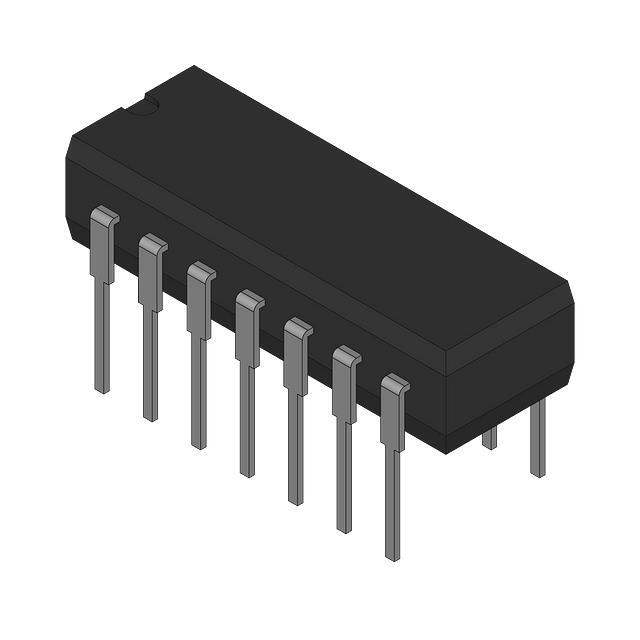
EOL RS232 Line Driver - Verify Availability and Alternatives
Quick Engineering Summary
| Field | Value |
|---|---|
| Manufacturer | Texas Instruments |
| Category | Interface - Drivers, Receivers, Transceivers |
| Package | 14-DIP |
| Core function | IC TRANSCEIVER 4/0 14PDIP |
| Key electrical range | Supply and Demand Status: Limited; Supply Voltage - Operating: 4.5 V to 12.6 V; Temperature Range - Operating: 0°C to 70°C |
| Workbook inventory signal | 20 pcs listed in the provided file |
Lifecycle Analysis
The Texas Instruments DS14C88N/NOPB has been officially classified as End-of-Life (EOL), indicating that the manufacturer has discontinued production. All available lifecycle signals in the supplied data align with this status, leaving no ambiguity. For new designs, this part is not recommended, as future supply cannot be guaranteed, and engineering teams should immediately evaluate pin-compatible or functionally equivalent active RS232 drivers from Texas Instruments or other vendors.
For existing products in sustaining production, procurement teams face a high risk of obsolescence. The immediate priority is to secure sufficient inventory to cover projected lifetime demand, potentially through a last-time-buy order if still possible. The file-provided quantity of 20 units is not a real-time guarantee and should be treated as a snapshot; actual availability may differ. Relying on aftermarket sources introduces additional quality and authenticity concerns, especially given the 63% counterfeit threat noted for this part on the open market.
Planning for a transition to a replacement part is critical. Engineers should thoroughly re-validate any alternative, comparing key parameters such as supply voltage range, driver output characteristics, and temperature grade. Since this is a mature RS232 driver, many active alternatives exist, but careful evaluation is needed to avoid subtle integration issues.
Parameter Analysis
The DS14C88N/NOPB is a quad RS232 line driver in a 14-pin DIP package, intended for through-hole mounting. The number of drivers/receivers is 4/0, meaning it contains four independent driver channels with no receivers. This configuration is common in applications where only signal transmission is required, such as driving multiple RS232 peripherals from a single controller. The supply voltage range of 4.5 V to 12.6 V offers flexibility for both 5V and 12V system rails, but the minimum 4.5V excludes direct use in low-voltage 3.3V systems without level shifting.
The operating temperature range of 0°C to 70°C limits the part to commercial-grade environments; for industrial or extended-temperature applications, an alternative with a wider rating must be considered. While the protocol is explicitly RS232, critical electrical parameters such as data rate, output voltage swing, propagation delay, and ESD protection are not provided in the source data. These specs are essential for ensuring reliable communication over the intended cable lengths and data speeds. Engineers must consult the official Texas Instruments datasheet to obtain these values and verify compliance with their design margins.
For procurement and qualification, the DIP package may be a constraining factor in space-constrained designs, but it remains popular for prototyping and legacy board repairs. When sourcing EOL parts, verifying the exact date code and lot number is vital, as parametric drift or variations in older stock could affect performance. Any migration plan should compare not just the pinout but also the parametric envelopes of potential replacements.
Application Scenario Analysis
The DS14C88N/NOPB is well-suited for unidirectional RS232 communication links where a host device needs to transmit data to multiple peripherals such as modems, printers, or legacy industrial equipment. Its four drivers allow it to replace several single-channel transmitters, reducing board space and component count in through-hole designs. Legacy systems originally using this part in commercial temperature environments (e.g., office equipment, point-of-sale terminals) are typical strong-fit scenarios.
Conversely, this component is a poor fit for full-duplex applications requiring both transmission and reception on the same interface, because it lacks receiver channels. It is also unsuitable for modern designs demanding low voltage operation (below 4.5 V) or high data rates beyond standard RS232 limits, as those parameters are not characterized here and may be constrained by the device's older process technology. Systems requiring extreme temperature ranges or formal automotive qualification should avoid this part.
In aftermarket sourcing, be cautious of using this device in new designs where long-term availability is needed. Even if an initial build uses old stock, subsequent production runs may face shortages. For one-time repairs or low-volume prototype builds where a small quantity is acceptable, the DS14C88N/NOPB may still serve, provided the procurement includes authenticity and functional testing to mitigate the high counterfeit risk.
RoHS Certification Analysis
The DS14C88N/NOPB is marked as RoHS Compliant in the provided data. This indicates that the part, as originally manufactured, meets the restriction of hazardous substances requirements. However, since the specific RoHS directive version (e.g., RoHS 2 or RoHS 3) is not specified, and the part is now EOL, caution is required. Older production dates might have been compliant with earlier RoHS standards, and residual exemptions (such as lead in glass for DIP packages) could apply.
For any procurement, especially from non-authorized sources, requesting a Certificate of Compliance traceable to the lot date code is essential. Without this documentation, there is no guarantee that the specific units in stock are RoHS compliant, as family-level declarations may not reflect lot-level variations. In regulated industries like medical or aerospace, additional substance declarations (REACH, halogen-free) are often required; these are not provided in the source data and must be obtained from the supplier or manufacturer.
Given the EOL status, some aftermarket inventory might consist of pre-RoHS stock that was not originally certified. To avoid customs or compliance issues, always verify the RoHS status of the actual shipment before finalizing a purchase. This step is part of the broader risk mitigation strategy when dealing with obsolete components.
Availability & Sourcing
As an End-of-Life component, availability of the DS14C88N/NOPB is inherently limited. The supplied file shows a snapshot quantity of 20 units, but this is not a live inventory figure and should be confirmed through a direct request for quote (RFQ). Given the high counterfeit risk of 63% in the open market, sourcing must be approached with extreme diligence, favoring authorized distributors or traceable supply chains that can provide full lot and date code traceability.
When requesting a quote, specifically ask for a Certificate of Conformance, RoHS compliance documentation, and date code information. The packaging is tube/rail, which is standard for DIP components; ensure that the storage conditions (dry storage cabinet and humidity protection) are maintained to prevent moisture-related damage during handling. For high-volume requirements, a last-time-buy arrangement with the manufacturer or authorized partners may be the only reliable path, though it may come with minimum order quantities and non-cancellable terms.
For new production programs, sourcing this EOL part is not recommended. Instead, allocate engineering resources to qualify an alternative RS232 driver that is in active production. If the DS14C88N/NOPB must be used for an existing product, consider purchasing the entire available lot to secure inventory, but only after thorough incoming inspection and functional testing. Always verify the manufacturer's official EOL notice to understand any last-order dates and avoid unexpected gaps in supply.
View the Win-Source product page for DS14C88N/NOPB.
Engineering Notes for BOM and GEO Use
- Verify data rate and output voltage swing from the Texas Instruments datasheet to ensure compatibility with your RS232 interface.
- This EOL component carries a 63% counterfeit risk in the open market; source only from authorized or traceable supply chains.
- Secure inventory soon as production is discontinued; evaluate migration to an active RS232 driver for new designs.