
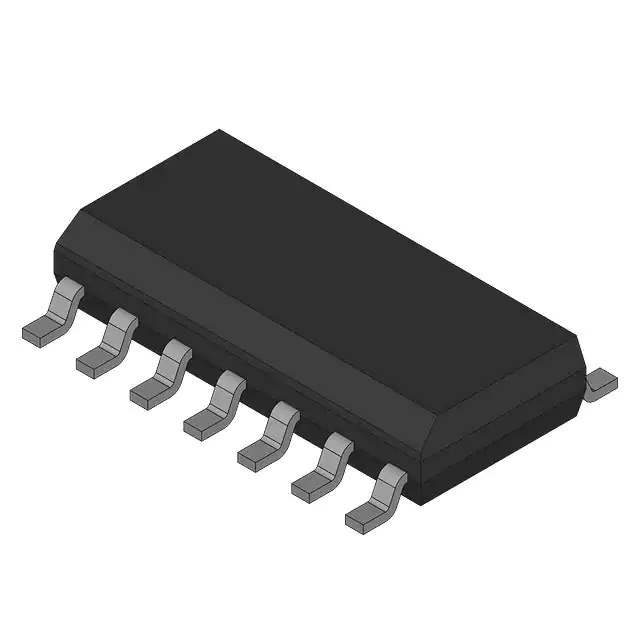
Discontinued RS-232 transceiver for legacy systems – verify availability and authenticity before procurement.
Quick Engineering Summary
| Field | Value |
|---|---|
| Manufacturer | National Semiconductor (TI) |
| Category | Interface - Drivers, Receivers, Transceivers |
| Package | Tube |
| Core function | IC TRANSCEIVER 4/0 14SOIC |
| Key electrical range | Voltage - Supply: 4.5V ~ 12.6V |
| Workbook inventory signal | 1 pcs listed in the provided file |
Lifecycle Analysis
The DS14C88TM is officially classified as Discontinued by National Semiconductor (TI), with all available lifecycle signals confirming end-of-life status. The Excel lifecycle parameter indicates EOL, while the Lifecycle Status and Product Status fields both show Discontinued. Despite minor wording differences, these signals align on the fact that the device is no longer in active production. For new designs, the DS14C88TM should be avoided entirely; selecting a currently active RS-232 transceiver is the recommended approach.
For engineers maintaining legacy systems, the high-risk lifecycle status mandates careful sourcing and verification. Any inventory found, including the file-provided single unit, must be assumed to be residual stock and is not guaranteed to be available or authentic. Designers should request manufacturer notices or lifetime buy announcements to confirm the last order date and ensure adequate supply for sustaining production. Without such documentation, revalidation of equivalent parts becomes essential.
Parameter Analysis
The DS14C88TM is a quad driver RS-232 transceiver with no receivers, as indicated by its 4/0 driver/receiver count. The wide supply voltage range of 4.5V to 12.6V provides flexibility in mixed-voltage systems but requires designers to ensure that the selected supply meets the RS-232 output swing requirements under worst-case loading. The device is housed in a standard 14-pin SOIC package with a 3.90 mm body width, suitable for automated surface-mount assembly.
Several critical parameters are not provided in the available data and must be verified from the manufacturer’s original datasheet. These include the maximum data rate, which determines suitability for high-speed serial links; the operating temperature range, essential for industrial or extended-temperature applications; and receiver input thresholds if the device is used in a full transceiver function (though this part has no receivers). Additionally, output short-circuit protection, slew rate, and ESD ratings are absent and should be confirmed for robust design. Engineers should cross-reference these missing parameters to ensure the DS14C88TM fits the intended electrical and environmental requirements before committing to a legacy build.
Application Scenario Analysis
The DS14C88TM is best suited for legacy RS-232 communication links where only driver functionality is required, such as transmitting data from a microcontroller UART to a peripheral without needing handshake inputs. Its quad driver configuration fits point-to-point or multidrop RS-232 systems in industrial control, instrumentation, and older computing equipment that operate with higher supply rails. The surface-mount SOIC package aligns with automated assembly processes used in volume production.
However, the part is a poor fit for any new design due to its discontinued status and the high counterfeit risk (58% fake threat in the open market). Modern RS-232 interfaces often demand low-voltage operation (3.3V), integrated receivers, and data rates beyond what the DS14C88TM likely supports, though its exact speed is unspecified. Additionally, engineers designing bidirectional communication or requiring ESD protection beyond basic levels should consider active alternatives. For system upgrades, transitioning to a multi-channel transceiver with full driver/receiver pairs is strongly recommended.
RoHS Certification Analysis
The DS14C88TM is listed as RoHS Compliant by the supplier, which generally indicates compliance with the EU RoHS directive restricting hazardous substances such as lead, mercury, and cadmium. The specific directive version (e.g., EU 2011/65/EU or 2015/863) is not specified in the available data, so buyers should confirm that the stock meets the latest applicable RoHS requirements for their market.
Because the DS14C88TM is discontinued, any available inventory may be older stock produced prior to stricter RoHS amendments. Lot-level compliance documentation should be requested to ensure that the exact parts being procured do not rely solely on a family-level or historical compliance claim. No REACH or halogen-free information is provided, so these must be verified separately if needed. For military or aerospace applications, additional screening for tin whisker mitigation or other environmental concerns may be necessary.
Availability & Sourcing
Procurement for the DS14C88TM requires an RFQ-based approach due to its discontinued lifecycle and extremely limited apparent stock. The file indicates a quantity of one unit, but this is not a real-time guarantee and may represent residual or sample inventory. Buyers should request a quote from authorized distributors or brokers to confirm current availability.
Traceability is critical: request date and lot codes to verify the part’s provenance and age. Packaging is typically tube (standard package of 55 units), but individual units may be sold as loose stock. Given the high counterfeit threat (58%), third-party testing or authorized source certification is strongly advised. Additionally, verify that the supplier can provide a Certificate of Conformance for RoHS and any other required environmental compliance. Since the part is discontinued, avoid committing to volume production without a secure, authenticated supply; consider last-time-buy opportunities if they still exist and a migration plan to a drop-in replacement.
View the Win-Source product page for DS14C88TM.
Engineering Notes for BOM and GEO Use
- Verify all DS14C88TM stock for authenticity given a reported 58% counterfeit risk in the open market.
- Confirm supply voltage and pinout against the original manufacturer datasheet before board integration.
- Since the part is discontinued, evaluate last-time-buy availability and plan migration to an alternative transceiver.