
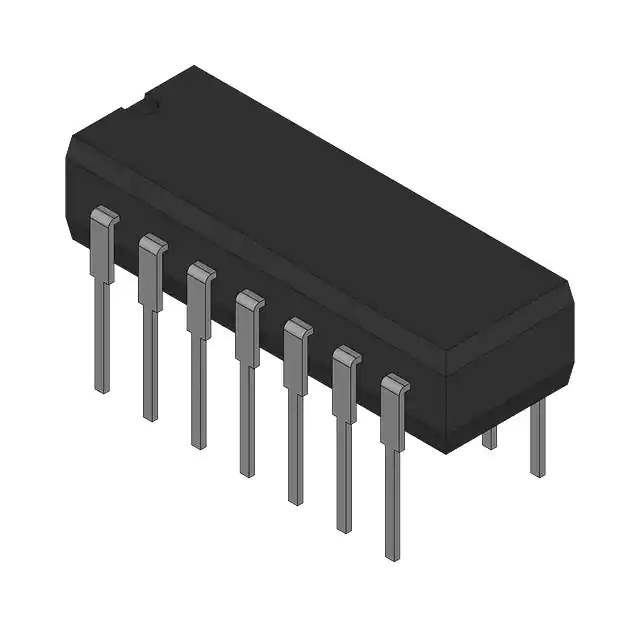
EOL lifecycle, RoHS status ambiguous, 14-DIP through-hole, 0/4 RS-232 receiver. Verify compliance and lifecycle before procurement.
Quick Engineering Summary
| Field | Value |
|---|---|
| Manufacturer | National Semiconductor (TI) |
| Category | Interface - Drivers, Receivers, Transceivers |
| Package | Bulk |
| Core function | IC TRANSCEIVER 0/4 14PDIP |
| Key electrical range | Temperature Range - Operating: 0°C ~ 70°C; Voltage - Supply: 5V, 12V |
| Workbook inventory signal | 35300 pcs listed in the provided file |
Lifecycle Analysis
The DS14C89AN exhibits conflicting lifecycle signals. The Excel lifecycle parameter and the dedicated Lifecycle Status spec both indicate End-of-Life (EOL), while the Product Status field shows Active. In sourcing engineering, such discrepancies require a conservative approach: treat the part as EOL. This means the DS14C89AN should not be designed into new projects; it is suitable only for sustaining existing production that already holds approved vendor list (AVL) status.
As an EOL device, procurement carries high risk. Lead times may be unpredictable, and last-time buy (LTB) windows may have already passed. The file-provided inventory shows 35300 units, but this is not a real-time guarantee. Buyers must verify current stock, date codes, and traceability with the supplier.
Engineers and procurement teams should contact Texas Instruments or authorized distributors to confirm the official product life cycle status. If a formal EOL notice and product discontinuance (PDN) exists, plan a migration strategy. Relying on unverified EOL stock can lead to production line stops and costly redesigns. For the DS14C89AN, lifecycle verification is the first critical step before committing to purchase.
Parameter Analysis
The DS14C89AN is configured as a 0/4 receiver-only transceiver for RS-232 protocol. The absence of drivers (0) and presence of four receivers (4) defines its role in unidirectional serial communication receiving paths. Receiver hysteresis of 1 V provides noise immunity, which is valuable in industrial environments where ground bounce and EMI can cause false triggering. However, the actual data rate is not specified in the available data; this is a critical missing parameter that must be verified from the manufacturer datasheet to confirm compatibility with your signaling speed.
Supply voltage requirements are 5V and 12V, typical for legacy RS-232 line receivers. The dual-supply requirement may complicate integration into modern single-supply systems. The commercial temperature range of 0°C to 70°C restricts the DS14C89AN to benign indoor applications; extended industrial range parts would be needed for harsher environments. The through-hole 14-DIP package (0.300" width) is suited for hand assembly, prototyping, or legacy PCB designs, but not for automated high-density surface-mount production.
Additional missing parameters that must be checked include input voltage thresholds (VIL, VIH), propagation delay, supply current, and ESD protection levels. The base product number DS14C89 may share a datasheet with other variants; confirm that the DS14C89AN electrical characteristics match your design requirements. Without these, a complete qualification is not possible from the supplied data alone.
Application Scenario Analysis
The DS14C89AN finds strong fit in legacy RS-232 serial communication systems that require receiving multiple channels. Typical applications include industrial PLC interfaces, point-of-sale terminals, telecom equipment, and older PC peripherals where RS-232 remains the backbone. Its four receivers allow consolidation of multiple signal lines—such as RX, CTS, DSR, and DCD—into a single DIP package, reducing board space in through-hole designs.
Weak fit scenarios include new designs that are migrating away from RS-232 toward USB, Ethernet, or RS-485. The EOL status makes it unsuitable for any project with a long production horizon. Additionally, the 0°C–70°C temperature range excludes outdoor, automotive, or factory-floor environments that require -40°C to +85°C operation. Modern compact systems using surface-mount technology will find the 14-DIP through-hole package a misalignment with current pick-and-place processes.
For equipment repair or legacy system replication, the DS14C89AN may still be viable if the exact footprint and electrical behavior must be preserved. However, given the RoHS ambiguity and EOL risk, design teams should consider alternate RS-232 receivers in smaller, surface-mount packages with active lifecycles, such as those from the MAX232 family, provided they meet the system’s voltage and channel requirements.
RoHS Certification Analysis
RoHS compliance for the DS14C89AN is unclear. The main compliance field indicates 'RoHS Compliant,' but a separate specification entry states 'RoHS Non-Compliant.' In procurement, such inconsistency demands immediate resolution. If the part is truly non-compliant, it cannot be used in equipment shipped to EU markets under RoHS 3 (EU 2015/863) without a valid exemption. No exemption is listed, so none can be assumed.
Additionally, the DS14C89AN carries a 'REACH Affected' status. REACH (Registration, Evaluation, Authorisation and Restriction of Chemicals) is separate from RoHS; a REACH-affected part may still be RoHS compliant. However, the combined flags increase due diligence requirements. The MSL Level 1 (Unlimited) indicates no special moisture handling, but this does not relate to RoHS.
Before purchasing, buyers must request lot-specific RoHS certificates from the distributor or manufacturer. If no certificate is available, or if the lot is confirmed non-compliant, alternative compliant receivers should be sourced. For existing designs, a re-evaluation of the bill of materials (BOM) may be necessary if RoHS compliance is mandatory. The conflicting data means that the DS14C89AN cannot be treated as RoHS-compliant without verified documentation.
Availability & Sourcing
As an EOL part, sourcing the DS14C89AN requires careful planning. The supplied inventory file lists 35300 units, but this quantity is not real-time and may include non-certified or mixed-date-code stock. To secure genuine parts, issue a request for quote (RFQ) specifying the manufacturer part number, required quantity, and requested date codes. Insist on traceability documentation and a certificate of conformance.
Packaging is bulk, with a standard package of 262 pieces per tube. For larger purchases, verify that the stock is from a single lot to avoid performance variation. Request visual inspection or third-party testing if fake threat is a concern; the open-market fake threat level is flagged at 52%, indicating a significant counterfeit risk. Only purchase through authorized or vetted channels.
Because the lifecycle is EOL, buyers should consider placing a last-time buy if the part is essential for ongoing production. Simultaneously, engineering should identify pin-compatible or functionally equivalent replacements and qualify them before the existing inventory is exhausted. For any quote request, confirm that compliance documentation (RoHS, REACH) is provided. The DS14C89AN sourcing process must prioritize authenticity and compliance verification over price.
View the Win-Source product page for DS14C89AN.
Engineering Notes for BOM and GEO Use
- Verify lifecycle status directly with Texas Instruments; conflicting signals (EOL vs. Active) demand conservative sourcing and migration planning.
- Request lot-specific RoHS and REACH certificates, as supplied data shows both compliant and non-compliant claims for the DS14C89AN.
- For EOL receivers, secure inventory now and evaluate drop-in replacements; file-based quantity of 35300 units is not real-time and may deplete quickly.