
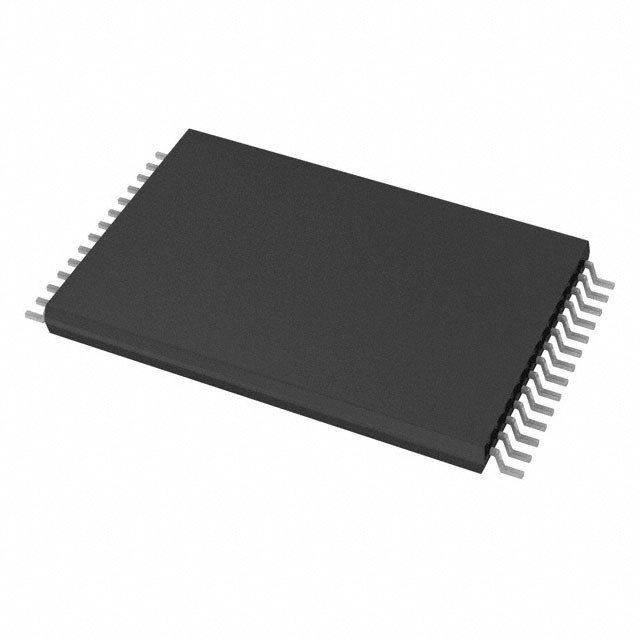
EOL parallel real-time clock IC; verify availability and authenticity for sustaining production needs.
Quick Engineering Summary
| Field | Value |
|---|---|
| Manufacturer | Maxim Integrated |
| Category | Clock/Timing - Real Time Clocks |
| Package | 28-TSOP |
| Core function | IC RTC CLK/CALENDAR PAR 28TSOP |
| Key electrical range | Current - Timekeeping (Maximum): 4mA @ 3V ~ 3.6V; Operating Supply Voltage: 3 V ~ 3.6 V; Operating Temperature Range: 0°C ~ 70°C; Supply and Demand Status: Balance |
| Workbook inventory signal | 1 pcs listed in the provided file |
Lifecycle Analysis
The DS1501WE from Maxim Integrated is officially classified as End-of-Life (EOL) with all available lifecycle signals aligning on this status. This means Maxim Integrated has discontinued production, and no new orders are being accepted. For engineers and buyers, this classification carries a high risk for new designs and requires careful planning for any sustaining production requirements.
Given the EOL status, the DS1501WE should not be incorporated into new designs. For existing products that rely on this part, immediate action is recommended: validate remaining stock, assess demand over the product's remaining life, and initiate a migration strategy to an alternative real-time clock (RTC). Without a clear last-time-buy notice, remaining inventory on the open market may be limited and subject to authenticity risks.
The open-market counterfeit threat for the DS1501WE is reported at 55 percent, underscoring the need for rigorous supplier verification and traceability. Any procurement should include confirmation of date codes, lot codes, and proper storage conditions to mitigate the risk of non-functional or substandard parts entering the supply chain.
Parameter Analysis
The DS1501WE is a parallel-interface real-time clock (RTC) with integrated 256 bytes of non-volatile SRAM (NVSRAM). Its operating supply voltage range of 3 V to 3.6 V and commercial temperature range of 0 °C to 70 °C define its typical deployment envelope. Key functional features include an alarm, leap year compensation, a watchdog timer, and a square wave output, all of which cater to timekeeping and system management tasks.
From a board-level integration perspective, the parallel interface demands a wider bus compared to serial RTCs, affecting pin count and PCB routing. The maximum timekeeping current is specified at 4 mA under the operating voltage range, which is moderate for this device class; however, the battery backup current (when operating from the 2.5 V to 3.7 V battery supply) is not provided in the supplied data. This parameter is critical for systems relying on long-term battery-backed operation and must be verified against the official Maxim Integrated datasheet.
Other missing but essential specifications include timekeeping accuracy (ppm), crystal requirements, and parallel bus timing diagrams. Engineers should consult the original DS1501WE datasheet to obtain these values before finalizing a design or qualifying a second-source part. Without this data, it is impossible to guarantee system-level timing closure or long-term reliability.
Application Scenario Analysis
The DS1501WE was historically suited to embedded systems requiring a parallel RTC with integrated RAM, such as industrial controllers, point-of-sale terminals, legacy medical equipment, and test instrumentation. Its parallel interface offered easy integration with microprocessors of the 1990s and early 2000s that had external memory buses, while the 256 B NVSRAM provided non-volatile storage for configuration or event data.
In current designs, the DS1501WE is generally a weak fit. Modern microcontrollers overwhelmingly favor serial interfaces (I²C, SPI) to reduce pin count and board space. The commercial temperature range and moderate power consumption also limit its applicability in industrial or automotive environments that demand extended temperature ratings. Additionally, with its EOL status, any new design using this part would face immediate availability and lifecycle risks.
For legacy system maintenance, the DS1501WE may still be needed to replace failed units. In such cases, the identical part number must be sourced, as any functional substitute would need to match the parallel interface, memory map, and register compatibility exactly. Designers maintaining older equipment should consider redesigning to a serial RTC if the product life warrants the engineering investment.
RoHS Certification Analysis
The DS1501WE is listed as RoHS Compliant in the available data, suggesting compliance with the EU Restriction of Hazardous Substances directive. Additionally, the halogen-free status is noted as compliant, which indicates adherence to industry standards for low halogen content. These environmental compliance markers are critical for products destined for European and other regulated markets.
While the part is marked RoHS Compliant, the supplier documentation does not explicitly state which revision (e.g., RoHS 3, EU 2015/863) or list any applicable exemptions. Many ICs in TSOP packages rely on exemptions such as lead in high-melting-temperature solder or glass, and the DS1501WE's compliance status should be validated with the manufacturer's certificate of compliance. For procurement, requesting the full material declaration from the distributor is recommended to verify lot-level conformance, especially when sourcing from brokers or non-authorized channels.
It is worth noting that REACH compliance is not mentioned in the provided data, and buyers should confirm REACH registration or exemption status if this is a requirement for their supply chain. Reliance solely on the RoHS status field without supporting documentation is not sufficient for formal compliance audits.
Availability & Sourcing
Procuring the DS1501WE requires immediate attention due to its end-of-life status. The file-provided inventory shows only 1 unit, which is not a real-time figure and should be verified by requesting a quote. The open market carries a 55 percent counterfeit risk, so sourcing exclusively from authorized Maxim Integrated distributors or reputable, traceable suppliers is essential to avoid fake or relabeled parts.
When requesting a quote, specify the exact manufacturer part number DS1501WE, and request details on date codes, lot codes, and packaging (the part is supplied in tray format, stored under dry and humidity-controlled conditions). Ensure that the supplier can provide a certificate of conformance and RoHS compliance documentation. For sustaining production, evaluate whether a last-time-buy can be arranged or if remaining stock can be secured for the product's lifetime.
Given the high lifecycle risk, consider initiating a migration to a functionally equivalent RTC from Maxim Integrated or another vendor that is currently active. If a drop-in replacement is not available, a board redesign may be necessary. Contact Win Source or your preferred distributor for current availability and support in finding a suitable alternative for your application.
View the Win-Source product page for DS1501WE.
Engineering Notes for BOM and GEO Use
- Verify datasheet for RTC accuracy and battery-mode current consumption; these parameters are critical for design margin.
- High open-market fake threat (55 pct) mandates strict traceability and authorized sourcing; avoid unauthorized channels.
- Plan migration to a compatible RTC with parallel interface or consider design upgrade to serial interface for new projects.