
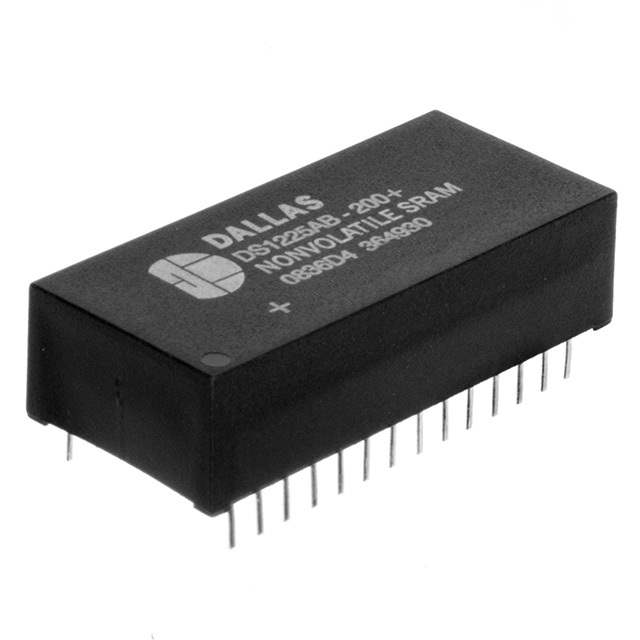
Active component with alarm, watchdog timer, NVSRAM, and Y2K compliance in 28-EDIP through-hole package.
Quick Engineering Summary
| Field | Value |
|---|---|
| Manufacturer | Maxim Integrated |
| Category | Clock/Timing - Real Time Clocks |
| Package | 28-EDIP |
| Core function | IC RTC CLK/CALENDAR PAR 28EDIP |
| Key electrical range | Current - Timekeeping (Max): 4mA @ 3V to 3.6V; Supply and Demand Status: Limited; Supply Voltage - Operating: 3 V to 3.6 V; Temperature Range - Operating: 0°C to 70°C |
| Workbook inventory signal | 1 pcs listed in the provided file |
Lifecycle Analysis
The Maxim Integrated DS1511W+ is designated as Active according to the manufacturer’s lifecycle status. This indicates the part is currently in full production and is suitable for new designs and volume procurement. Designers can proceed without immediate risk of obsolescence; however, it is prudent to periodically revalidate lifecycle status directly with Maxim Integrated, as manufacturer roadmaps can shift.
Supply and demand indicators suggest limited availability, with file-provided inventory showing a single unit at the time of data collection. This does not represent real-time stock, so procurement teams should confirm lead times and volumes before committing to production schedules. The active lifecycle status remains the primary signal for design-in decisions, but the constrained availability signal warrants careful planning to avoid shortages.
Parameter Analysis
The DS1511W+ operates from a main supply voltage of 3V to 3.6V, with a timekeeping current of 4mA maximum under that range, making it suitable for low-power systems. A separate battery input (2.5V to 3.7V) enables timekeeping and NVSRAM retention during main power loss. The integrated 256B NVSRAM provides non-volatile storage for critical data, eliminating external memory. Features such as a watchdog timer, square wave output, and alarm function reduce external component count and simplify design.
Key parameters to verify in the official datasheet include the parallel interface timing and pinout, as this through-hole 28-EDIP package uses a parallel bus rather than serial interfaces like I²C or SPI. The commercial temperature range (0°C to 70°C) must be evaluated against application ambient requirements; industrial or extended-range alternatives may be necessary for harsher environments. Also confirm NVSRAM write endurance and the accuracy of the integrated crystal if not using an external reference.
Application Scenario Analysis
With its alarm, watchdog timer, NVSRAM, and Y2K-compliant calendar, the DS1511W+ fits well in embedded systems that require precise timekeeping and non-volatile data storage. Industrial controllers, medical devices, point-of-sale terminals, and security panels are example applications where battery-backed memory and a watchdog enhance reliability. The parallel interface suits designs where pin count is not a primary constraint, such as larger MCUs or legacy 8-bit systems.
Less ideal scenarios include space-constrained designs that prefer small-footprint serial RTCs, or ultra-low-power devices where the 4mA timekeeping current is prohibitive. For designs that do not need NVSRAM or watchdog functions, simpler RTCs may offer cost savings. Engineers should weigh the integrated features against cost and interface complexity when selecting this part.
RoHS Certification Analysis
The DS1511W+ is listed as RoHS Compliant, aligning with EU Directive 2015/863 (RoHS 3) requirements for hazardous substance restrictions. This certification typically covers lead-free solder and the absence of restricted materials like mercury and cadmium. No exemptions are noted, implying full compliance across the device.
Verification at the lot level is recommended during procurement; request a certificate of conformance or test reports from the distributor. REACH compliance is not explicitly stated in the provided data and should be confirmed if needed for EU market access. The through-hole package and tube/rail packaging do not inherently conflict with RoHS, but buyers should ensure that the entire bill of materials, including the internal battery connection, meets compliance.
Availability & Sourcing
The DS1511W+ is available through distributors, with Win Source listing part number 138691. File-provided stock shows limited quantity, but actual availability can fluctuate. The open market carries a 30% fake threat risk according to supplied data, so sourcing from authorized Maxim Integrated channels is strongly advised to avoid counterfeit components.
Packaging is tube/rail, which is suitable for through-hole assembly lines. Storage conditions call for dry storage and humidity-protected packaging, especially given the through-hole leads. Requesting a quote with lead time, date/lot code traceability, and compliance certificates (RoHS, REACH if needed) is essential. Since the lifecycle is active, the recommended CTA is to quote and validate all documentation before placing production orders. For NRND or EOL devices, additional steps would apply, but here the focus is on ensuring authentic, in-stock parts.
View the Win-Source product page for DS1511W+.
Engineering Notes for BOM and GEO Use
- Verify parallel interface timing and bus loading in the datasheet to ensure compatibility with host microcontroller.
- Confirm NVSRAM write endurance and data retention specifications, especially for frequently updated parameters.
- Evaluate commercial temperature range (0°C--70°C); consider forced airflow or industrial-grade alternatives for elevated ambient environments.