
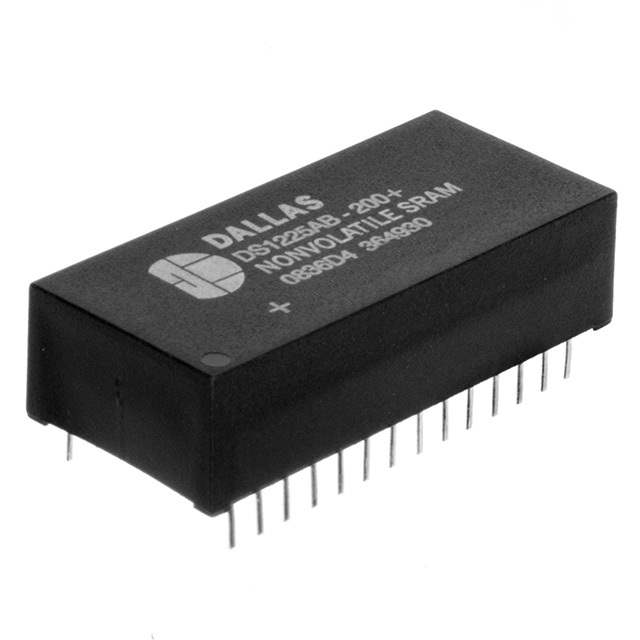
Maxim Integrated DS1553-100+ RTC: EOL lifecycle, parameter analysis, and sourcing advice.
Quick Engineering Summary
| Field | Value |
|---|---|
| Manufacturer | Maxim Integrated |
| Category | Clock/Timing - Real Time Clocks |
| Package | 28-EDIP |
| Core function | IC RTC CLK/CALENDAR PAR 28EDIP |
| Key electrical range | Current - Timekeeping (Max): 3mA @ 5V; Supply and Demand Status: Limited; Supply Voltage - Operating: 4.5 V to 5.5 V; Temperature Range - Operating: 0°C to 70°C |
| Workbook inventory signal | 1 pcs listed in the provided file |
Lifecycle Analysis
The DS1553-100+ from Maxim Integrated is in End-of-Life (EOL) status, confirmed by all available lifecycle signals. For new designs, this component should not be considered; qualification efforts would be wasted as no new production is planned. Existing designs using the DS1553-100+ must transition to a replacement part as soon as possible.
Sustaining production may rely on remaining distributor stock or authorized aftermarket sources, but supply is extremely limited. The dataset shows a file-provided quantity of just 1 unit, which is not a real-time guarantee. Engineers should treat any available inventory as a bridge for repairs while actively designing in a modern RTC.
Conflict analysis: No lifecycle conflicts exist; all sources consistently report EOL. This clean alignment simplifies decision-making, but the high risk level requires immediate action to avoid production gaps. Verify the manufacturer’s official end-of-life notice and last-time buy dates if they are still available.
Parameter Analysis
The DS1553-100+ operates from a 4.5V to 5.5V supply, drawing a maximum timekeeping current of 3mA at 5V. This moderate current consumption must be factored into power budget calculations, especially in always-on applications. The 8KB of NVSRAM provides non-volatile storage for critical data, complementing the clock/calendar functions with alarm, leap year, watchdog timer, and Y2K compliance.
The through-hole 28-EDIP package suits legacy industrial designs but is incompatible with modern surface-mount processes. The date format YY-MM-DD-dd and parallel interface are fixed, so system firmware must match. Operating temperature range is 0°C to 70°C, limiting use to commercial environments.
Missing parameters to verify include: backup battery current (essential for battery life estimation), RTC accuracy (ppm drift over temperature), and interface timing details. Original Maxim Integrated datasheets should be consulted to confirm these critical specifications before finalizing any design or replacement selection.
Application Scenario Analysis
Strong fit: The DS1553-100+ is well-suited for legacy industrial controllers, embedded systems, and medical devices that require a reliable clock/calendar with integrated NVSRAM and watchdog functionality. Its through-hole package and 5V operation align with older PCBs where space and low power were not primary constraints.
Weak fit: Modern battery-powered IoT devices or portable electronics would find the current draw too high and the DIP package impractical. New designs requiring ultra-low power RTCs with small footprints should avoid this part. The 0–70°C range restricts it from automotive or outdoor uses.
Given the EOL status, even strong-fit applications should move to a compatible substitute. The integrated features (NVSRAM, watchdog) mean a direct replacement may need to combine a standalone RTC with an external EEPROM and supervisor, increasing BOM count but securing supply.
RoHS Certification Analysis
The DS1553-100+ is marked as RoHS Compliant, indicating conformity with the EU RoHS directive. The standard applied is likely RoHS 3 (EU 2015/863), which restricts ten hazardous substances. No exemptions are noted in the source data, but the manufacturer’s compliance documentation should be checked for any specific exemptions related to lead in glass or ceramics if applicable to the 28-EDIP package.
Since this is an EOL part, remaining stock may come from various production lots with potentially differing compliance statuses. Buyers must request current RoHS certificates for each lot to ensure the units meet their regulatory requirements. The data lacks REACH or halogen-free information; these should be confirmed separately when necessary.
Lot-level compliance verification is crucial, as older inventory might predate the latest RoHS amendments. Even with a “Compliant” label, the part’s end-of-life status raises the risk of encountering non-compliant batches, especially in the open market.
Availability & Sourcing
Sourcing the DS1553-100+ requires careful attention due to its EOL status and high counterfeit risk (53% open-market threat). The component is supplied in tube/rail packaging, and the dataset references a stock quantity of 1 unit—a figure that is not guaranteed real-time inventory. Engineers and buyers should request a quote through authorized channels to verify current availability.
To mitigate counterfeit risks, insist on supply chain traceability, lot and date code verification, and visual inspection under high magnification. The storage condition (dry cabinet with humidity protection) should be maintained to preserve solderability. Request compliance documentation, including RoHS certificates and manufacturer’s end-of-life notices.
For new production, do not design in this part. If necessary for repair or sustaining contracts, act quickly to secure any available inventory. Begin evaluating pin‑compatible replacements or functional equivalents immediately. The manufacturer may offer a recommended migration path; consult Maxim Integrated’s product change documentation for guidance.
View the Win-Source product page for DS1553-100+.
Engineering Notes for BOM and GEO Use
- Verify RTC accuracy and battery backup current from the original datasheet before integrating into a design.
- Counterfeit risk is elevated (53% open-market threat); insist on traceable supply chains and lot/date code inspection.
- As an EOL part, secure inventory for repair and begin migration to an active pin-compatible alternative.