
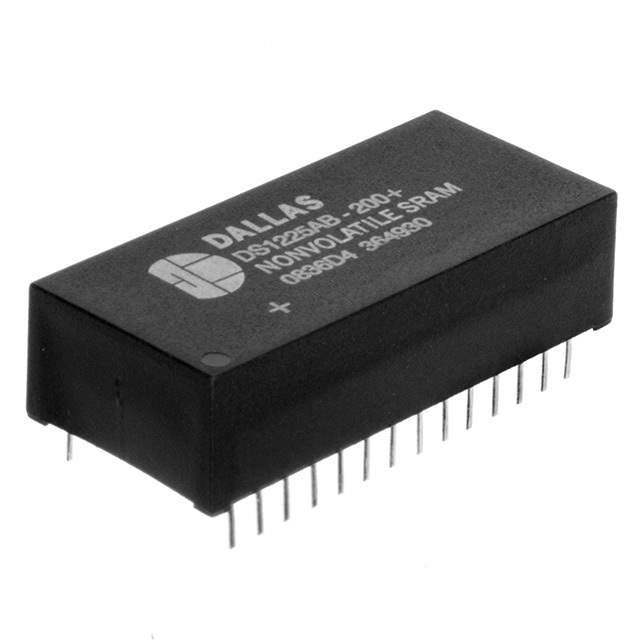
EOL RTC with 8KB NVSRAM, parallel interface, and through-hole EDIP package. Engineering and sourcing considerations.
Quick Engineering Summary
| Field | Value |
|---|---|
| Manufacturer | Maxim Integrated |
| Category | Clock/Timing - Real Time Clocks |
| Package | 28-EDIP |
| Core function | IC RTC CLK/CALENDAR PAR 28EDIP |
| Key electrical range | Current - Timekeeping (Maximum): 3mA @ 5V; Operating Supply Voltage: 4.5 V ~ 5.5 V; Operating Temperature Range: 0°C ~ 70°C; Supply and Demand Status: Limited |
| Workbook inventory signal | 1 pcs listed in the provided file |
Lifecycle Analysis
The DS1553-100 from Maxim Integrated (now Analog Devices) carries an end-of-life (EOL) status. All available lifecycle signals align, confirming that the manufacturer has discontinued production. For new designs, this part should be avoided entirely, as no long-term availability is assured. For sustaining production or legacy system repair, procurement teams must recognize that only existing stock remains, and no further supply will be manufactured.
The EOL date is listed as obsolete. Engineers relying on this part for critical applications must immediately evaluate migration paths or secure lifetime buy quantities. The file-provided inventory shows one unit, but real-time availability may vary and cannot be guaranteed. It is essential to confirm current stock through direct quotation and verify that inventory is genuine, given the high counterfeit risk in the open market.
Given the high risk level, procurement should prioritize early warning with design teams. Any last-time purchases should be validated against manufacturer notifications to avoid unauthorized sources. The DS1553-100 may still be available through authorized distributors or surplus channels, but traceability and certification are critical.
Parameter Analysis
The DS1553-100 integrates a real-time clock and calendar with an 8KB nonvolatile SRAM, accessed via a parallel interface. The timekeeping current is specified at 3mA maximum at 5V, a key figure for battery backup design. The operating supply voltage range of 4.5V to 5.5V suits standard 5V logic levels, while the 0°C to 70°C temperature range limits use to commercial environments. The device includes alarm, leap year, watchdog timer, and Y2K-compliant features.
The parallel interface provides fast access but consumes more I/O pins compared to serial RTCs, which is a consideration for legacy microcontroller designs. The through-hole 28-EDIP package simplifies prototyping and repair but is less suitable for modern surface-mount production. The 8KB NVSRAM enables storage of configuration data or time stamps during power loss.
Important datasheet parameters not provided here include standby current for battery operation, timekeeping accuracy (crystal frequency tolerance), write cycle endurance, and data retention after power-off. These must be verified against the original Maxim Integrated datasheet to ensure fit. Additionally, the absence of a battery-backed oscillator specification may require external validation if the part is used in time-critical applications.
Application Scenario Analysis
The DS1553-100 is primarily suited for legacy embedded systems that require a simple parallel real-time clock with nonvolatile memory. Typical applications include industrial controllers, older test equipment, medical devices, and networking gear where an original design used this specific RTC and redesign is cost-prohibitive. The through-hole package makes it convenient for board-level repair of aging systems.
In new designs, the DS1553-100 is not recommended due to its EOL status and parallel interface, which has been largely superseded by serial I2C or SPI RTCs. The 0°C to 70°C operating range rules out outdoor or harsh-environment deployments. Its 5V operation also limits integration with modern low-voltage microcontrollers. For engineers maintaining existing systems, sourcing this exact part may be the path of least resistance, but a forward-looking plan for redesign should be initiated.
The integrated watchdog timer and NVSRAM add value in safety-critical or data-logging applications, but these features are available in many current-production parts. If the DS1553-100 is absolutely required, careful verification of authenticity is necessary given the reported 42% fake threat.
RoHS Certification Analysis
The supplied data contains a critical conflict regarding RoHS compliance: the compliance status is listed as 'RoHS Compliant' while the specifications detail shows 'RoHS Non-Compliant'. This discrepancy must be resolved before procurement. Given the part's introduction in 1999 and EOL status, it is likely that original production was non-compliant. Maxim Integrated may have produced both compliant and non-compliant variants over time.
Without additional certifications such as REACH and without information on lead-free or halogen-free materials, the DS1553-100 should be treated as potentially non-RoHS unless explicit documentation is provided for a specific lot. Buyers requiring RoHS-compliant parts must request conformity certificates from the supplier and, if possible, cross-reference with the manufacturer's materials declarations. For markets with strict environmental regulations (e.g., EU RoHS 3), using a non-compliant or uncertain part carries legal risk.
It is advisable to only source from authorized channels where compliance can be verified. Non-compliant stock may still be usable for exempted applications, but that decision requires engineering and legal review. In summary, due to conflicting signals, this part's environmental compliance is unresolved and must be clarified per lot.
Availability & Sourcing
The DS1553-100 is listed as end-of-life with limited availability. The file indicates a quantity of one unit, but this is not a real-time inventory guarantee. Procurement teams should request a quote to confirm current stock and lead time. The part is packaged in tubes and requires dry storage with humidity protection, as noted in the storage condition.
Given the 42% fake threat in the open market, authenticity verification is paramount. Buyers should insist on traceable date and lot codes, and consider third-party testing for high-risk purchases. The EOL status means that sourcing may rely on surplus or broker channels, which increases counterfeit risk. Working only with reputable suppliers who can provide manufacturer or authorized distributor documentation is strongly recommended.
To secure the DS1553-100 for ongoing production needs, a last-time buy may be considered if it can be arranged with the manufacturer or its remaining authorized distributors. However, for new procurement, priority should be given to verifying lifecycle status with Maxim Integrated/Analog Devices and exploring compatible replacements to avoid future shortages. Submitting a request for quote is the first step to assessing true market availability.
View the Win-Source product page for DS1553-100.
Engineering Notes for BOM and GEO Use
- DS1553-100 is end-of-life; verify manufacturer notices and plan for migration.
- Supply is limited; authenticate components to mitigate 42% fake threat in open market.
- RoHS compliance is ambiguous; request certificates before procurement.