
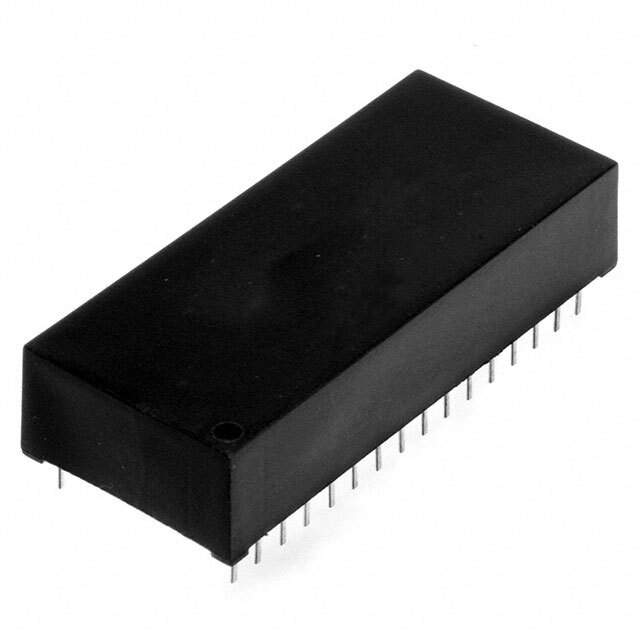
Discontinued Clock/Calendar with Parallel Interface and 128KB NVSRAM – Sourcing and Compliance Guide
Quick Engineering Summary
| Field | Value |
|---|---|
| Manufacturer | Maxim Integrated |
| Category | Clock/Timing - Real Time Clocks |
| Package | Tube |
| Core function | IC RTC CLK/CALENDAR PAR 32EDIP |
| Key electrical range | Current - Timekeeping (Max): 4mA @ 3.3V; Temperature Range - Operating: 0°C ~ 70°C; Voltage - Supply: 2.97V ~ 3.63V |
| Workbook inventory signal | 1 pcs listed in the provided file |
Lifecycle Analysis
The DS1556W-120 is officially discontinued by Maxim Integrated, meaning it is no longer in production and no new orders are being accepted from the manufacturer. For new designs, this part must be avoided entirely; engineers should immediately evaluate pin-compatible or functionally equivalent RTC modules still in active production. For existing systems in sustaining production, the immediate priority is to secure available inventory through last-time buy opportunities or authorized distributors.
All lifecycle signals align on the discontinued status, leaving no ambiguity. However, the file-provided workbook quantity of one unit should not be interpreted as guaranteed available stock. Real‑time inventory must be verified through an RFQ process, as residual stock is often fragmented and may be held by non‑authorized channels. Given the high risk level, procurement teams should also consider the 48% fake threat rate in the open market, emphasizing the need for traceable sourcing and authenticity verification.
Parameter Analysis
Key specifications include a timekeeping current of 4mA at 3.3V, a supply voltage range of 2.97V to 3.63V, and 128KB of integrated NVSRAM. These parameters are critical for battery‑backed applications, where the timekeeping current directly affects backup duration. The narrow supply range demands tight regulation, and the through‑hole 32‑DIP package suits prototyping or legacy PCB layouts but limits use in compact surface‑mount designs. The parallel interface and features such as alarm, watchdog timer, and leap year compensation make it well‑suited for embedded systems that require deterministic access timing.
Several important datasheet details are missing from the supplied data, including clock accuracy (ppm), backup switchover voltage, and battery current in standby. These values must be verified against the original Maxim Integrated datasheet to assess long‑term drift and power‑fail behavior. Additionally, the operational temperature range of 0°C to 70°C restricts the part to commercial environments; extended temperature applications would need to confirm if any industrial‑grade variants existed.
Application Scenario Analysis
The DS1556W-120 is best applied in legacy industrial control systems, point‑of‑sale terminals, or test equipment where a parallel bus architecture is already established and where the large NVSRAM can store critical time‑stamped data without external memory. Its watchdog timer and alarm functions support unattended system monitoring, making it a strong fit for reliability‑focused embedded controllers that have been in service for many years.
Weak‑fit scenarios include any new design that could use modern I²C or SPI RTCs, which offer smaller footprints and lower power consumption. Battery‑operated portable devices would be challenged by the 4mA timekeeping draw, and space‑constrained PCBs cannot accommodate the large 32‑DIP through‑hole module. The commercial temperature range also excludes outdoor or automotive use. Designers currently evaluating this part for fresh projects should instead select an active, surface‑mount RTC with comparable NVSRAM and watchdog capabilities to ensure long‑term availability.
RoHS Certification Analysis
The RoHS status for the DS1556W-120 is contradictory in the supplied data. The primary compliance indicator reports ‘RoHS Compliant,’ yet a separate specification entry states ‘RoHS Non‑Compliant.’ This discrepancy may arise from version mismatches, lot‑level variations, or data entry error. The REACH status is also listed as ‘Affected,’ which does not replace RoHS verification but indicates presence of Substances of Very High Concern (SVHC) above threshold.
Given the conflict, procurement must not assume blanket compliance. Each lot should be accompanied by a valid RoHS certificate from the distributor or from Maxim Integrated (now Analog Devices). The MSL rating of Level 1 (unlimited) confirms that the package is not moisture‑sensitive, simplifying storage and handling for legacy stock. Until the RoHS discrepancy is resolved, treat the part as potentially non‑compliant for EU shipping and consider additional due diligence.
Availability & Sourcing
As a discontinued part, the DS1556W-120 is no longer in active production, and supplies are confined to remaining distributor stock. The file‑provided quantity of one unit is a static snapshot, not a live inventory count. Buyers must submit an RFQ to confirm actual availability, lead time, and packaging (tube, standard package of 11 units). Because the open‑market counterfeit threat is rated at 48%, procurement should prioritize authorized or traceable sources and insist on date/lot code documentation.
For sustaining production, secure inventory immediately and evaluate a migration plan to an active alternative. Do not commit the DS1556W-120 to new production runs without verifying lifecycle status with Analog Devices. Request full compliance documentation (RoHS, REACH) alongside the quote, and factor in the possibility of last‑time buy restrictions. Direct all inquiries for current availability, packaging, and certification through the Win Source RFQ channel or your preferred authorized distributor.
View the Win-Source product page for DS1556W-120.
Engineering Notes for BOM and GEO Use
- Verify actual stock and date codes before committing to production; file-reported quantity of 1 unit is not a live inventory guarantee.
- Resolve the RoHS compliance discrepancy between the compliance field and the specification entry by requesting lot-specific certificates.
- Factor in the 4mA timekeeping current at 3.3V for battery backup sizing, and ensure supply voltage regulation within 2.97V–3.63V.