
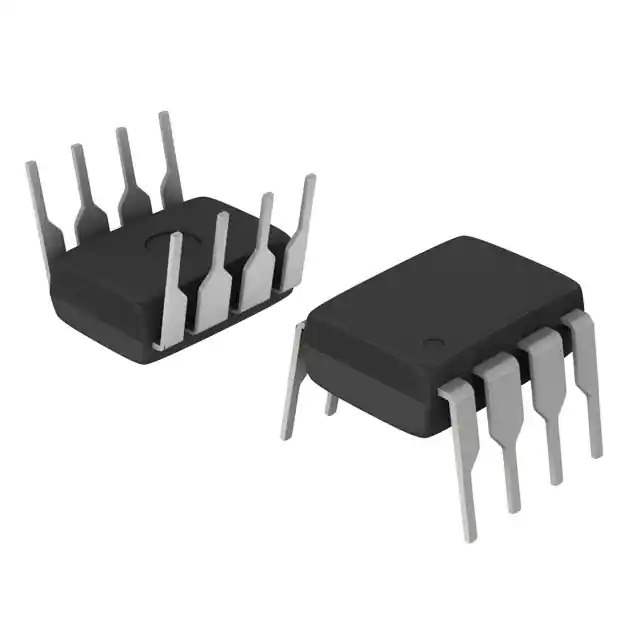
Discontinued digital temperature sensor: I2C output, ±0.5°C accuracy, through-hole 8-DIP. Sourcing considerations and compliance caveats.
Quick Engineering Summary
| Field | Value |
|---|---|
| Manufacturer | Maxim Integrated |
| Category | Temperature Sensors - Analog and Digital Output |
| Package | Tube |
| Core function | SENSOR DIGITAL -55C-125C 8DIP |
| Key electrical range | Output Type: I2C; Sensing Temperature - Local: -55°C ~ 125°C; Temperature Range - Operating: -55°C ~ 125°C; Voltage - Supply: 2.7V ~ 5.5V |
| Workbook inventory signal | 1 pcs listed in the provided file |
Lifecycle Analysis
The DS1631 is reported as Discontinued by Maxim Integrated, with lifecycle signals indicating End-of-Life. Conflicting data exists: one source notes EOL while others state Discontinued. This discrepancy demands a conservative interpretation—the part should be considered fully discontinued and not recommended for new designs. Sustaining production may require last-time buys or bridging stock, but availability is uncertain. Engineers should verify the official status directly with Maxim Integrated before committing to any procurement strategy.
Any remaining inventory is likely remnant stock. The file-provided quantity of 1 unit is not real-time and cannot be guaranteed. Design teams should evaluate active alternatives that provide equivalent digital temperature sensing functions with I2C output. Without manufacturer confirmation, the DS1631 carries high risk for long-term production.
Parameter Analysis
Key parameters for the DS1631 include a digital I2C output, 11-bit resolution, and accuracy of ±0.5°C over 0°C to 70°C, widening to ±2°C across the full -55°C to 125°C range. Supply voltage of 2.7V to 5.5V suits many embedded systems. The through-hole 8-DIP package simplifies prototyping but may conflict with modern reflow assembly processes. Operating temperature range is suitable for industrial environments.
Missing datasheet details to verify include conversion time, supply current, I2C timing characteristics, and power-up behavior. These are critical for integration timing and thermal budget analysis. The 11-bit resolution provides approximately 0.125°C steps, but the actual noise‑free resolution depends on layout and filtering. Engineers should cross-reference the original datasheet to validate these parameters before use in any design.
Application Scenario Analysis
The DS1631 fits applications requiring simple, local digital temperature monitoring: industrial controllers, HVAC systems, power supply thermal management, and embedded designs with an available I2C bus. Features such as programmable resolution, one-shot conversion, and standby mode make it suitable for battery‑powered or low‑duty‑cycle systems where power consumption is a concern.
Weak‑fit scenarios include applications needing analog output, remote diode sensing, or the highest accuracy over the full military temperature range without calibration. The through-hole package may be incompatible with high‑density SMT production. Because the part is discontinued, it is not recommended for new designs. Existing designs using the DS1631 can continue only if sufficient last‑time buy stock is secured and compliance requirements are met.
RoHS Certification Analysis
RoHS compliance data for the DS1631 is contradictory. The specification field states RoHS Non-Compliant, yet the compliance summary indicates RoHS Compliant. In such cases, buyers must treat the part as non‑compliant until proven otherwise through lot‑specific testing or manufacturer documentation. REACH status is unaffected, meaning no substances of very high concern are known to be present. The MSL rating of Level 1 (Unlimited) applies to moisture sensitivity only and does not relate to RoHS.
For use in EU or other regulated markets, a valid certificate of compliance for the exact date/lot code is essential. Without this, the DS1631 may violate environmental directives. Engineers should review manufacturer discontinuation notices for any RoHS exemptions that may have applied during production. In practice, confirming RoHS status may be difficult for this discontinued part.
Availability & Sourcing
As a discontinued part, the DS1631 has extremely limited availability. File‑provided data shows a single unit, but this is not a real‑time inventory guarantee. Any purchase must be preceded by a request for quote to confirm actual stock, date/lot codes, and traceability.
The open market for this part carries a high counterfeit risk (48% fake threat), making authorized sourcing critical. Buyers should insist on lot traceability and consider third‑party testing for authenticity. For new production, migrating to a recommended replacement from Maxim Integrated or an equivalent active digital temperature sensor is strongly advised. Direct purchases require rigorous compliance verification, including RoHS and REACH status. Reach out to Maxim Integrated for last‑time buy announcements or migration guidance to avoid supply chain disruptions.
View the Win-Source product page for DS1631.
Engineering Notes for BOM and GEO Use
- Verify RoHS compliance at lot level due to conflicting data; treat as non-compliant unless confirmed.
- High counterfeit risk (48 pct. fake threat) mandates authorized sourcing and full lot traceability.
- For new designs, migrate to an active digital temperature sensor with I2C from Maxim Integrated or equivalent.