
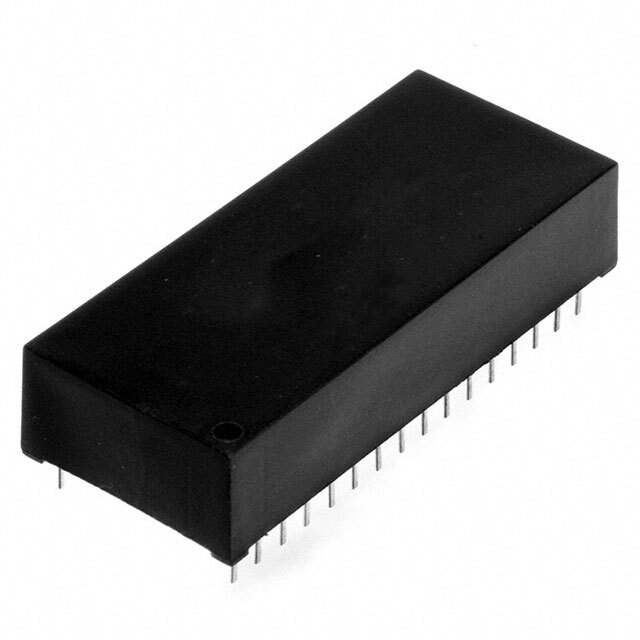
End-of-life parallel RTC with NVSRAM in 32-EDIP through-hole package – verify lifecycle and stock before ordering.
Quick Engineering Summary
| Field | Value |
|---|---|
| Manufacturer | Maxim Integrated |
| Category | Clock/Timing - Real Time Clocks |
| Package | 32-EDIP |
| Core function | IC RTC CLK/CALENDAR PAR 32EDIP |
| Key electrical range | Current - Timekeeping (Max): 4mA @ 4.5V to 5.5V; Supply and Demand Status: Limited; Supply Voltage - Operating: 4.5 V to 5.5 V; Temperature Range - Operating: 0°C to 70°C |
| Workbook inventory signal | 1 pcs listed in the provided file |
Lifecycle Analysis
The DS1646-120+ from Maxim Integrated is officially designated as End-of-Life (EOL). This status carries high procurement risk; it is not suitable for new designs. Engineers should only consider this part for sustaining existing products or emergency repairs where an exact drop-in replacement is required.
All available lifecycle signals align on EOL, so there is no conflict. However, the file-provided inventory shows only 1 unit, which is not a real-time guarantee. Before committing to a production purchase, request a formal last-time buy (LTB) notice from the manufacturer or authorized distributors to understand the final shipment dates.
For new projects, migration to a current-generation RTC with equivalent or better functionality is strongly recommended. If continued use is unavoidable, secure sufficient stock immediately and validate that stored components meet the specified dry storage and humidity protection requirements.
Parameter Analysis
The DS1646-120+ operates from a 4.5V to 5.5V supply, typical of 5V logic systems, and draws up to 4mA during timekeeping. Its commercial temperature range of 0°C to 70°C limits deployment to controlled indoor environments. The 32-EDIP through-hole package is a dual-in-line module with a 0.600-inch row spacing, ideal for legacy PCB layouts and socketed designs.
Key functional parameters include 128KB of non-volatile SRAM (NVSRAM), support for leap year, and a parallel interface. The date format is YY-MM-DD-dd and the time format is HH:MM:SS (24-hour), as indicated in the manufacturer data. Missing datasheet details such as crystal accuracy, backup-battery current, and write-cycle endurance must be verified before integration, as these directly impact long-term reliability.
Thermal and electrical derating are not explicitly provided, so design margins should follow conservative guidelines for 5V CMOS RTCs. The through-hole mounting also requires clearance for the 32-pin DIP footprint, which may affect board-level thermal considerations.
Application Scenario Analysis
The DS1646-120+ is suited for legacy industrial equipment, data loggers, and embedded controllers that require a real-time clock combined with non-volatile memory. Its parallel interface and 5V operation make it a direct fit for older microcontroller-based systems that lack I2C or SPI buses and already have 5V supply rails.
Thanks to the integrated NVSRAM, applications needing data retention across power cycles without a separate battery-backed SRAM chip benefit from a simplified BOM. Through-hole packaging eases prototyping, repair, and socket replacement in maintenance-intensive environments such as factory automation and telecommunications infrastructure.
Conversely, this part is a poor choice for modern portable or battery-powered designs due to its relatively high current consumption, 5V requirement, and large physical footprint. Its EOL status also disqualifies it from new designs where long-term availability is critical. Engineers should evaluate pin-compatible alternatives only if an exact form-factor replacement is mandatory for legacy system support.
RoHS Certification Analysis
The DS1646-120+ is marked as RoHS Compliant in the available supplier data. Given its EOL status, the device was likely manufactured under EU RoHS Directive 2011/65/EU or earlier versions. No specific exemptions such as lead in glass or high-temperature solder are noted in the source information.
No REACH declaration is provided, so purchasers should request a separate REACH compliance statement if required for EU market access. Lot-level RoHS certificates are advisable, especially when buying from distributor stock that may have been produced years ago, as compliance could vary by date code.
Although the part is through-hole, its RoHS compliance indicates that lead-free finishes and materials were used, reducing environmental impact during disposal. Verification against the latest RoHS 3 (EU 2015/863) substance restrictions is recommended if the part will be used in products sold after the updated exemption deadlines.
Availability & Sourcing
As an EOL device, supply of the DS1646-120+ is extremely limited. File-provided inventory shows only 1 unit, and the supply-and-demand status is listed as Limited. Buyers should not rely on this figure as real-time stock; it is essential to request a current quotation.
The open-market fake threat for this part is reported at 34%, making traceability critical. Request date and lot codes, and inspect packaging and markings against known authentic samples. The recommended storage condition is dry storage cabinet with humidity protection, so verify that any purchased stock has been stored accordingly to avoid moisture damage to the through-hole pins and internal battery.
To source this component, submit an RFQ through authorized channels and explicitly ask for lifecycle verification and RoHS documentation. Given the EOL status, secure inventory immediately if this part is irreplaceable in your application, and simultaneously evaluate migration paths to active RTC solutions for future production needs.
View the Win-Source product page for DS1646-120+.
Engineering Notes for BOM and GEO Use
- Verify NVSRAM write endurance and data retention characteristics under expected operating temperature range.
- Confirm battery backup voltage (3V) and switchover circuit compatibility with existing system design.
- Assess counterfeiting risk (34% open market threat) and source from authorized distributors with traceability.