
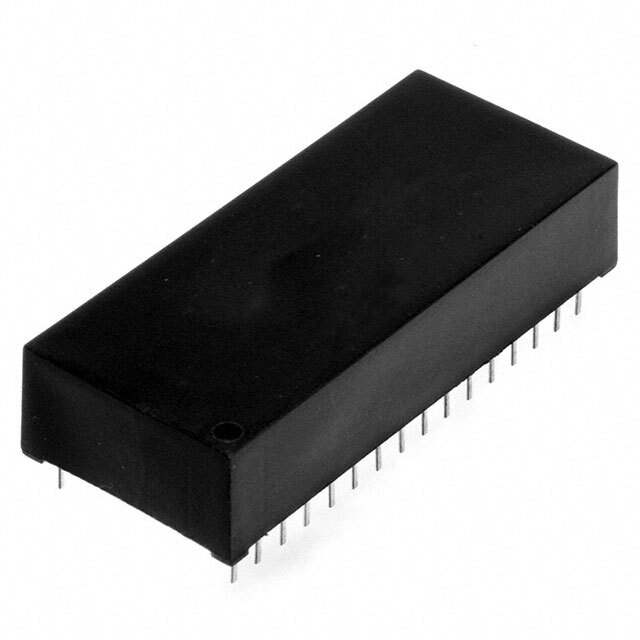
Maxim Integrated DS1646-120 Clock/Calendar with NVSRAM through-hole DIP-32 package.
Quick Engineering Summary
| Field | Value |
|---|---|
| Manufacturer | Maxim Integrated |
| Category | Clock/Timing - Real Time Clocks |
| Package | 32-EDIP |
| Core function | IC RTC CLK/CALENDAR PAR 32EDIP |
| Key electrical range | Supply and Demand Status: Limited; Supply Voltage - Operating: 4.5 V to 5.5 V |
| Workbook inventory signal | 1 pcs listed in the provided file |
Lifecycle Analysis
The lifecycle status of the DS1646-120 is officially unknown based on core supply chain signals, but a specification field indicates 'Active'. This conflict requires immediate resolution with Analog Devices/Maxim Integrated. Without a clear lifecycle, any new design-in carries moderate risk; production programs should assume possible NRND or constrained availability until confirmed.
Current inventory data shows a single piece in the workbook, hinting at limited distribution. For sustaining production, this part may still be procurable through excess channels, but volume availability is uncertain. Engineers should request a formal PCN/PDN notice and evaluate whether the part remains recommended for new designs or has been earmarked for discontinuation.
If the DS1646-120 is slated for EOL, plan a migration path to a compatible RTC with NVSRAM, possibly in a surface-mount package. Verify with Maxim Integrated that no mask-set changes or fab transfers have occurred that could affect long-term reliability.
Parameter Analysis
The DS1646-120 operates from a 4.5 V to 5.5 V supply, typical of legacy 5V microcontroller systems. Its integrated 128KB NVSRAM provides non-volatile storage without battery wear issues, suitable for data logging and system configuration retention. The YY-MM-DD-dd date format and leap-year feature ensure accurate long-term timekeeping.
Through-hole 32-EDIP packaging simplifies prototyping and field repair but limits adoption in compact, reflow-soldered designs. PCB layout must accommodate the DIP footprint and consider clearance for a backup battery holder if required. Tube/rail packaging is standard for through-hole parts, but may require repackaging for automated insertion.
Missing from the available data are critical timing parameters such as I2C or parallel interface speed, access time, clock accuracy (ppm), backup current, and battery voltage range. Datasheet review is essential to confirm register map, address decoding, and software compatibility. Verify operating temperature range if used outside 0–70°C commercial grade.
Application Scenario Analysis
The DS1646-120 is a strong fit for industrial computers, CNC controllers, and telecom base stations that require a self-contained timekeeping and data storage solution in a socketed, easily replaceable package. Its 128KB NVSRAM is ample for storing configuration parameters, event logs, or calibration data, making it ideal for meters, HVAC controllers, and security systems.
Legacy medical devices and point-of-sale terminals often use through-hole RTC/NVSRAM combos for data integrity during power cycles. The parallel interface suggests use with microprocessor buses that can directly address the memory map, minimizing CPU overhead. Designers should confirm timing compatibility with host processors, especially for faster bus speeds.
Weak-fit scenarios include wearable devices, IoT endpoints, and any battery-constrained, size-optimized designs where surface-mount, low-power RTCs with serial interfaces are more appropriate. Devices requiring stringent shock and vibration resistance may also prefer SMD packages. Verify whether the integrated lithium back-up battery is replaceable or the unit is encapsulated; this affects serviceability in long-life products.
RoHS Certification Analysis
The compliance data presents a contradiction: the primary compliance field marks the DS1646-120 as RoHS Compliant, but a secondary specification lists it as RoHS Non-Compliant. This likely stems from the through-hole DIP package, which historically used tin-lead plating. If the device is RoHS compliant, it may fall under exemption 7(c)-I (lead in glass of electronic components) or similar, but no exemption is documented.
Buyers must request the manufacturer’s full RoHS certificate of conformity (CoC) or a material declaration. For EU markets, compliance with EU RoHS Directive 2011/65/EU plus amendments (e.g., 2015/863) is mandatory. Without verified documentation, assume non-compliant and plan for leaded process if necessary.
REACH compliance is not addressed in the supplied data. For global distribution, also confirm halogen-free status if required. In high-reliability sectors, lot-level RoHS testing reports may be required to avoid supply chain rejections.
Availability & Sourcing
Current workbook data shows extremely limited availability (1 unit), with a supply-and-demand status of 'Limited'. The 68% fake threat level in the open market highlights the need for strict sourcing controls. Buyers should request a quote through authorized Maxim Integrated distributors or verified specialists to obtain genuine stock.
Insist on full traceability: date codes, lot codes, and original packaging (tube/rail). Storage conditions (dry and humidity-protected) are relevant for through-hole, though MSL sensitivity is typically low. Because lifecycle is unverified, do not commit to high-volume production without written confirmation from the manufacturer.
For prototyping or small builds, this part may be sourced from excess inventory providers, but demand a Certificate of Conformance. If the DS1646-120 is indeed active, negotiate buffer stock with lead-time commitments. If it is NRND or EOL, accelerate migration planning. Always verify RoHS status and lifecycle with the factory before ordering.
View the Win-Source product page for DS1646-120.
Engineering Notes for BOM and GEO Use
- Verify lifecycle status with the manufacturer before using in new designs; conflicting data sources may indicate an undocumented transition.
- Resolve RoHS compliance discrepancy: request a full material declaration and confirm lead-free exemption status for the through-hole package.
- Plan for anti-counterfeit screening due to high fake threat percentage (68%); insist on traceable date/lot codes and authorized distribution.