
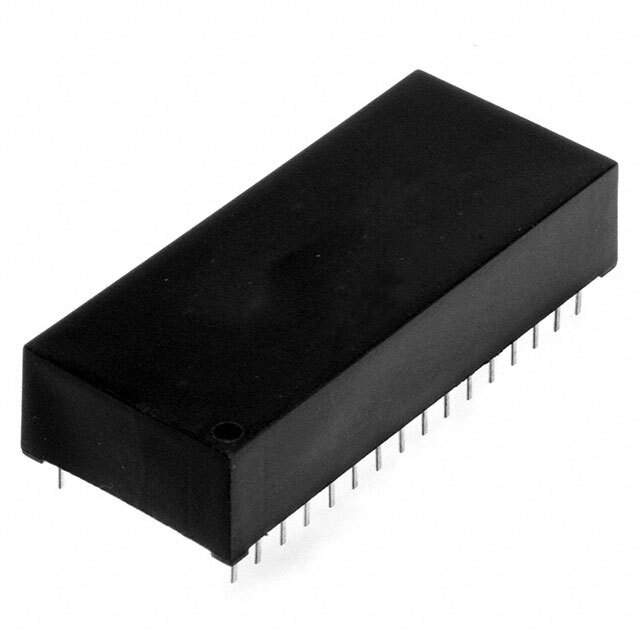
EOL Maxim Integrated RTC with parallel interface, 512kb NVSRAM, RoHS compliant.
Quick Engineering Summary
| Field | Value |
|---|---|
| Manufacturer | Maxim Integrated |
| Category | Clock/Timing - Real Time Clocks |
| Package | 32-EDIP |
| Core function | IC RTC CLK/CALENDAR PAR 32EDIP |
| Key electrical range | Current - Timekeeping (Maximum): 4mA @ 4.5V ~ 5.5V; Operating Supply Voltage: 4.5 V ~ 5.5 V; Operating Temperature Range: 0°C ~ 70°C; Supply and Demand Status: Limited |
| Workbook inventory signal | 1 pcs listed in the provided file |
Lifecycle Analysis
The DS1647-120+ is confirmed as End-of-Life (EOL) by the manufacturer, Maxim Integrated. This status means the part is no longer in active production and should not be designed into new products. For existing designs, sustaining production depends on securing remaining inventory or identifying alternative sources, which carries high risk due to limited supply and potential obsolescence.
The open market presents a significant counterfeit risk, with a reported fake threat probability of 70%. The file-provided inventory indicates a single unit, but this is not a real-time guarantee and must be validated through a formal quote. Engineers and buyers should request the manufacturer's Product Change Notification (PCN) or discontinuation notice to understand the timeline and any last-time-buy options. Without such documentation, any purchase should be treated as high-risk, and rigorous incoming inspection is essential.
Given the EOL status, immediate action is recommended: verify lifecycle directly with Maxim Integrated (now Analog Devices), evaluate inventory across authorized distribution channels, and consider redesigning with an alternative RTC if production volumes are expected to continue.
Parameter Analysis
The DS1647-120+ integrates a real-time clock/calendar with 512kb of NVSRAM, accessed via a parallel interface. This combination is critical for applications requiring timekeeping data retention during power loss, as the NVSRAM does not require an external battery for memory backup. Key electrical specifications include an operating voltage range of 4.5V to 5.5V and a maximum timekeeping current of 4mA at 5V, which dictates the power supply design and thermal margins. The through-hole 32-EDIP package (0.600" width) suits prototyping or legacy PCB layouts but limits use in high-density SMT assemblies.
Date and time formatting is hardware-defined as YY-MM-DD-dd, with features including leap year compensation. The operating temperature range of 0°C to 70°C limits deployment to commercial environments. Missing datasheet parameters such as backup battery voltage, standby current, timing accuracy (ppm), and access times must be verified from the official Maxim Integrated datasheet before integration. These parameters directly impact battery selection, timing precision, and system-level performance.
Engineers should also confirm the memory map, interrupt capabilities, and register addressing, as these are not detailed in the supplied data. For replacement or migration, any alternative part must match the parallel interface, memory size, and package footprint to avoid board rework.
Application Scenario Analysis
The DS1647-120+ is well-suited for legacy industrial systems, embedded controllers, and data loggers that require reliable timekeeping with non-volatile data storage. Its 512kb NVSRAM is ideal for retaining critical parameters during power cycles, making it a strong fit for utility meters, medical devices, and test equipment originally designed with through-hole RTC modules.
Conversely, this part is a weak fit for modern, high-density designs requiring low-power operation or small form factors, as its through-hole package and 5V-only operation conflict with current trends toward 3.3V and surface-mount technology. High-speed data acquisition systems may also find the parallel interface and access times insufficient. Additionally, the narrow temperature range restricts use in outdoor or ruggedized applications.
When evaluating the DS1647-120+ for a repair or one-off build, the part's integrated NVSRAM and leap year feature remain valuable for maintaining time continuity without external memory. However, for any new design, migration to an active, pin-compatible or functionally equivalent part from Analog Devices or another vendor is strongly advised.
RoHS Certification Analysis
The DS1647-120+ is listed as RoHS Compliant, meaning it meets the European Union's Restriction of Hazardous Substances directive. This status implies that the component is free from lead, mercury, cadmium, and other restricted materials above permitted thresholds under current regulations (presumably EU 2015/863). However, the exact RoHS revision is not specified in the provided data, so procurement teams should confirm whether compliance covers RoHS 3 or an earlier version.
No REACH, halogen-free, or MSL data is available; the absence of REACH does not substitute for RoHS compliance. The part's through-hole construction and legacy design may involve exemptions for certain materials, but none are declared. To ensure lot-level compliance, buyers must request a Certificate of Compliance (CoC) from the supplier, especially given the EOL status and high counterfeit risk. This documentation should be cross-referenced with the manufacturer's official compliance statements.
For organizations with strict environmental policies, verifying against the latest RoHS directives and additional standards such as China RoHS or WEEE might be necessary. Without a direct manufacturer link due to EOL status, third-party testing may be required if traceability is uncertain.
Availability & Sourcing
Sourcing the DS1647-120+ requires immediate action due to its EOL status. The file-provided inventory of one unit is not a real-time guarantee; buyers must submit an RFQ to obtain current stock levels, pricing, and lead times from authorized distributors. Standard packaging is in tubes, which should be confirmed upon order. Traceability is paramount: request date codes, lot codes, and manufacturer certificates to mitigate the 70% reported counterfeit threat.
For sustaining production, prioritize securing stock from Maxim Integrated (or Analog Devices) franchised partners. Non-authorized sources should be avoided unless rigorous visual and electrical inspection can be performed. The part's limited supply-demand status and EOL nature suggest that available quantities may be small and final. Consider a last-time buy if volumes are predictable, and simultaneously initiate a redesign with a recommended replacement from the manufacturer.
As the part is in the Clock/Timing - Real Time Clocks category, alternative RTCs with parallel NVSRAM may be limited. Evaluate migration to an active part that matches the memory size, package, and interface to minimize redesign effort. For any purchase, insist on RoHS compliance documentation and conduct counterfeit detection testing to ensure functional reliability.
View the Win-Source product page for DS1647-120+.
Engineering Notes for BOM and GEO Use
- EOL status: Verify lifecycle and secure inventory before new production.
- High counterfeit risk (70%): Source from authorized distributors with traceability.
- RoHS compliant but confirm lot-level documentation.